
Beyond the Like: Measuring the Harsh Reality of Social Media Marketing in Start-ups
The Role of Social Networks in Online Marketing and Measurement of Their Effectiveness – The Case Study
This paper examines the integration and efficacy of social media within the online marketing strategy of a design-focused start-up. Using a case study approach, it compares planned performance metrics against actual outcomes for platforms like Facebook, Pinterest, and Instagram to evaluate ROI and organic reach.
TL;DR
Social media is often touted as a "low-cost" silver bullet for start-ups, but the reality is frequently a story of missed targets. This paper analyzes a 2017 case study of a design platform, revealing a massive gap between ambitious growth plans and actual conversion reality, highlighting that organic reach alone is rarely enough for high-ticket items.
Background Positioning
In the landscape of digital marketing research, this study serves as a reality-check practitioner report. While many papers focus on the algorithmic technicalities of social networks, Mohelska and Sokolova provide a sobering look at the "Efficiency Gap"—the space between marketing theory and startup execution.
Problem & Motivation: The "Organic" Trap
The central pain point explored is the over-reliance on organic (unpaid) social media reach. For a start-up connecting 500 worldwide designers with enthusiasts, the assumption was that high-quality content would naturally lead to high sales.
The authors suggest that the "Motivation" for this study was to identify why specialized tools (SEO, Link-building, PPC) often fail to harmonize. They observe that while the Internet offers "accurate targeting and personalization," the costs are only "relatively low" when efficiency is high—which is rarely the case for un-subsidized organic content.
Methodology: The "Comparison" Model
The authors utilized a 2017 dataset extracted from Google Analytics, Google AdWords, and MailChimp. The methodology focuses on the "Planned vs. Actual" state, a traditional management metric applied to modern digital platforms.
Core Metrics Tracked:
- Traffic & Share: Percentage of total site visits originating from social channels.
- Conversion Rate: Actual orders attributed to social clicks.
- Fan Acquisition: Growth of the follower base as a proxy for brand awareness.
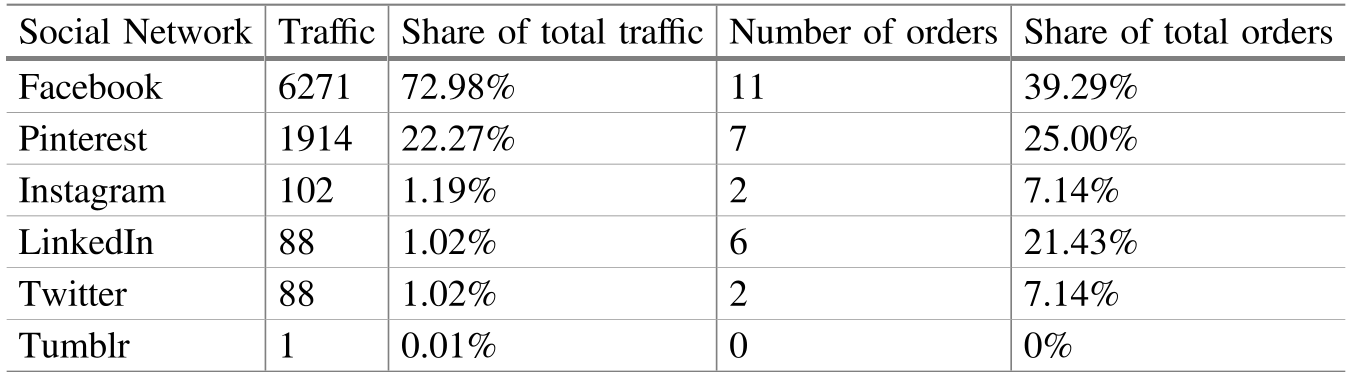 Table 1: Social Network performance distribution—note the dominance of Facebook in traffic but the low total order volume.
Experiments & Results: A Tough Year for ROI
The results provide a stark lesson for digital marketers. While the project aimed for 50,000 visits via social media, it achieved only 8,464 (under 17% of the goal). Even more critical, the target of 500 orders resulted in only 28 actual conversions.
Platform-Specific Breakdown:
- Facebook: The traffic workhorse, providing nearly 73% of social traffic but failing to scale orders.
- Instagram & Pinterest: The only successful channels for "Fan Growth," meeting their targets (Instagram reaching 1,956 fans).
- LinkedIn & Twitter: Remained marginal players in both traffic and conversion for this specific design niche.
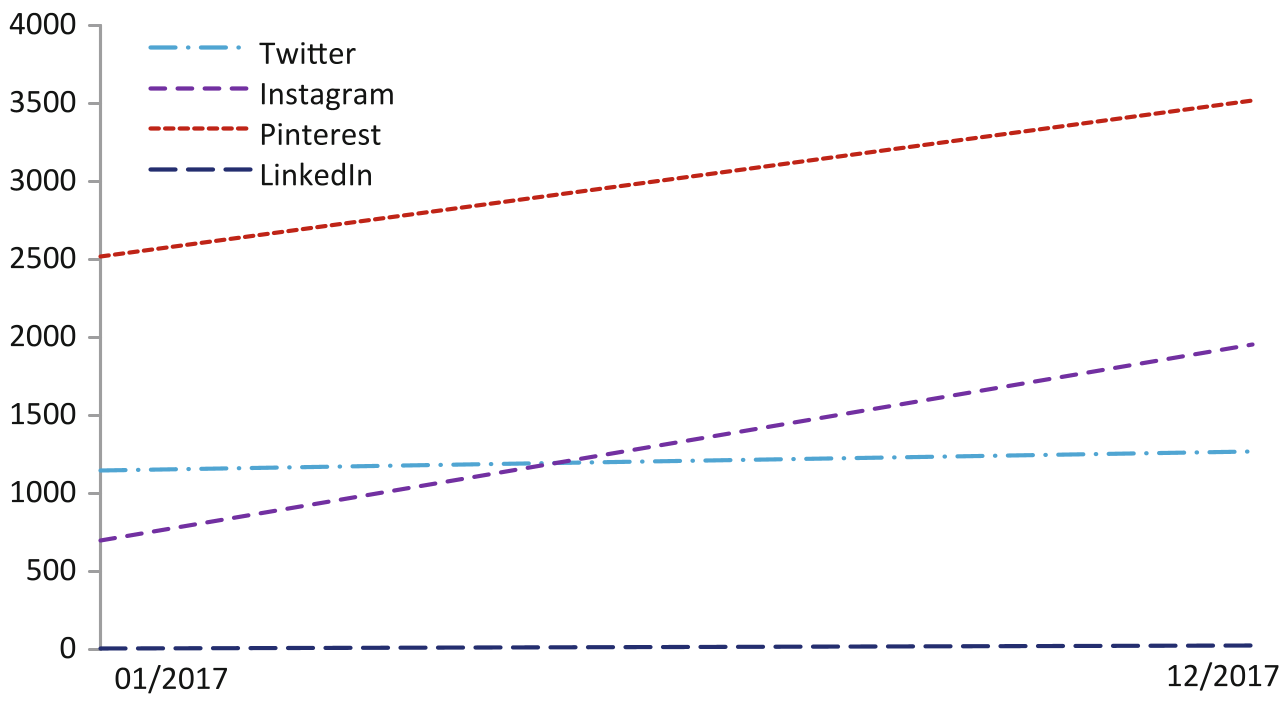 Fig 1: Relative growth of fans across Pinterest, Instagram, Twitter, and LinkedIn throughout 2017.
Critical Analysis & Conclusion
Why did it fail to meet targets?
- Lack of Financial Backing: The study emphasizes that these results were unpaid. In the 2017-era social landscape, the "pay-to-play" model had already become a necessity.
- Product-Market Friction: High-priced original design products require higher trust and longer consideration cycles than organic social posts typically provide.
- Capacity Constraints: The authors note that the lack of "human capacity" and "content variety" hampered the e-mailing and social campaigns.
Takeaway
The paper concludes that for a start-up to survive, it must treat social media not just as a free megaphone, but as a discipline requiring financial investment and multi-channel integration (including offline events). The "boom" of social media is over; the era of sophisticated, paid efficiency measurement is the new baseline.