
Social Capital in the Digital Frontier: Why "Who You Know" Dictates Online Success
Social networks and online store performance in emerging economies: the mediating effect of legitimacy
This study investigates how social network constructs—specifically family ties, tie strength, and structural holes—influence online store performance in emerging economies. Using data from 243 Taobao stores, the authors demonstrate that legitimacy acts as a critical mediator in this relationship.
TL;DR
A deep dive into 243 Taobao stores reveals that social networks aren't always a blessing. While tie strength and structural holes propel online store performance by building legitimacy, an over-reliance on family ties actually drags performance down. In the informal institutional environment of China's e-marketplaces, legitimacy is the "secret sauce" that turns social connections into sales.
The Paradox of Social Networks in Emerging Economies
In emerging economies like China, formal institutions (banks, legal systems) often have "voids." Consequently, online entrepreneurs rely on informal networks. However, the academic community has long debated: Does a close-knit network help or hinder? On Taobao—the world's largest e-marketplace—nearly 60% of employees are family members. Does this nepotism breed efficiency or unprofessionalism?
This paper argues that the impact of these networks isn't direct—it is filtered through Legitimacy: the perception that a business is "desirable, proper, or appropriate."
Methodology: Mapping the Ego-Network
The authors categorize social networks into three pillars:
- Content (Family Ties): Tangible/intangible resources from kin.
- Governance (Tie Strength): The intimacy and intensity of relationships.
- Structure (Structural Holes): The ability to bridge disconnected groups.
Using a "Name Generator" approach, store owners identified their five most vital connections, allowing the researchers to quantify the architecture of their social world.
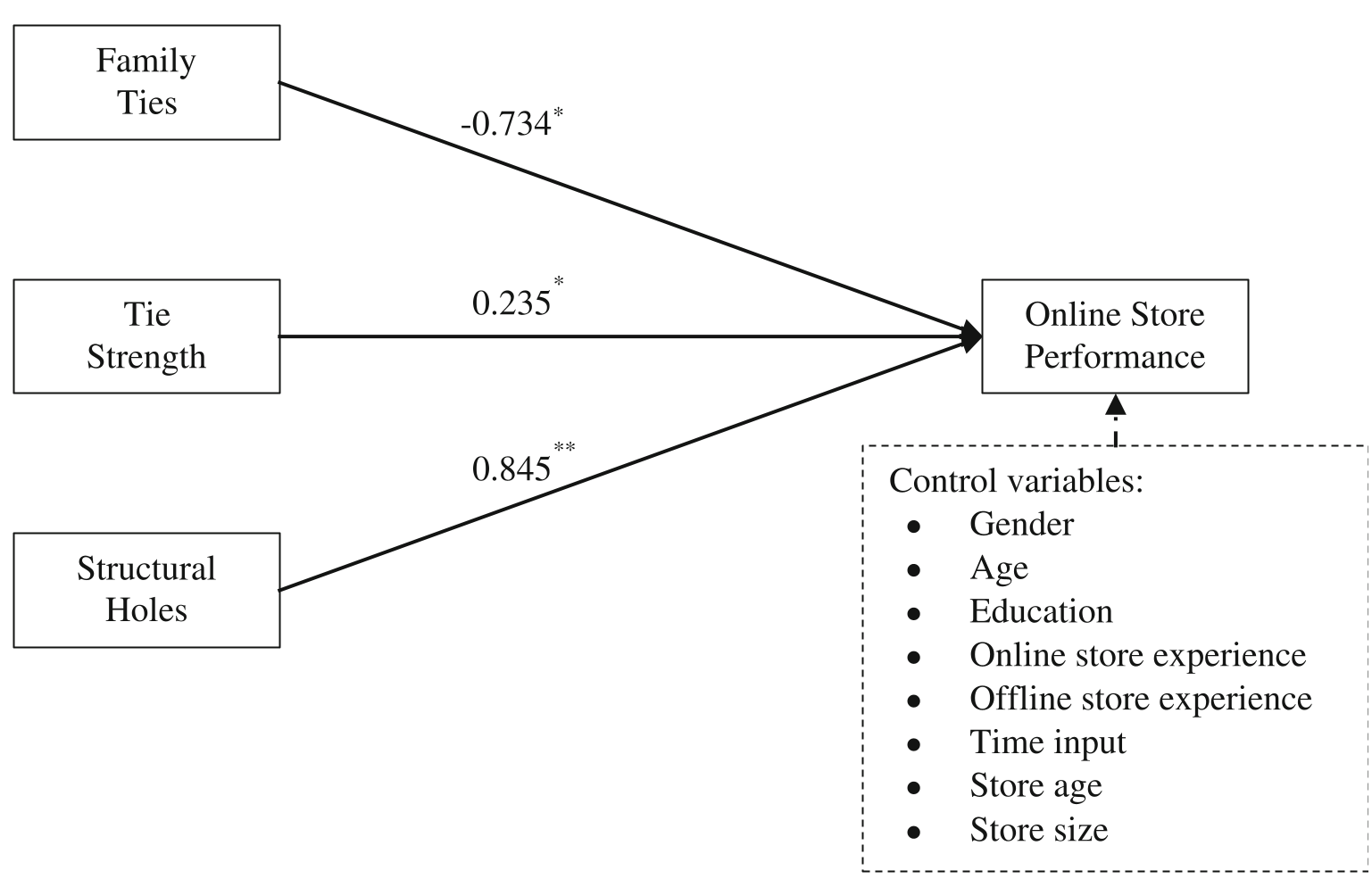
Deep Dive: The Three Key Findings
1. The "Dark Side" of Family Ties
Contrary to the "safe harbor" intuition, Family Ties have a negative effect on performance.
- The Insight: Family members often provide "unprofessional labor." Think of the owner's brother eating the inventory or providing "messy" customer service.
- The Meditator: High family involvement signals a lack of professional standards, which erodes the store's legitimacy in the eyes of customers and partners.
2. The Power of "Strong Ties"
Tie Strength is a positive driver, but only if it builds legitimacy.
- The Insight: In high-uncertainty markets, strong ties facilitate deep trust and knowledge exchange.
- The Mediator: Interestingly, legitimacy fully mediates this effect. This means strong ties don't inherently increase sales; they increase the store's perceived "properness" (e.g., endorsements, ISO certifications), which then drives sales.
3. Structural Holes: The Broker's Advantage
Structural Holes (bridging disconnected groups) are the strongest predictors of success.
- The Insight: Owners who act as "brokers" between different social circles have more autonomy and access to non-redundant information.
- The Outcome: This enables them to identify market gaps faster than competitors trapped in "echo chamber" networks.
Experimental Evidence: The Data from Taobao
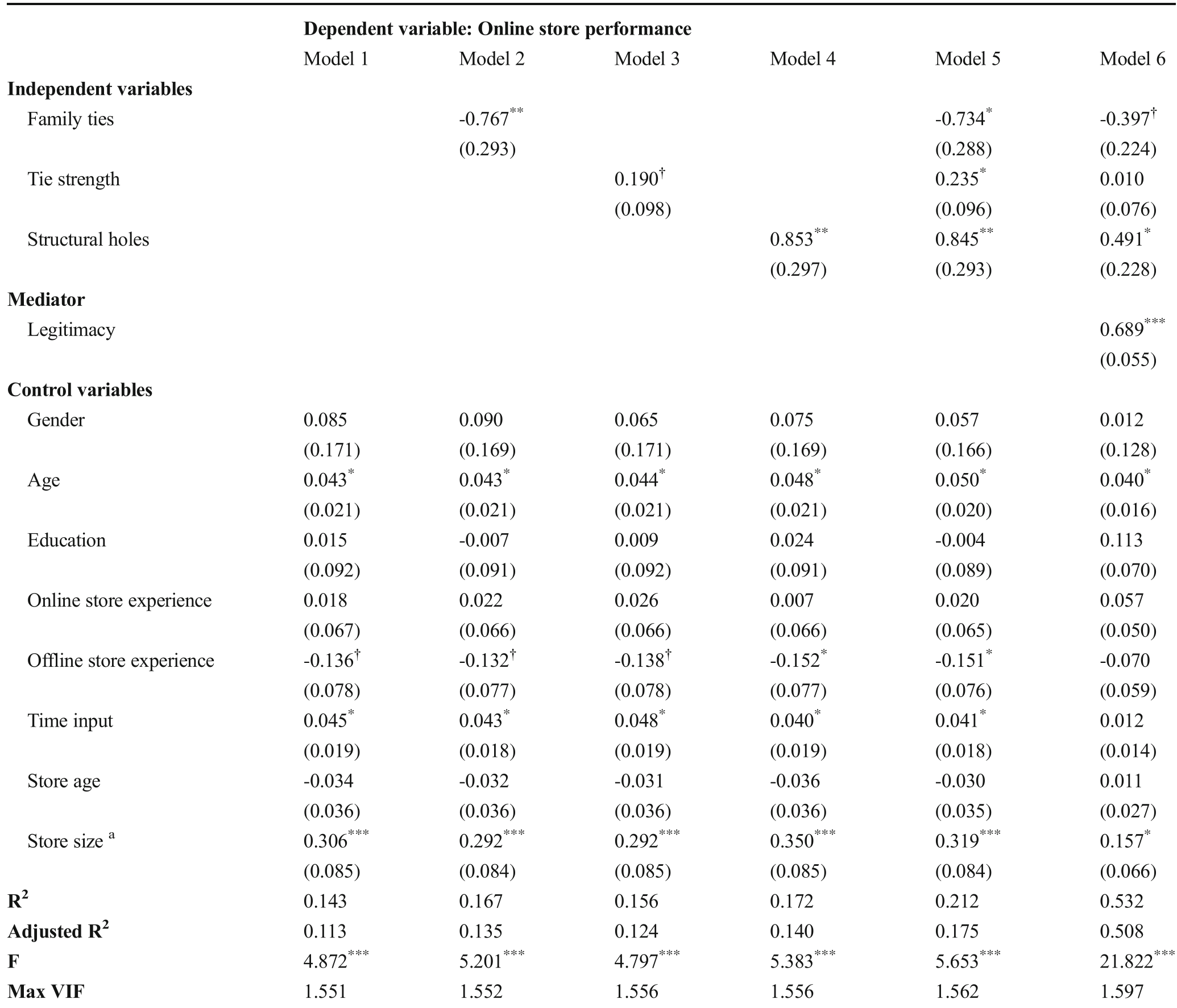
The regression analysis provided robust support for these theories. As seen in the results table, the introduction of "Legitimacy" as a variable significantly reduced the direct coefficients of the social network constructs, proving its role as the engine of performance.
Critical Analysis & Managerial Implication
This paper serves as a warning for "Digital Mom-and-Pop" shops. To scale in an emerging economy, one must transition from kinship-based support to brokerage-based legitimacy.
Takeaways for Online Store Owners:
- Avoid the "Family Trap": Resist using untrained family members just to save costs; the resulting loss in professionalism (legitimacy) costs more in the long run.
- Invest in Tie Intensity: Spend time building deep, reciprocal relationships with high-status stakeholders (suppliers, platform monitors) to signal stability.
- Be a Bridge: Seek connections outside your immediate circle. Bridging structural holes provides the informational "alpha" needed to outperform the competition.
Limitations
The study relies on self-reported data from Taobao owners, which may include social desirability bias. Furthermore, legitimacy is treated as a single construct, though it may have multiple dimensions (moral, pragmatic, cognitive) that future research should decouple.
Final Summary
Legitimacy is the bridge over the institutional void. By strategically managing who they know and how they interact, online entrepreneurs can thrive even in the most volatile emerging markets.