
Cybervetting Unveiled: How HR Professionals Actually Use Your Social Media
Social networks in personnel selection: profile features analyzed and issues faced by hiring professionals
This study investigates "Cybervetting" practices among Portuguese HR professionals using a sequential mixed-methods approach (survey of 429 practitioners and 24 interviews). It identifies three distinct patterns of Social Networking Site (SNS) usage—Screening, Knowing the Applicant, and Assessing Disqualifying Behavior—to support personnel selection.
TL;DR
Is your Facebook profile a dealbreaker for your next job? This study explores the "Cybervetting" habits of HR professionals, revealing that they don't just look for "red flags"—they use social media to screen candidates before interviews and deepen their understanding of your professional persona. While job-related data is the priority, the study warns of a "wild west" environment where privacy and bias often collide.
Background: The Academic-Practitioner Gap
There is a massive disconnect between the boardroom and the classroom. While academic researchers warn that Facebook profiles are poor predictors of job performance and rife with bias, over 70% of employers are already using these tools. This paper moves past the "should they do it" debate to ask a more practical question: "How are they doing it, and what exactly are they looking for?"
The "Why": Motivation for the Study
The authors identify a shift in recruitment dynamics. Employers are no longer just looking at a CV; they are looking for "Negligent Hiring" risks and cultural fit. However, the lack of a standardized procedure means your future might depend on whether your recruiter values "common sense" over "formal privacy policies."
Methodology: The Three Modes of Cybervetting
By analyzing data from Portuguese HR professionals, the researchers used Exploratory Factor Analysis (EFA) to categorize how SNS features are utilized.
1. The Architecture of Selection
The study found that recruiters don't just "browse"; they follow patterns based on the stage of the hiring process.
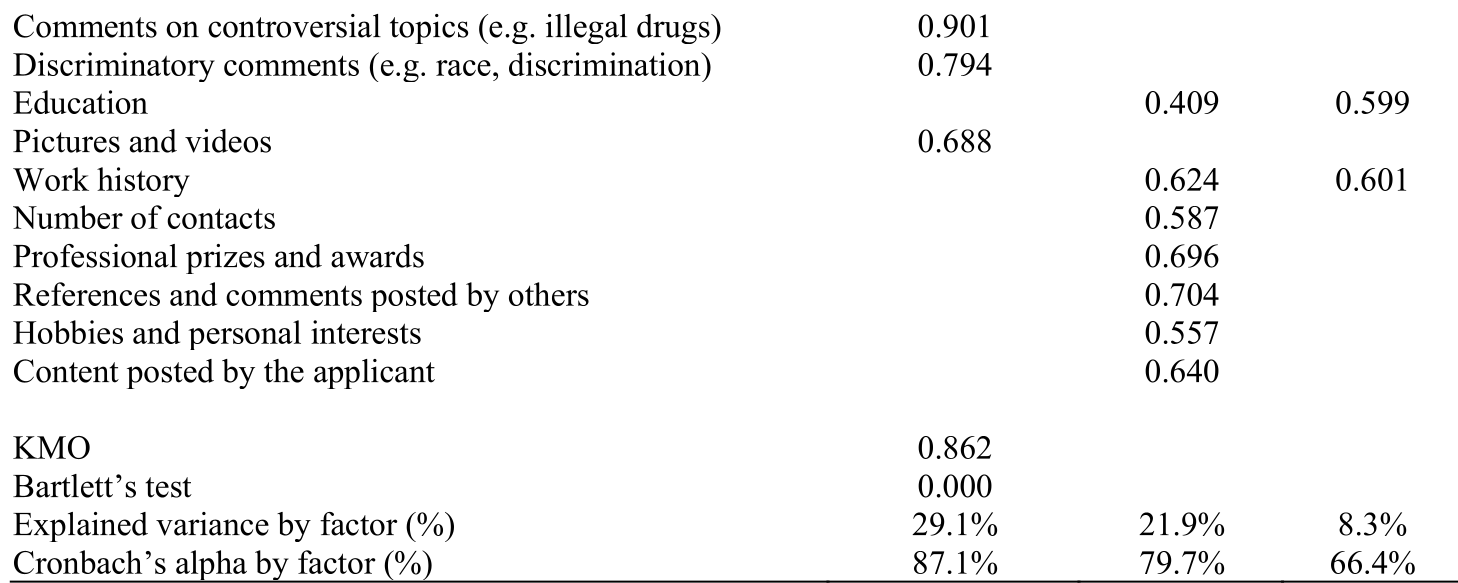 In the table above, Factor 1 (Disqualifying Behavior) and Factor 3 (Screening) show the dichotomy between filtering "out" bad candidates and filtering "in" qualified ones.
- Screening (Pre-Interview): Focuses on hard data—education and work history. If you don't match the LinkedIn "template," you might not even get the call.
- Knowing the Applicant (Holistic View): Includes hobbies, personal interests, and awards. This is used to build a "3D" image of the person behind the paper.
- Assessing Disqualifying Behavior (Post-Interview): This is the "investigation" phase. Recruiters look for controversial photos or discriminatory comments to confirm if a candidate they liked in person has any hidden liabilities.
Key Findings: Bias and Education
One of the most striking insights is the correlation between a recruiter's education level and their ethics.
- The Education Shield: Recruiters with Master’s or Doctorate degrees were significantly less likely to peek into "informal photos" or "personal information" (age, gender).
- Small vs. Large Organizations: Selectors at smaller firms were more prone to analyzing controversial topics and photos compared to those at large corporations with established HR departments.
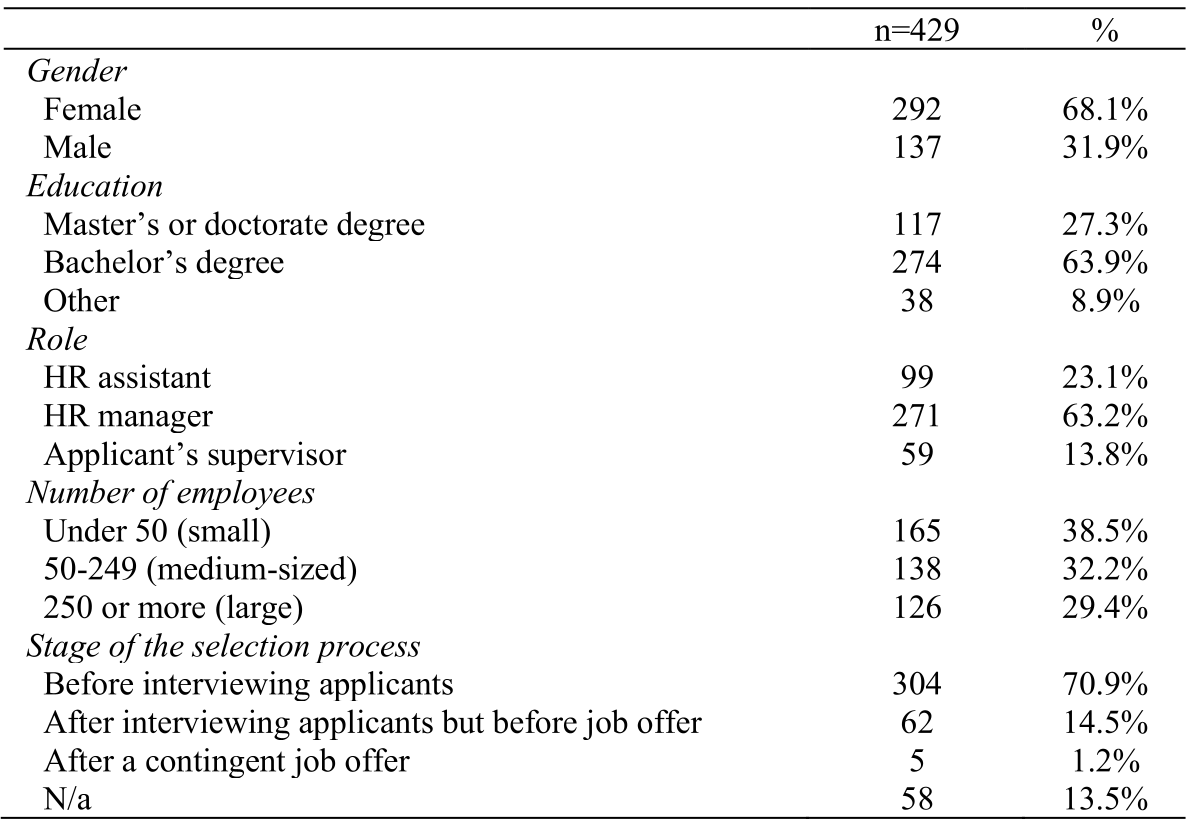 The demographic spread shows a variety of roles, highlighting that Cybervetting isn't just for HR managers but also for direct supervisors.
Critical Insight: The "Talent War" Acceleration
The interviews revealed a fascinating side effect of professional networks like LinkedIn: The Hyper-Speed Selection. Because everyone’s profile is visible to all competitors (the "Passive Applicant" pool), HR professionals feel they are "running over each other" to secure talent. This pressure often leads to a "shoot first, ask questions later" approach where formal privacy rules are bypassed to maintain speed.
Deep Insight & Conclusion
The study concludes that SNS has moved from being a "complementary" tool to a selection tool per se.
Takeaways for Practitioners:
- Stop "Informal" Browsing: Spontaneous, non-standardized checks are the breeding ground for lawsuits and bias.
- Training is Essential: Recruiters must be trained to separate "Job-Relatedness" from "Interesting but Irrelevant" personal data.
- The Privacy Paradox: Even if an applicant makes their profile "Public," it doesn't give a recruiter the moral or legal right to use non-job-related information (like religious views or age) in a hiring decision.
Future Outlook: As HR becomes more digitized, the boundary between "Professional Self" and "Private Self" will continue to blur. This paper serves as a critical reminder that while the data is "effortlessly available," the cost of using it incorrectly is incredibly high.