
Matrix Factorization Meets FCA: Reducing Complexity in Social Network Analysis
On Social Networks Reduction
The paper proposes a novel framework for social network reduction using a combination of Formal Concept Analysis (FCA) and matrix factorization methods (NMF, SVD, SDD). It aims to reduce the computational complexity and improve the visualization clarity of two-mode social networks by lowering the data dimensionality while quantifying information loss.
TL;DR
Analyzing social networks often requires understanding complex relationships between subjects and events (two-mode data). While Formal Concept Analysis (FCA) provides a rigorous mathematical framework for this, the resulting "concept lattices" become computationally explosive and visually chaotic as networks grow. This paper introduces a dimensionality reduction approach using Non-negative Matrix Factorization (NMF) and Singular Value Decomposition (SVD) to simplify these lattices, providing a faster, clearer, and measurable way to study large-scale social structures.
The Scalability Wall in Social Networks
In the study of social networks, we often deal with "two-mode" data—for instance, a group of people and the events they attend. FCA captures these relations perfectly through Galois Lattices, showing every possible grouping of people sharing specific attributes.
However, there is a catch:
- Exponential Complexity: The number of concepts in a lattice can grow exponentially relative to the input size.
- Visual Overload: Once you have thousands of nodes, the Hasse diagram (the standard visualization) becomes a "hairball" where no meaningful patterns can be discerned.
- The Information Noise: Not every formal concept is equally important; many are minor variations that drown out the core structural signal.
Methodology: Approximation via Factorization
The researchers' key insight is to treat the social network context as a binary matrix and apply Matrix Factorization. By decomposing the original matrix into two lower-rank matrices and (), they effectively "smooth out" the noise and force the model to keep only the most salient structural features.
The Core Workflow
- Decomposition: Use algorithms like NMF or SVD to find a low-rank approximation of the attendance matrix.
- Reconstruction: Re-binarize the result to create a "reduced" formal context.
- Lattice Generation: Build the concept lattice from this simplified data.
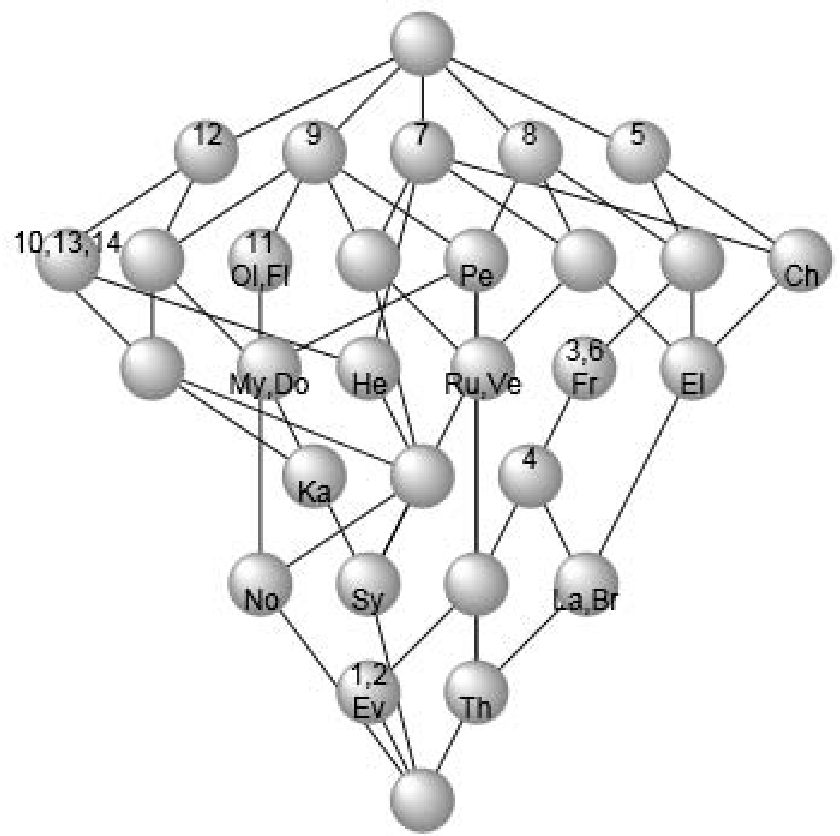 Above: The original concept lattice of the Davis "Southern Women" dataset, showing the intricate (and often overlapping) social ties.
Measuring "What We Lost"
Any reduction involves information loss. To quantify this, the authors employ two sophisticated tools:
- Normalized Correlation Dimension (NCD): A metric derived from fractal dimension theory that estimates the number of independent variables in the dataset.
- Lorenz Curves: Borrowed from economics, these curves visualize the dissimilarity between the original and reduced contexts, allowing researchers to see exactly how much structural integrity is being sacrificed for simplicity.
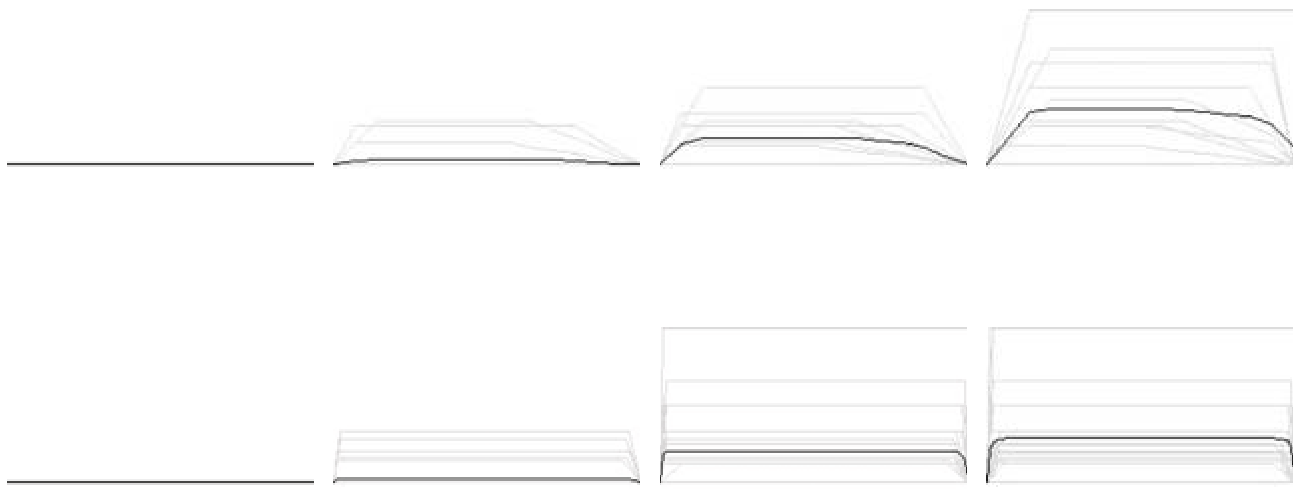 Figure 5: Lorenz curves comparing the original context and lattices against reduced versions at various ranks (8, 5, 3).
Key Findings: Why NMF Wins
The experiments compared NMF, SVD, and Semidiscrete Decomposition (SDD).
- Efficiency: On synthetic data (400 subjects), reducing the rank from 40 to 15 slashed the number of concepts from 15,477 to just 348 (using NMF).
- Interpretation: While SVD often retains more "concepts" for the same rank, the authors note that NMF provides more intuitive results. This is because NMF's non-negativity constraint leads to a "parts-based representation," which maps more naturally to social groups than SVD's orthogonal components.
Critical Insight & Future Outlook
The brilliance of this approach lies in its gradual nature. Reduction isn't all-or-nothing; a user can dial the "Rank" up or down to find the sweet spot between a high-level summary and granular detail.
Limitations: The re-binarization of the matrix after factorization requires setting a threshold, which can be sensitive. Furthermore, while the general layout is preserved, the loss of "rare" concepts might obscure outliers who play critical "bridge" roles in a network.
Future Impact: This methodology opens the door for applying formal symbolic analysis to massive datasets like the World Wide Web or large-scale biological networks, where exact computation was previously impossible. It bridges the gap between linear algebra-based data mining and the rich, qualitative insights provided by Formal Concept Analysis.