
Social Networks: The Silent Pedagogical Agents in CS Education
The role of social networks in students' learning experiences
This paper provides a comprehensive literature review and theoretical framework for the role of social networks in Computer Science education. It explores how Web 2.0 technologies and social software act as pedagogical agents to facilitate collaborative learning, group formation, and knowledge construction.
TL;DR
This research explores the intersection of social structures and academic achievement. By treating social networks as active pedagogical agents, the authors reveal how peer-to-peer interactions, mediated by Web 2.0 technologies, are critical for student retention, knowledge sharing, and overcoming the "solitary" culture of Computer Science.
Background & Positioning
In the spectrum of educational research, this paper sits at the crossroads of Sociology, Human Factors, and Artificial Intelligence. It isn't just about "using Facebook in class"; it is a theoretical deep-dive into how the topology of social ties (strong vs. weak) influences the phenomenology of learning. It positions social software not as an elective tool, but as a fundamental infrastructure for modern higher education.
Problem & Motivation: The Loneliness of the Long-Distance Coder
A recurring crisis in Computer Science education is the high attrition rate, particularly among female students and minorities. The authors argue that:
- Academic Isolation: Purely focusing on curriculum without social support leads to "computer anxiety" and dropouts.
- The Diversity Gap: Traditional group allocation often ignores the "Homophily" (birds of a feather) effect, where students feel rejected if they lack strong social ties.
- Formal vs. Informal: Universities group students for tasks, but students function in networks. There is a mismatch between how institutions organize labor and how students actually seek help.
Methodology: Social Networks as Activity Systems
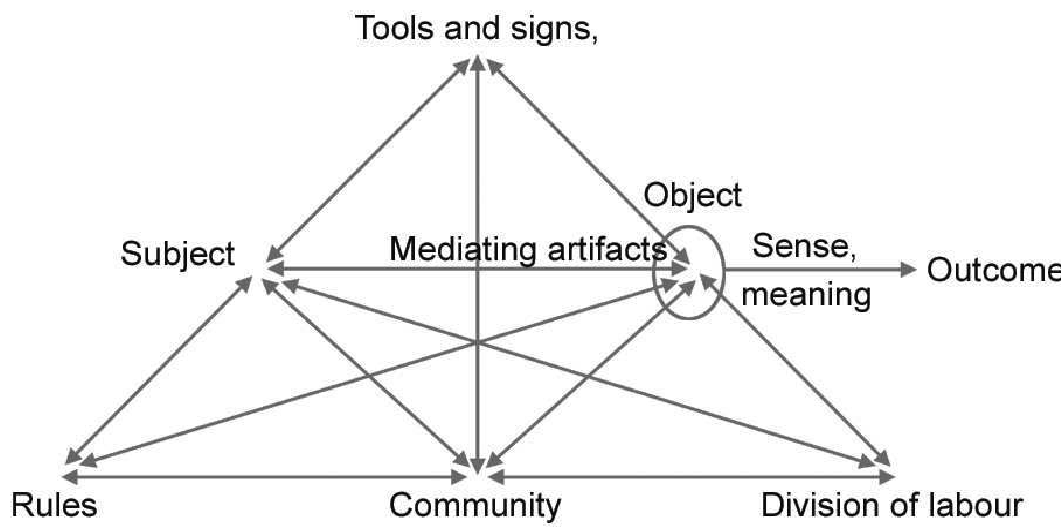
The authors leverage Engeström’s Activity Theory to demystify how learning happens within a network. In this framework, the "Subject" (Student) reaches the "Object" (Knowledge) through "Tools" (Social Software).
The Activity System Model
The paper visualizes the social network as more than a graph of friends; it is a system governed by Rules (institutional policies) and Division of Labor (assigned roles vs. emergent leaders).
Algorithms for Connection
The paper bridges the social-technical gap by discussing real algorithms used to facilitate these networks:
- Neighboring Matchmaker: Introductions mediated by mutual friends to preserve trust.
- Expertise Recommenders: Using metadata to match students with the right "expert" peers (SOTA at the time of writing).
- Folksonomies: Using decentralized tagging (e.g., del.icio.us style) to allow the "wisdom of the crowd" to organize learning materials.
Experiments & Theoretical Insights
While this initial paper is a literature-driven framework, it draws on significant SOTA evidence to highlight:
- Social Presence: The deficit of non-verbal cues in online networks (CMC) is the biggest hurdle for complex decision-making. However, "Digital Natives" are increasingly adept at using emoticons and synchronous tools to bridge this gap.
- The Power of Weak Ties: While "Strong Ties" (close friends) provide emotional support, "Weak Ties" (acquaintances across years/courses) are the primary source of new information and varied expertise.
Note: The paper highlights the contrast between face-to-face richness and CMC efficiency, suggesting that hybrid models are optimal for CS labs.
Critical Analysis & Conclusion
The Takeaway: The "lab culture" in Computer Science is a social network that must be digitized carefully. Successful education depends on a student feeling like an "insider."
Limitations:
- Privacy & Trust: The authors rightly point out that current social software is "in its infancy" regarding data provenance and security. A "broken trust" in a social learning network can be more academically damaging than no network at all.
- Common Identity vs. Common Bond: CS students often bond over a Common Identity (being a coder), which promotes conformity but may inadvertently stifle diversity if the "culture" is exclusive.
Future Outlook: As we move into an era of AI-mediated learning, the role of "Social Software" will likely shift toward Semantic Group Formation, where AI agents don't just find "experts," but actively balance groups for both task efficiency and social cohesion.
Senior Editor's Note: This work serves as a reminder that in the high-tech world of Computer Science, the "Human Factor"—the simple need to belong to a community—remains the most vital component of the learning algorithm.