
From Absence to Connected Presence: How Technology Re-Stitches the Social Fabric
Are social networks technologically embedded? How networks are changing today with changes in communication technology
This seminal paper investigates how Information and Communication Technologies (ICTs) are structurally and qualitatively transforming social networks. It explores the transition from a "compensatory" model of communication to a new paradigm of "connected presence," where digital mediations such as SMS and e-mail foster a seamless web of quasi-continuous interaction.
TL;DR
This research challenges the classical view that digital communication is merely a "second-best" substitute for meeting in person. By examining major life events like child-birth and moving, the authors reveal that our choice of communication tools—be it a quick SMS or a long phone call—effectively redraws the hierarchy of our social networks. We are moving away from a world of "presence vs. absence" toward a state of "connected presence," where the constant flow of messages is more vital than the messages themselves.
The "Relational Work" Problem: Beyond Static Ties
In the landscape of social network analysis, ties are often treated as fixed lines on a graph. However, the authors argue that social ties are actually a lived experience—what Simmel called "faithfulness"—that requires active maintenance.
The core friction today lies in the technoscape: a crowded environment of letters, e-mails, phone calls, and instant messages. The problem is no longer just who you talk to, but how you choose to reach them. This choice is a high-stakes performance of "communicative rationality."
Methodology: Testing Ties through Life Transitions
The authors utilized "biographical events"—specifically the birth of a first child and moving to a new city—as laboratory conditions. These events act as "tests" for a social network.
- The Announcement Ritual: How do you tell someone your baby is born?
- Immediate Family: Direct phone calls (immediate).
- Close Friends: Phone calls within 24 hours.
- Distant Contacts: E-mail or printed cards (delayed).
The delay allowed by the medium is a direct statement of the "tempo" of the relationship. Choosing e-mail over a call isn't just a matter of convenience; it’s a public negotiation of distance.
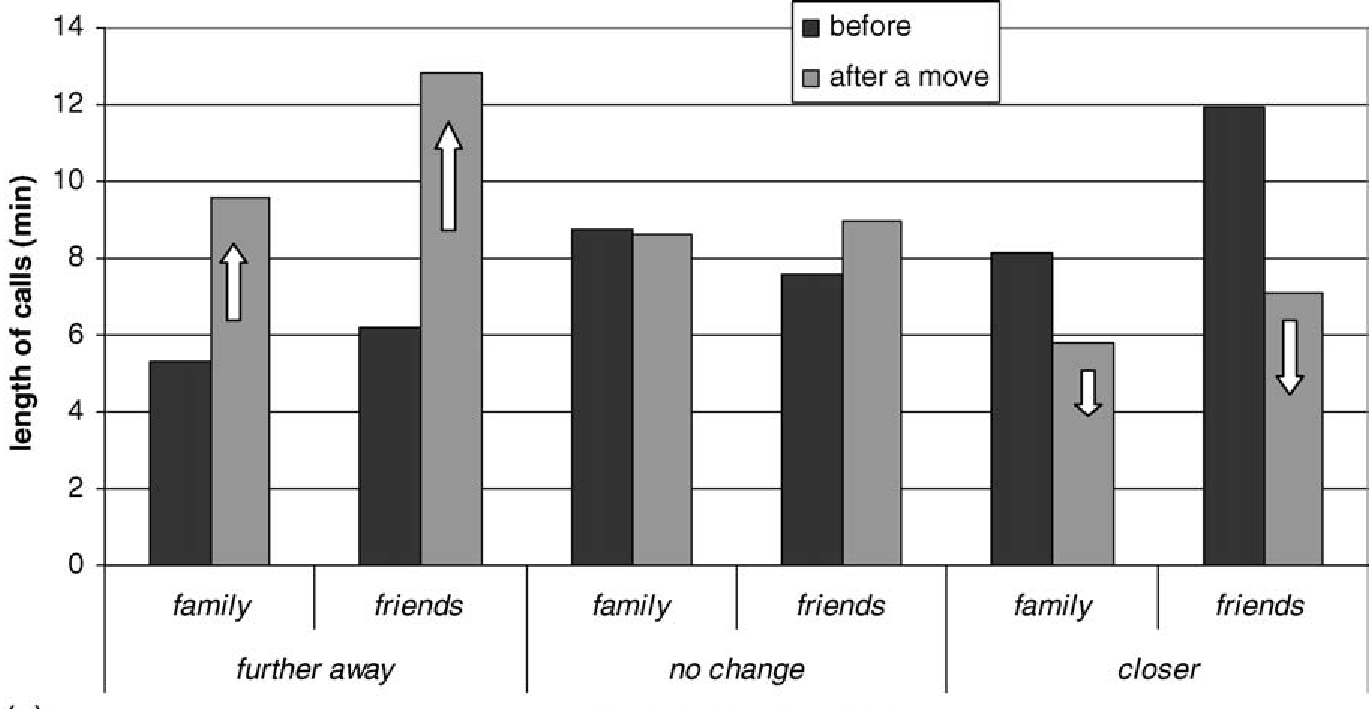 Note: The data illustrates a "compensatory economy"—as physical distance increases, calls become rarer but significantly longer to "make up" for the absence.
Two Regimes of Sociability
1. Intermittent Presence (The Compensatory Model)
This is the traditional view. Physical meeting is the ideal. Letters and phone calls are "surrogates" used when face-to-face is impossible.
- Logic: Absence is a void to be filled.
- Behavior: High geographical distance leads to longer conversations as callers attempt to reconstruct a shared world through words.
2. Connected Presence (The New Paradigm)
With the advent of mobile phones and SMS, a new pattern of "always connected" sociability has emerged.
- Logic: Absence is no longer the opposite of presence.
- Phatic Communication: Messages like "Thinking of you" or "You have mail" serve to maintain the tie even if no new information is shared. The gesture is the message.
- Lowered Stakes: Technologies like SMS allow for a "civil lack of attention," making it easier to manage aggressive or high-intensity emotions without the "violence" of a real-time dialogue.
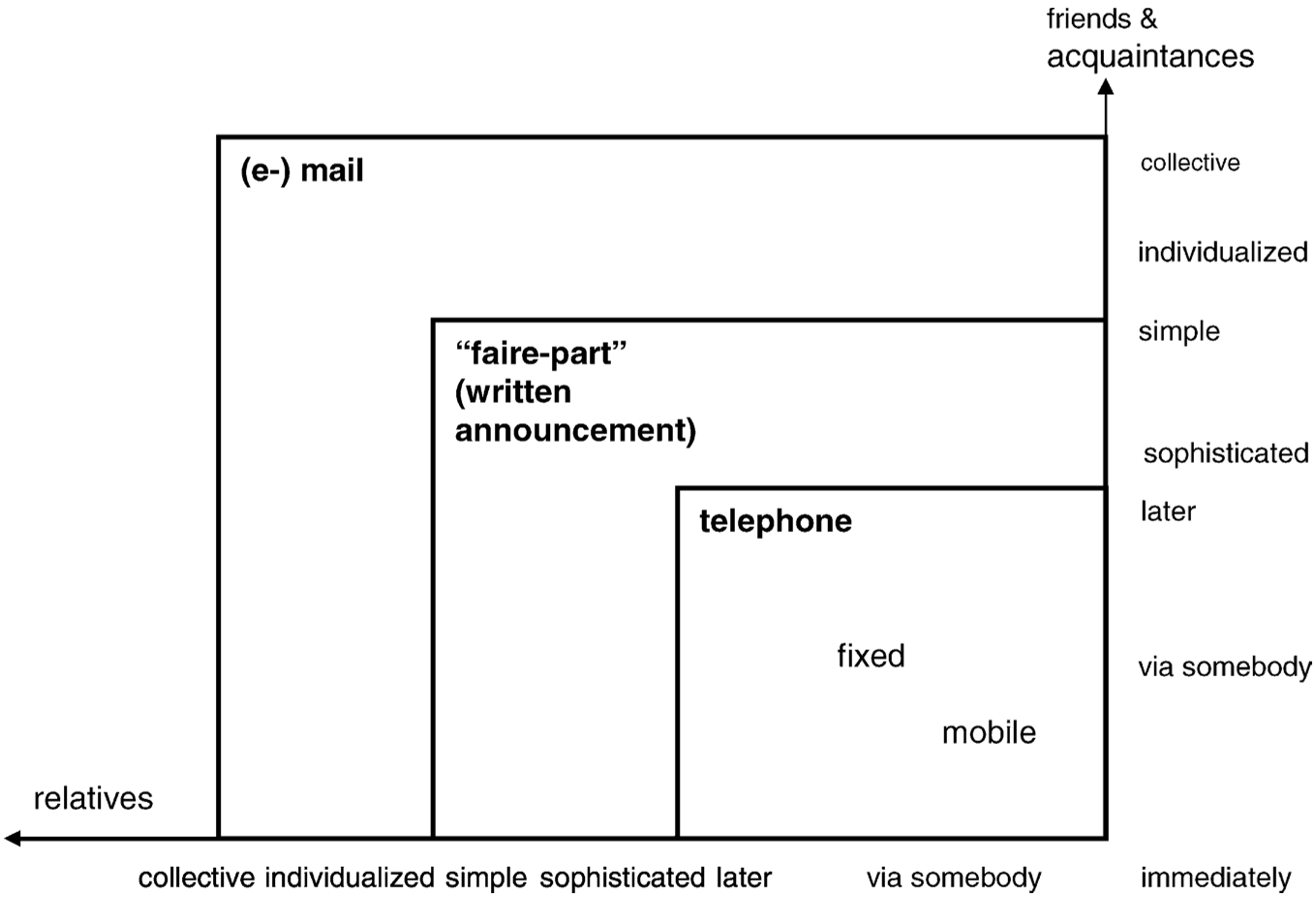 Model of how relational proximity dictates the choice between direct/synchronous and indirect/asynchronous media.
Deep Insight: The Phatic Shift
Perhaps the paper’s most profound takeaway is the rise of phatic communication. In the regime of connected presence, the "inner sense of commitment" must be matched by a "continuity of the flow of messages." If the mailbox is empty, the relationship feels threatened. This explains why we feel a compulsion to check our devices—not because we expect news, but because we seek the reassurance of being "in the loop."
Conclusion and Future Outlook
The authors successfully demonstrate that social networks are not just about structure; they are about timing and mediation.
Limitations: The study, written in the early 2000s, focuses heavily on the transition to mobile phones and early e-mail. It could not foresee the algorithmic curation of presence we see today in the era of "Stories" and "Reels."
Legacy: This work provides the theoretical foundation for understanding "Zoom fatigue" and the modern anxiety of "ghosting"—phenomena that arise when the thin thread of connected presence is unexpectedly snapped.