
SNVC: Leveraging Social Graphs to Cure the Trust Deficit in Vehicular Networks
SNVC: Social networks for vehicular certification
This paper proposes SNVC (Social Networks for Vehicular Certification), a decentralized security mechanism for Vehicular Disruption Tolerant Networks (vDTNs). It leverages social network relationships and a reputation system to enable reliable certificate validation and message exchange without needing a constant connection to a Central Authority (CA).
TL;DR
In the world of Vehicular Disruption Tolerant Networks (vDTNs), connectivity is a luxury, not a guarantee. SNVC (Social Networks for Vehicular Certification) ditches the requirement for a "live" Central Authority. Instead, it uses your social circle to validate identities. By combining peer-to-peer certificate signing with a robust reputation system, it ensures that even when the Internet is down, your car knows which information—and which driver—to trust.
Problem & Motivation: The Centralization Trap
Conventional Vehicular Ad-hoc Networks (VANETs) rely heavily on Public Key Infrastructure (PKI). This works fine if every car can ping a server to verify a certificate. However, in "challenged" environments—like remote highways or post-disaster zones—connections are sporadic.
The authors identify two fatal flaws in prior work:
- Connectivity Blindness: Many security models assume an end-to-end path exists to a CA, which is rarely true in DTNs.
- Human Factor: Machines might be secure, but humans lie. A technically "authenticated" message could still contain false traffic reports meant to divert cars away from a specific route for the sender's benefit.
Methodology: Trust as a Graph, Not a Server
The core of SNVC is moving from a hierarchical trust tree to a socially-driven certification graph.
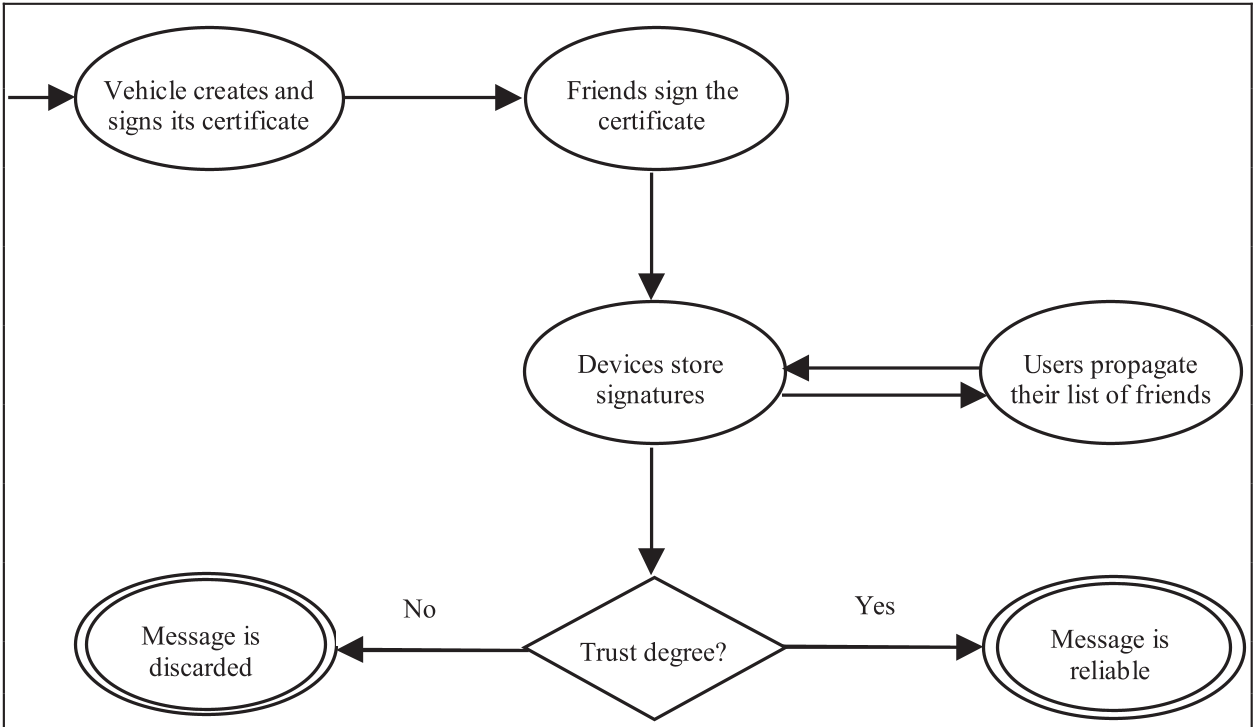
1. Direct and Indirect Certification
Trust degrees are categorized similarly to how humans perceive relationships:
- HIGH (Friends): Established via direct physical contact (e.g., in a parking lot) where both parties sign each other's certificates.
- MEDIUM (Friend-of-a-Friend): Validated if a common friend's public key exists in the social graph.
- LOW (Reputation): Validated based on historical behavior and tokens assigned by other reliable users.
2. The Reputation Token System
When a user provides helpful information (e.g., a verified accident report), those who benefit issue a positive token. Conversely, bad actors receive negative tokens. These tokens propagate through the social network, allowing the system to filter out "NULL" trust nodes (strangers with bad history).
Experiments & Results: Real-World Validity
The researchers tested SNVC against real-world mobility traces from DieselNet (Massachusetts), Chicago (bus-based), and Seattle.
Key Performance Indicators:
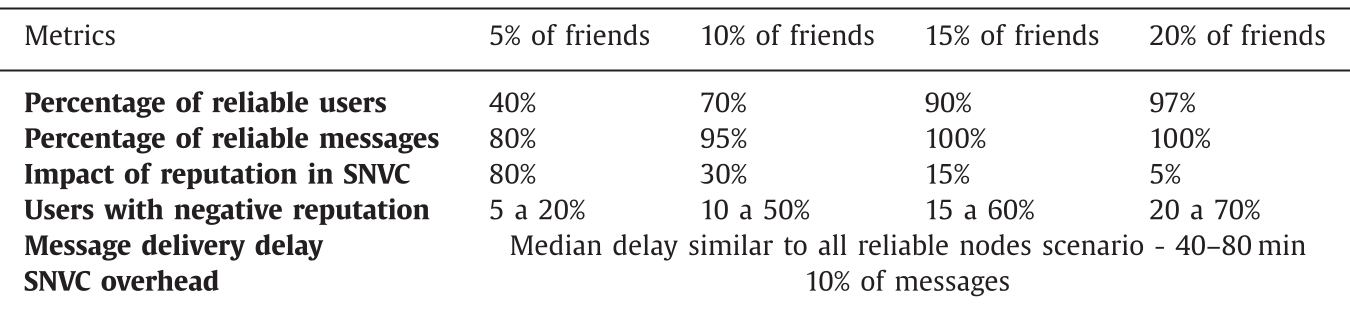
- Resilience through Friends: In the DieselNet trace, as the percentage of friends increases to just 5%, the percentage of "Reliable Messages" (those from trusted sources) jumps to 80%.
- Reputation Impact: Reputation is most critical when social circles are small. It acts as the "safety net" for identifying reliable strangers.
- Low Overhead: Crucially, the cost of this security is minimal. The protocol overhead is only ~10% of total traffic, making it highly efficient for bandwidt-constrained vDTNs.
Critical Analysis & Conclusion
Takeaway
SNVC proves that we don't need a "Big Brother" CA to have a secure vehicular network. Social proximity provides a high-integrity Inductive Bias for trust. By mirroring the way humans build reputation in the physical world, SNVC creates a cyber-physical security layer that is naturally resilient to disconnections.
Limitations
While the system prevents simple collusion by weighting reputation tokens based on the receiver's own social circle, a large-scale "sybil attack" (where one malicious actor creates many fake social identities) could still pose a threat if the initial "friend" verification is not strictly physical.
Future Outlook
This work opens the door for Socially-Aware Smart Cities, where the reliability of crowd-sourced data isn't just about the data itself, but the "social weight" of the citizen providing it.