
From Articles to Interactions: Decoding the Social Fabric of Wikipedia
Social networks of Wikipedia
This paper introduces methodologies for extracting social networks from Wikipedia's User Talk Pages (UTPs) by mapping interpersonal communications. It compares two automated approaches—"Signature-based" and "Edit History-based"—against a manually coded ground truth from the Venetian Wikipedia to evaluate data reliability in computational sociology.
TL;DR
While Wikipedia is famous for its encyclopedic content, its "User Talk Pages" (UTPs) host a massive, under-studied social network. This paper by Paolo Massa explores how to reliably extract these "talk" networks using automated algorithms. By comparing machine-extracted data with human-coded analysis of the Venetian Wikipedia, the author reveals the pitfalls of wiki data—from bot-generated welcomes to the chaos of personalized signatures—and maps out a path for a more rigorous Computational Sociology of Wikis.
Background: The Hidden Social Web
Most academic interest in Wikipedia settles on the product (the articles). However, the process is inherently social. UTPs function as public "walls" or message boards where editors coordinate, argue, and welcome newcomers. To understand the power dynamics and community health of a wiki, we must look at who is talking to whom.
Methodology: Two Ways to Map a Conversation
The author identifies that because Wikipedia doesn't enforce a strict database schema for comments, extraction requires creative heuristics.
1. The Signature Algorithm (Mirroring Human Perception)
This approach scans the current text of talk pages for specific "signatures" (usually identified by links preceded by [[User:).
- The Logic: It captures what a human reader sees as a "signed" message.
- The Flaw: It fails if a user forgets to sign (roughly 8.3% of cases) or uses a non-standard template for their signature.
2. The History Algorithm (The "Ground Truth" of Actions)
This method ignores the text and looks at the stub-meta-history XML files. Every time User A edits User B's UTP, the algorithm records a message.
- The Logic: It captures every action, regardless of whether it was signed.
- The Flaw: It captures "noise"—bots moving templates, vandals posting nonsense that gets deleted, and small typo fixes that aren't new messages.
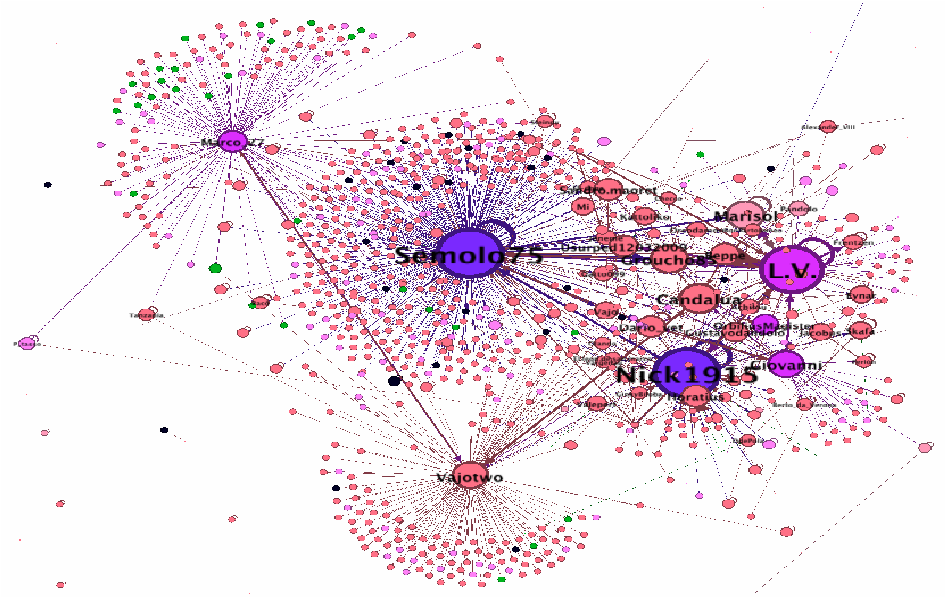 Figure 1: Social network of Venetian Wikipedia users. Node size represents indegree (received messages), highlighting central community figures.
The Venetian "Ground Truth" Experiment
To validate these algorithms, the researchers manually coded every single message on the Venetian Wikipedia. The findings were revealing:
- The Bot Factor: On Venetian Wikipedia, a single bot (Marco27Bot) was responsible for hundreds of invisible "edits" that weren't social interactions but mass-template updates.
- The Vandalism Factor: Anonymous users frequently post vandalism that is deleted. The History algorithm sees these "ghost" interactions, whereas the Signature algorithm (and human coders) misses them because the text is gone.
Experimental Comparison
The following table highlights how different definitions of a "message" change the perceived size of the network:
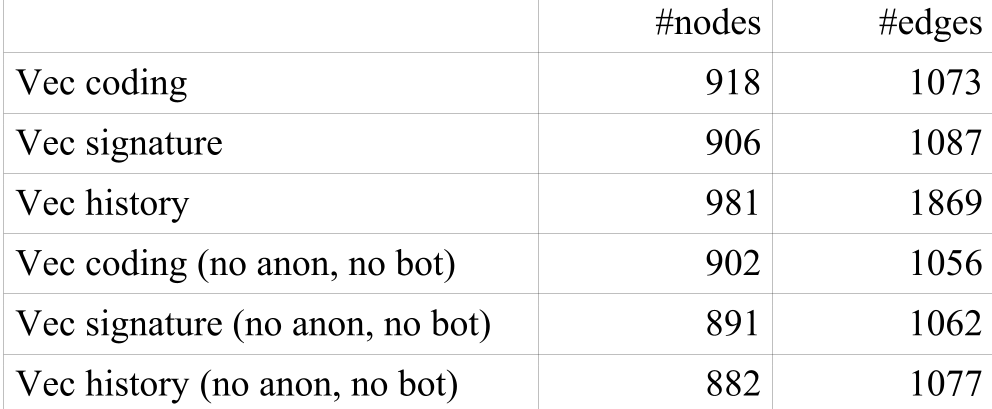 Table 1: Comparison of Nodes and Edges across different extraction methods.
As seen above, the "History" method identifies nearly 75% more edges than manual coding. However, once you exclude bots and anonymous users, the numbers align much more closely, suggesting that the History method is highly reliable if filtered correctly.
Critical Insight: The "History" Advantage
The author concludes that the History-based approach is the future of wiki research. Why?
- Language Agnostic: It doesn't care if the wiki is in English, Venetian, or Chinese—the XML structure for "who edited what" remains the same.
- Longitudinal Depth: It allows researchers to see how a network evolved over 10 years by tracking timestamps, which is impossible with a "current-version only" signature scan.
- Traceability: It captures the interactions of users who have since been renamed or whose posts were deleted.
Conclusion and Future Outlook
This work provides the foundational "plumbing" for computational sociology. By releasing their Python scripts as open-source, the authors enable others to study the 270+ language versions of Wikipedia consistently.
The ultimate takeaway is a warning to Big Data researchers: Data collection is not neutral. How you choose to extract a link—whether by looking at a signature or an edit log—fundamentally changes the "reality" of the social network you are describing. Moving forward, the community must leverage platform-level logs (History) while carefully filtering for non-human noise (Bots).