
Engineering Cooperation: How Social Norms Drive the Evolution of Online Communities
Influencing the long-term evolution of online communities using social norms
This paper investigates the long-term evolution of online communities composed of self-interested users by designing social norms based on indirect reciprocity. It proposes a threshold-based social rule and reputation scheme, modeled as a Markov Decision Process (MDP), to induce cooperative behavior and achieve a stochastically stable equilibrium in finite populations.
TL;DR
Online communities fail when self-interest leads to "free-riding." This paper proposes a robust framework using social norms and reputation systems to steer a community of intelligent, self-interested users toward a stable state of mutual cooperation. By modeling user behavior as a Markov Decision Process (MDP), the authors identify the exact mathematical conditions under which cooperation becomes the "best response" for every individual.
Background: The Tragedy of the Digital Commons
In P2P networks, multimedia communities, and social platforms, providing services (like uploading data or sharing compute) costs the provider but benefits the receiver. If users are purely "rational," they maximize their utility by consuming services without ever providing them. While direct reciprocity ("I help you because you helped me") works in small groups, it fails in large, anonymous online spaces.
The authors argue that we need indirect reciprocity—a system where high reputation scores act as a "social currency." However, in finite populations, small errors (reporting mistakes or system glitches) can cause reputation distributions to fluctuate, potentially collapsing the cooperative order.
Methodology: The Social Norm as a Control Mechanism
The authors define a social norm through two components:
- A Social Rule (): Specifies that "good users" (high reputation) only need to serve other "good users," while "bad users" must serve everyone to regain standing.
- A Reputation Scheme (): Updates a user's label based on their actions. If you follow the rule, your reputation increases (up to ); if you deviate, it resets to zero.
The MDP Framework
Each user solves an individual stochastic control problem. They observe the "community configuration" (the distribution of reputations) and decide on a service threshold.
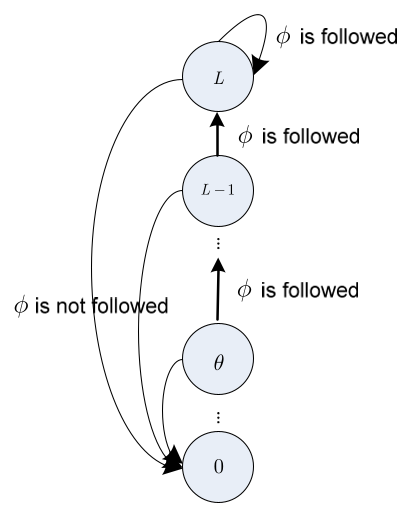 Figure 1: The feedback loop between individual strategy adaptation and community reputation distribution.
The paper proves that users naturally adopt threshold-based strategies. A user only provides service if the client's reputation is above a certain level . The interaction is modeled as an asymmetric "gift-giving game."
The Long-Term Evolution: Stochastic Stability
Using Markov Chain analysis, the authors look for Stochastically Stable Equilibria. These are states that the community will inhabit most of the time as the probability of "noise" or error () approaches zero.
Theorem 1 & 2 Insight: A community essentially polarizes. In a stable state, users are either at reputation (perfectly cooperative) or reputation (defective). To ensure everyone gravitates toward , the protocol designer must ensure:
- Patience (): Users must value future rewards highly enough.
- Cost/Benefit Ratio (): The rewards of the community must significantly outweighs the cost of contribution.
- The "H" Threshold: Paradoxically, punishment shouldn't be too harsh. If the threshold to be considered a "good user" is too high, users who fall to reputation 0 will find it mathematically impossible/unprofitable to climb back up, leading to a community of "permanent outcasts."
Experimental Validation
The authors simulated 1,000 users over periods. The results confirm that keeping the error rate low is critical. At , the community never settles; at , a stable cooperative core emerges.
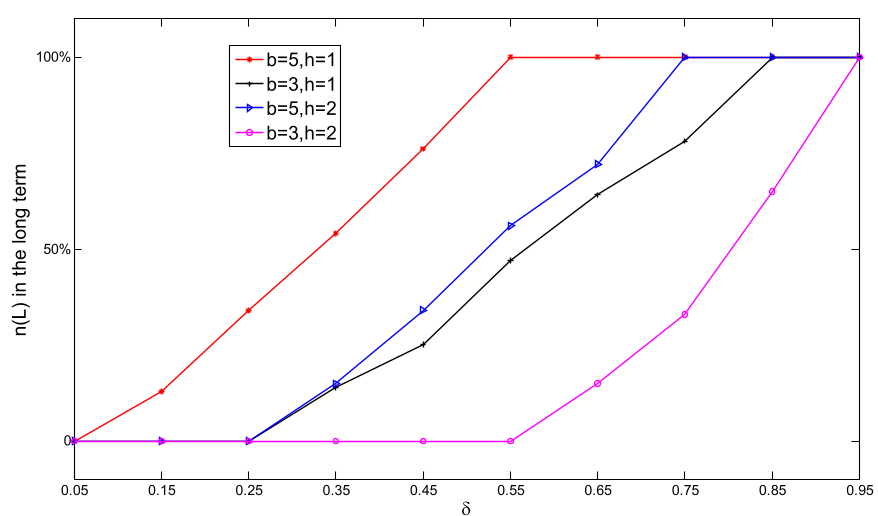 Figure 2: Average reputation distribution. Notice how higher benefits () and higher discount factors () lead to a nearly unanimous reputation (cooperation).
Critical Analysis & Conclusion
The brilliance of this work lies in its prescriptive nature. Instead of just describing how users learn, it tells designers how to build "incentive-compatible" rules.
Limitations:
- Homogeneity: The current model assumes all users value the benefit and cost identically.
- Perfect Information: It assumes the "Tracker" broadcasts the configuration to everyone perfectly. In real-world decentralized systems, users only have "local" views of their neighbors.
Future Outlook: This research underscores that online community management is a problem of dynamic Mechanism Design. As we move toward DAO (Decentralized Autonomous Organization) governance, these Markovian models of social norms will be essential for ensuring that self-interest ultimately serves the collective good.