
Social Optima in Robust Mean Field LQG Control: Navigating Uncertainty in Large-Scale Cooperation
16536_Social Optima in Robust Mean Field LQG Control From Finite to Infinite Horizon.
This paper investigates the social optimal control of Mean Field Linear-Quadratic-Gaussian (LQG) models under drift uncertainty. It proposes a robust optimization framework where agents cooperate to minimize a collective social cost while treating a common uncertain drift as an adversarial player, achieving asymptotic optimality in both finite and infinite horizons.
TL;DR
Controlling thousands of interacting agents (like a swarm of drones or a massive power grid) usually relies on Mean Field Control (MFC). However, what happens when the environment itself is unpredictable? This paper introduces a robust framework for MFC where agents work together (social optimum) to combat a common, adversarial environmental drift. By solving a complex system of Forward-Backward Stochastic Differential Equations (FBSDEs), the authors provide decentralized rules that become "perfect" as the number of agents grows to infinity.
Problem & Motivation: The Complexity of Cooperation
In large-scale systems, the Social Optimum represents the "team spirit" approach—where every agent collaborates to minimize the total cost of the group. This is much harder than finding a Nash Equilibrium (where everyone is selfish), because any change by one agent affects the collective average, which in turn affects everyone else.
Add Model Uncertainty to the mix, and the problem becomes a nightmare. If the drift of the system is unknown, a conservative strategy is to assume the environment is an "adversary" trying to maximize the group's cost. Previous work focused either on selfish agents in robust games or cooperative agents in certain environments. This paper bridges the gap: How can a massive team cooperate optimally when the environment is fighting back?
Methodology: The Architecture of Robustness
The authors tackle this by splitting the problem into two sequential steps:
- The Adversary’s Move: Identifying the "worst-case" drift using a centralized optimization perspective.
- The Team’s Response: Designing decentralized control laws that respond to this worst-case scenario.
1. Robust Variational Derivation
To avoid the "curse of dimensionality" (calculating for separate agents), the paper uses Social Functional Variation. It asks: If one agent moves slightly, how does it scale across the whole field? This leads to an auxiliary control problem for a "generic" agent.
2. The FBSDE Framework
The core of the solution lies in a system of Forward-Backward Stochastic Differential Equations (FBSDEs). The "Forward" part tracks the state of the agent, while the "Backward" part tracks a "co-state" or price signal that reflects the social influence.
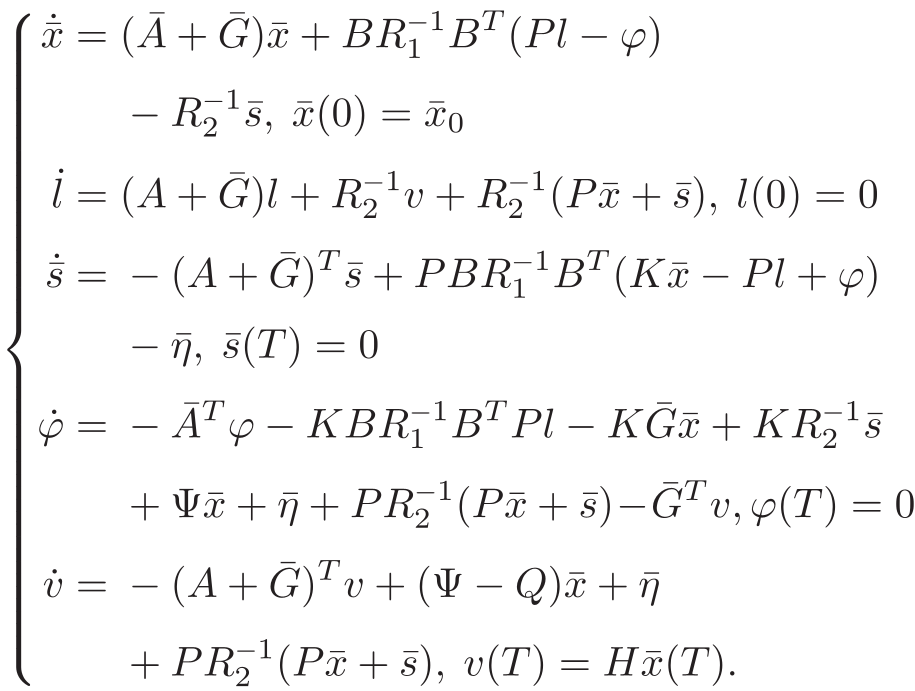 Figure: The system of 5n consistency equations derived to ensure that the decentralized actions match the aggregate mean field.
Experiments & Results: Proving Asymptotic Optimality
The beauty of Mean Field theory is that as , the approximation error should vanish. The authors prove that the difference between their decentralized robust cost and the theoretical "perfect" centralized cost is .
Numerical Insight
The paper provides a numerical example using Riccati equations to find the steady-state gain () and the auxiliary parameters (). As shown in the provided simulations, the solution remains stable within specific time horizons, providing a clear "recipe" for implementation.
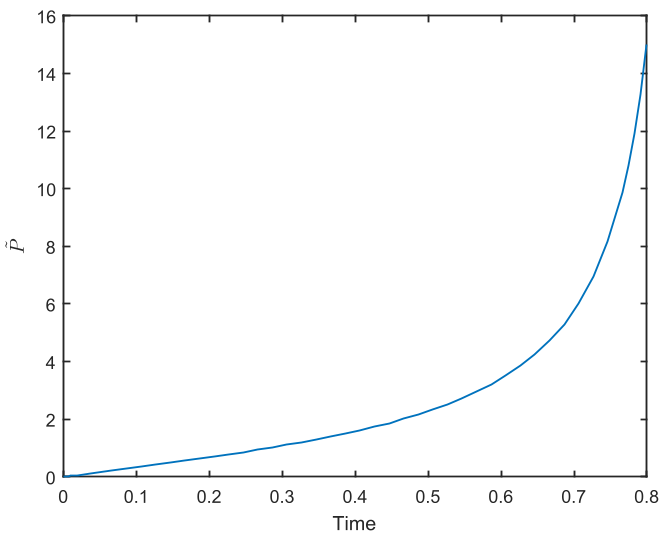 Figure: The evolution of the Riccati solution , which is essentially the 'robustness gain' for the social optimizer.
Deep Insight: Why This Matters
Most "robust" AI today (like Robust RL) is designed for single agents or competitive games. This research specifically empowers collaborative swarms.
Key Contributions:
- Low-dimensional Convexity: They transformed a massive -agent problem into a simple matrix test (Proposition 2.2), making it computationally feasible to check if a robust solution even exists.
- Infinite Horizon Stability: They provided the criteria for systems that need to run forever (like climate control or economic filters) using Algebraic Riccati Equations.
Limitations & Future Work
The current model assumes a common drift uncertainty. In many scenarios, uncertainty might be local (e.g., individual sensor noise) or the noise itself might have uncertain volatility (common noise volatility uncertainty). The authors suggest that exploring "volatility-uncertain common noise" is the next frontier for this mathematical framework.
Conclusion
This paper is a masterclass in applying high-level stochastic analysis to practical engineering problems. It proves that robustness doesn't have to come at the cost of cooperation. By using mean-field approximations, we can design massive teams that are both socially efficient and resilient to the "worst" the environment can throw at them.