
Clops: Bridging the Gap Between P2P Privacy and Cloud Reliability
Social Overlays Meet the Cloud: A Hybrid Architecture for Profile Dissemination in Decentralized Social Networks
The paper introduces Clops, a hybrid architecture for decentralized online social networks (OSNs). It combines a serverless social overlay with inexpensive cloud-based profile stores to ensure fast profile updates and high availability while preventing data exploitation by centralized providers.
TL;DR
The dream of Decentralized Online Social Networks (OSNs) has long been hampered by a practical reality: when your friends go offline, your newsfeed stops updating. Clops solves this by introducing a hybrid architecture. It uses a Social Overlay for the majority of communication but "patches" connectivity gaps using inexpensive, encrypted cloud storage. The result is a system that matches the speed of Facebook while maintaining the privacy of Peer-to-Peer (P2P) networks.
The Problem: The "Partition" Penalty
In a true P2P social network, messages travel through a chain of friends. However, "churn"—the constant logging in and out of users—creates transient partitions. If a key friend in the middle of a chain goes offline, the dissemination of an update can stall for hours.
Prior works often struggled with two extremes:
- Pure P2P: High privacy, but terrible latency (delays can exceed 3 hours for 1% of users).
- Cloud Aliases: Running a virtual node in the cloud is expensive and exposes private keys to the provider.
Methodology: The Hybrid "Patching" Strategy
Clops introduces the concept of Cloud-based Profile Stores. Unlike a full "alias" (which is an active server), a Profile Store is passive storage (like Amazon S3).
1. Adaptive Polling (HYBRID Protocol)
Instead of every node constantly hitting the cloud, Clops uses the social overlay to "quench" cloud access. If a node retrieves an update from the cloud, it tells its friends on the overlay. Those friends then refrain from hitting the cloud themselves, saving money and bandwidth.
2. Specialized Gossip Protocols
To handle the irregular structure of social graphs, the authors developed:
- QUICK: Uses "Message Histories" to avoid sending duplicate data to the same node clusters.
- THRIFTY: A bandwidth-aware protocol. It uses a reweighing factor based on node degrees to ensure that "popular" nodes (with thousands of friends) aren't crushed by incoming traffic.
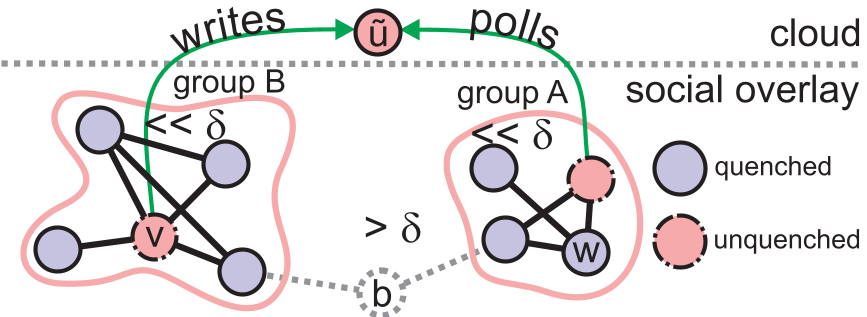 The figure illustrates how a single cloud access can "quench" or satisfy multiple nodes in a delay group, preventing unnecessary costs.
Experiments & Results: SOTA Performance
Using the Orkut dataset (3M nodes/117M edges), the authors tested Clops against purely decentralized and purely centralized baselines.
- Latency: While Pure P2P had a "long tail" of delays reaching days, Clops (Hybrid/15/14) achieved average receiver delays of just 42 seconds.
- Economic Viability: For a typical user, the annual cost of the cloud "safety net" is less than $10 USD.
- Bandwidth Control: THRIFTY successfully limited bandwidth even for users with high connectivity, preventing the network from clogging.
 The table highlights that Clops variants (HYBRID) significantly outperform PureP2P and even aggressive polling (PUREPOLL) in consistency and speed.
Critical Insight & Conclusion
The genius of Clops lies in its "Passive Cloud" philosophy. By treating the cloud as a simple encrypted mailbox rather than a computing hub, the authors circumvented the main privacy and cost barriers of hybrid OSNs.
Takeaway: Future decentralized systems should not fear the cloud; they should use it as a highly available "buffer" to mask the inherent instability of edge devices. However, the system still faces a scalability cap at roughly 5,000 friends—a limitation currently shared by even the largest centralized platforms like Facebook.