
TrustSPR: Enhancing Recommendation via Transitive Social Trust Networks
Social personalized ranking recommendation algorithm by trust
The paper introduces TrustSPR, a novel Social Personalized Ranking algorithm that integrates transitive social trust networks into a list-wise ranking framework. By combining the ListRank approach with TrustMF mechanisms, it achieves superior ranking performance in recommendation tasks using explicit feedback.
TL;DR
TrustSPR is a sophisticated Social Personalized Ranking (SPR) algorithm that addresses the limitations of direct social integration. By leveraging transitive trust—the idea that trust can propagate through a network—and combining it with a list-wise ranking objective, it achieves state-of-the-art results on sparse datasets like Epinions.
Background & Motivation: Moving Beyond Direct Social Links
In the realm of Collaborative Filtering (CF), the transition from rating prediction (predicting a score) to ranking prediction (predicting a preference order) has proven more effective for real-world applications. However, most Social Personalized Ranking (SPR) models simply "stitch" direct social links into the latent factor model.
The authors argue that this is insufficient. Traditional models like SoRank use RSTE, which treats a user's preference as a weighted average of their immediate friends. The core insight of this paper is that trust is transitive. If User A trusts User B, and User B trusts User C, there is a latent trust signal between A and C that can be leveraged to alleviate the cold-start and data-sparsity problems.
Methodology: The Fusion of ListRank and TrustMF
The core of TrustSPR lies in its objective function, which balances ranking accuracy with social manifold regularization.
1. List-wise Ranking Loss
Instead of comparing items in pairs (like BPR), TrustSPR uses a list-wise approach derived from ListRank. It treats the items rated by a user as a probability distribution and minimizes the cross-entropy between the ground truth distribution and the predicted ranking distribution.
2. Transitive Trust Regularization
The model incorporates the TrustMF logic. It assumes that users have dual roles: "trusters" and "trustees." The trust relation is modeled by the interaction between the user feature matrix and a social feature matrix .
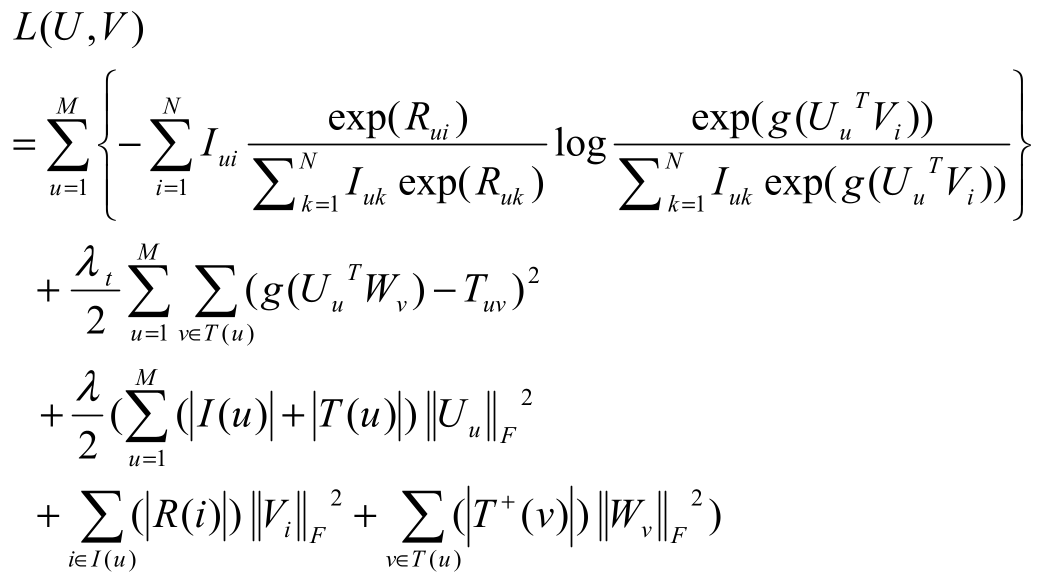
The term ensures that the learned user latent factors are constrained by the trust network topology, effectively propagating trust across the graph.
Experimental Validation
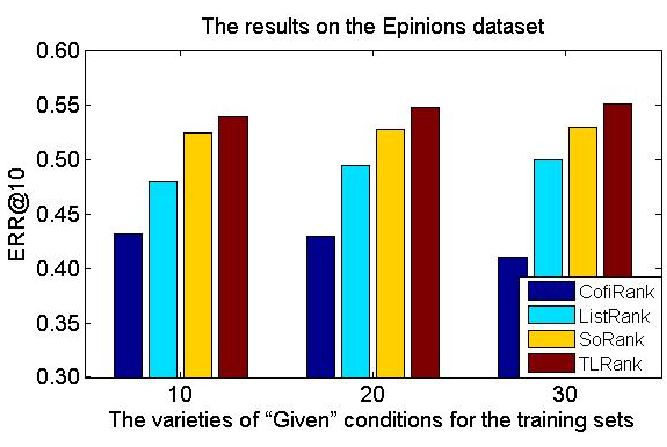
The authors evaluated TrustSPR on the Epinions dataset, a benchmark known for its extreme sparsity (0.0118% density).
SOTA Comparison
TrustSPR was compared against:
- SoRank: The previous SOTA in social ranking.
- ListRank: The non-social version of the ranking algorithm.
- CofiRank: A collaborative ranking baseline.
The results (as shown in the performance charts) indicate that TrustSPR consistently beats SoRank. This confirms that the way social information is integrated—transitive vs. direct—matters more than just having the social data itself.
Parameter Sensitivity
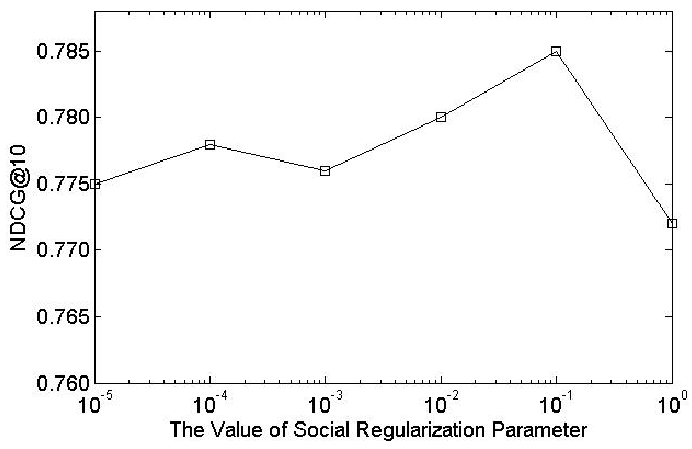
An interesting finding reported in the paper is that the model is relatively robust to the social regularization parameter . This suggests that the trust signal is highly consistent with the ranking signal, making the model easier to tune in production environments.
Critical Analysis & Conclusion
Takeaway
TrustSPR proves that list-wise ranking and social transitivity are complementary. By modeling how trust flows through a network, the algorithm can "borrow" information from distant nodes to make better local recommendations.
Limitations & Future Work
While effective, the model relies on a linear decomposition of trust. Modern social networks often exhibit non-linear interactions. The authors acknowledge this, suggesting Deep Learning and Neural Collaborative Filtering (NCF) as the next frontier for TrustSPR. Furthermore, applying this to implicit feedback (clicks/views) rather than explicit ratings remains an open challenge for this specific architecture.
Essentially, TrustSPR provides a robust mathematical framework for any system where "who you know" and "how you rank" are inextricably linked.