
Social Power Convergence: How Duplex Networks Shape Autocratic and Democratic Systems
Social power convergence on duplex influence networks with self-appraisals
This paper introduces a Duplex DeGroot-Friedkin (DF) model to investigate how social power and self-appraisals evolve across multiple layers of influence networks. By integrating the reflected appraisal mechanism within a duplex structure, the authors demonstrate that network topology—specifically star and doubly-stochastic configurations—critically determines whether a group reaches an autocratic or democratic equilibrium.
TL;DR
Can the structure of our social circles—online and offline—automatically determine who holds power? This paper extends the mathematical DeGroot-Friedkin (DF) model to duplex networks, revealing that the convergence of "self-appraisal" (confidence) into either a single dictator or a perfect democracy is driven primarily by the underlying graph topology, irrespective of individual starting points.
Problem & Motivation: The Limits of Single-Layer Thinking
Most classic models of social influence assume a "flat" world where all interactions happen on one graph. However, human society is inherently multi-layered: you might be a subordinate at work but a high-influence leader in a hobbyist community.
The authors argue that social power isn't just about what you say, but where you stand in a duplex network. They target a specific gap: how does the interaction between these multiple layers of influence (represented by different matrices and ) affect the long-term evolution of an individual's social power?
Methodology: The Duplex DeGroot-Friedkin Model
The core innovation lies in the Reflected Appraisal Mechanism. In this model, an individual’s confidence (self-weight) for a new issue is derived from the social power they wielded during the previous issue.
The Formal Framework
The authors define the evolution of self-weights as a convex combination of social power from both layers: Where:
- are the dominant left eigenvectors of the influence matrices.
- represents the relative importance of Layer 1 vs. Layer 2.
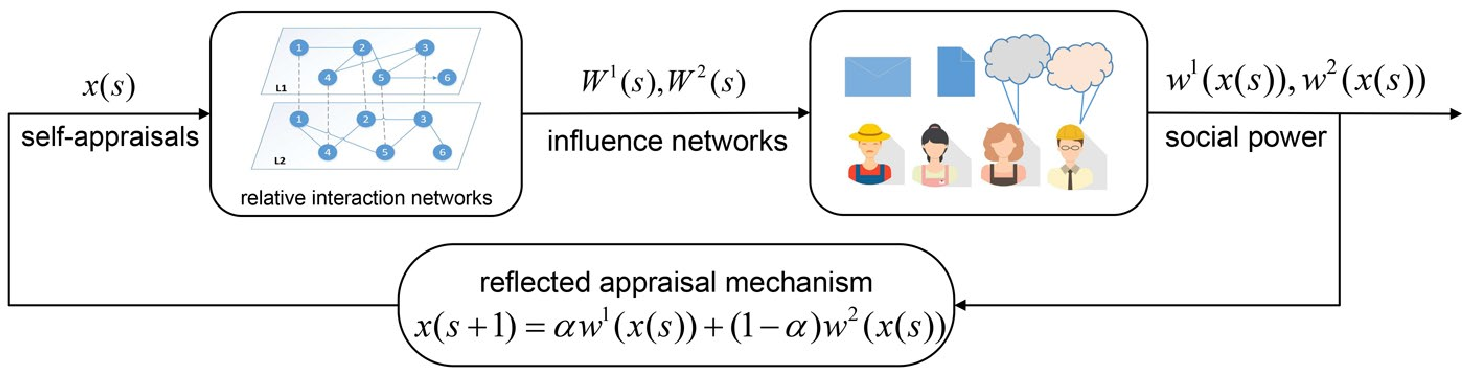 Fig 1: The cyclic process where social power on two layers feeds back into the agent's self-appraisal for the next issue.
The paper provides a rigorous proof using the Lipschitz constant to show that this mapping is continuous across the simplex of possible self-weights, ensuring that the system moves predictably toward stability.
Two Paths: Autocracy vs. Democracy
The authors explore two extreme topological scenarios that lead to vastly different social orders.
1. The Star Topology (The Road to Autocracy)
If both layers are structured as a "star"—where everyone connects to a central hub—the system inevitably collapses into Autocracy. Even if the central agent starts with low confidence, the mathematical feedback loop essentially "pumps" all social power to the hub.
- Result: (The central agent holds 100% influence).
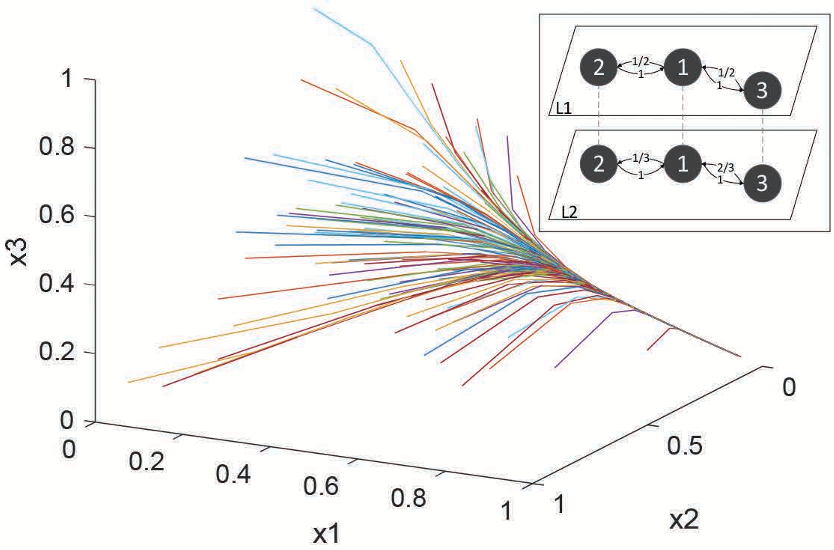 Fig 2: Trajectories on a star network show all paths leading to the apex of the triangle—the autocratic center.
2. Doubly-Stochastic Networks (The Path to Democracy)
If the networks are "fair" (where the sum of influence given and received for each node is equal), the system reaches a Democratic Configuration. Every agent ends up with exactly social power.
- Result: .
Critical Insight: The "Vanishing"
One of the most surprising findings is that in both these specific topologies, the parameter (the weight of one layer over another) becomes irrelevant at equilibrium. Whether you value your work network at 10% or 90%, the structural properties of the graph dominate the final distribution of power.
Conclusion & Future Horizons
This work provides a rigorous mathematical foundation for "structural determinism" in social power. While the research proves convergence for star and doubly-stochastic networks, the "Holy Grail" remains: general duplex networks.
If the layers have conflicting topologies (e.g., a star in Layer 1 and a cycle in Layer 2), who wins? The tension between layers suggests a rich area for future research in system control and computational sociology.