
Social-PPM: Turning Personal Experience into Collective Intelligence
Social-PPM: Personal Experience Sharing and Recommendation
Social-PPM is a mobile social network application designed to document, execute, and share personal processes (e.g., filing taxes, visa applications). It leverages a specialized Collaborative Filtering algorithm to recommend relevant "life goal" processes by analyzing user interaction history and social context.
TL;DR
We often seek advice on "how to do things"—like applying for a PhD or starting a small business—but this knowledge is usually scattered across blogs or locked in private emails. Social-PPM is a mobile social networking platform that treats these personal experiences as "processes" that can be structured, executed, and shared. By applying a socially-aware recommendation engine, it helps users discover life-improving routines based on what similar users have successfully completed.
The Problem: The "Siloed" Knowledge of Daily Life
Most productivity tools fall into two extremes:
- Strict BPM Systems: Designed for corporations, these are too rigid for the messy, ad-hoc nature of personal life.
- To-Do Lists & Static Wikis: Apps like Todoist are just fancy text editors, while WikiHow offers text advice that isn't "executable" or context-aware.
The authors argue that when someone figures out a complex routine, that knowledge is lost to the community. There is no mechanism to reuse the structure of a successful personal journey.
Methodology: The Social-Aware Process Model
Social-PPM introduces a dual-layer approach to manage the flexibility of human life:
1. The Flexible TaskListTemplate
Unlike business workflows that break if you skip a step, Social-PPM uses a TaskListTemplate. It treats a goal as a tree of tasks that can be re-ordered, deleted, or added on the fly. Each task tracks:
- Planning State: Deciding what to do.
- Execution State: Recording when and where a task was actually finished.
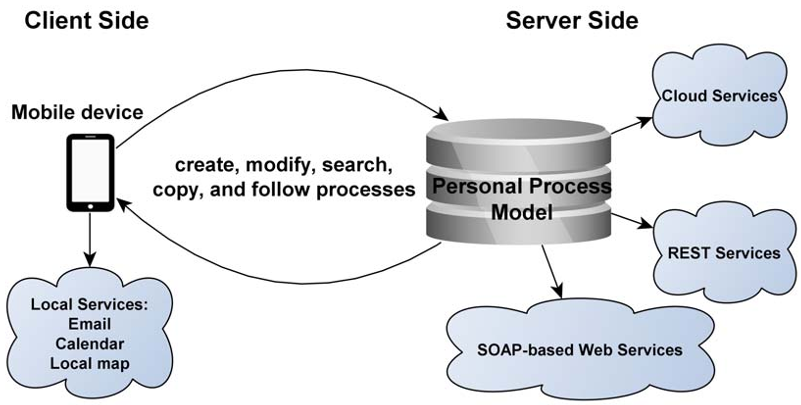 Figure 1: The Social-PPM architecture connecting mobile users to a collaborative process repository.
2. Weighted Collaborative Filtering
The core "magic" is the recommendation engine. The system assumes that if you and another user both copied a "PhD Application" process, you likely share similar life goals. However, not all actions are equal:
- Copying (1.0 weight): High intent; you want to do this yourself.
- Following (0.5 weight): Moderate intent; you are just curious.
- Task Ratings: Derived from collective reviews of specific steps within the process.
Experiments & Real-World Application
The authors demonstrated the system using a "PhD Application" scenario. Users can search for a process, copy it, and then "Auto-execute" certain tasks (like sending emails) directly through the app.
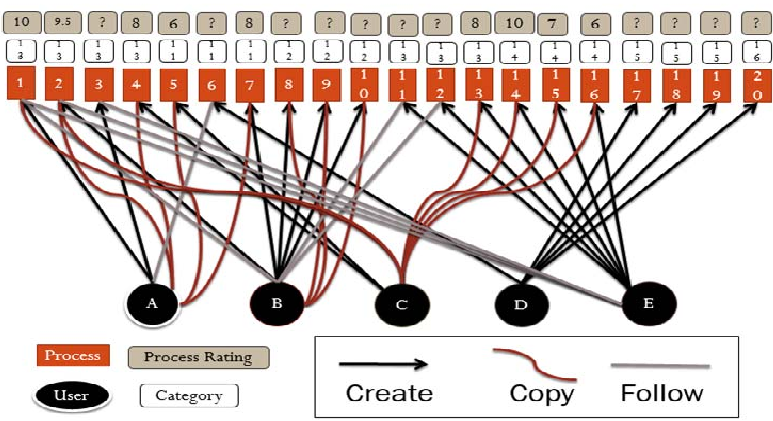 Figure 2: Experimental data showing the mapping between 5 users and 20 processes to validate the recommendation accuracy.
In testing, the algorithm's Comprehensive Score (combining Jaccard similarity and normalized ratings) successfully ranked potential processes for users, effectively filtering through the "information overload" common on mobile devices.
Critical Insight: Why This Matters
The standard "Social Network" is currently built around content (images, text). Social-PPM proposes a social network built around action.
Limitations: The paper acknowledges the "Cold Start" problem—newly created processes won't be recommended until someone interacts with them. The authors suggest future work in Content-Based Filtering (using category similarity) to bridge this gap.
Conclusion
Social-PPM provides a blueprint for a "21st-century mechanism" of passing down wisdom. Instead of writing a blog post about "How I moved to Sydney," a user can simply share their executed process template, allowing others to follow in their footsteps with one click.
Keywords: Personal Process Management (PPM), Collaborative Filtering, Crowdsourcing, Social Computing.