
SPM: Mastering DTN Multicast Through the Lens of Social Profiles
Social profile-based multicast routing scheme for delay-tolerant networks
The paper proposes the Social Profile-based Multicast (SPM) routing scheme for Delay-Tolerant Networks (DTNs). By utilizing static social features like affiliation and language instead of complex contact histories, it achieves high data delivery ratios with significantly reduced transmission costs.
TL;DR
In the world of Delay-Tolerant Networks (DTNs), knowing "who knows whom" is usually expensive. This paper introduces SPM (Social Profile-based Multicast), a routing scheme that replaces complex contact history tracking with static social attributes like workplace affiliation and spoken language. The result? A multicast system that is as efficient as state-of-the-art history-based models but significantly lighter on resource consumption.
Background: The High Cost of Memory
Intermittent connectivity is the defining characteristic of DTNs. To deliver a message to a group (multicast), a node must decide: "Is this encounter likely to bring the message closer to the destination?"
Most current SOTA (State Of The Art) methods answer this by maintaining exhaustive logs of past meetings. However, in mobile social networks, these logs grow exponentially and become stale quickly. The authors of this paper ask a fundamental question: Can we use what we already know about people—their static social profiles—to predict these encounters instead?
Methodology: Identifying the "Social Core"
The researchers didn't just guess which features matter. They applied information theory (Shannon Entropy) to the Infocom06 trace to find the most informative features.
1. The Power of Affiliation and Language
They discovered that Affiliation has the highest entropy (most informative) while Language remains remarkably independent of other factors (like city or nationality).
- The Affiliation Insight: There is a near-linear correlation between "affiliation distance" (how closely related two organizations are) and contact probability.
- The Language Insight: Shared languages (excluding the common working language, English) significantly increase the frequency of encounters.
2. The SPM Routing Logic
The Social Profile-based Multicast (SPM) uses these two metrics to select relays. Instead of a single path, it calculates:
- Average Affiliation Distance: How "far" a relay candidate is from the average of the multicast group.
- Common Language Ratio: The density of shared communication potential with group members.
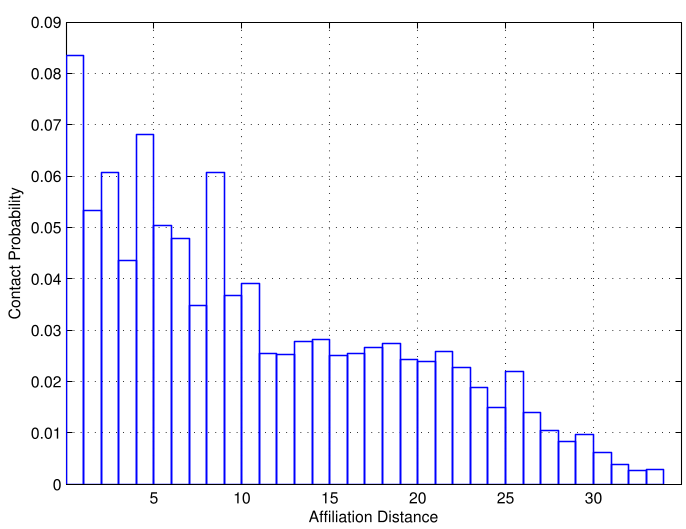 Figure 1: (a) Relationship between affiliation distance and contact likelihood; (b) Inter-contact time distributions for language-based groups.
Experiments & Results
The authors compared SPM against Epidemic (flooding) and Non-Replication (NR) (a dynamic history-based tree).
- Delivery Performance: SPM achieved a delivery ratio nearly identical to the NR scheme, proving that social profiles are excellent predictors of future contacts.
- Efficiency: SPM reduced the transmission cost (number of times a message is copied) by a massive margin compared to Epidemic routing. Unlike Epidemic, SPM's cost remained stable even when the Time-To-Live (TTL) of messages was increased.
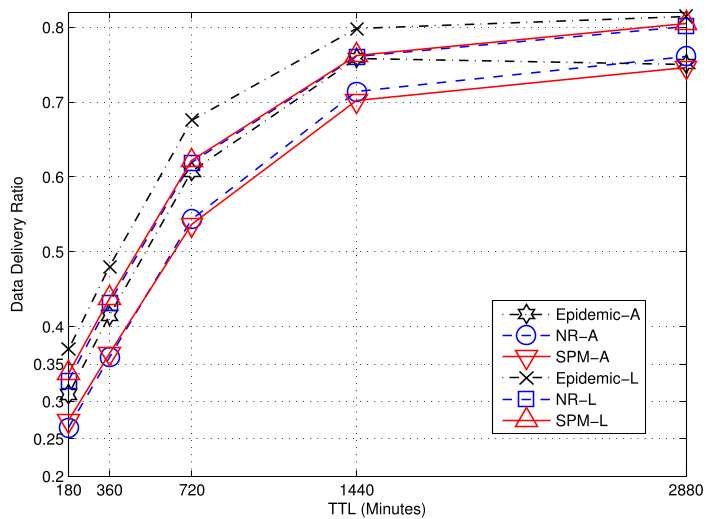 Figure 2: Delivery ratio and transmission cost across different TTL settings. Note how SPM (Social Profile-based) keeps costs low while maintaining high delivery.
Critical Analysis: Why It Works
The genius of SPM lies in its Inductive Bias. It assumes that human mobility is not random but governed by social structures. By mathematically modeling the "distance" between nodes in a social manifold (Affiliation/Language space), the protocol bypasses the need for high-frequency updates of contact states.
Limitations & Future Directions
While effective, the current SPM assumes users are willing to share their profile data (privacy concerns) and that these profiles are accurate. Future work could look into:
- Privacy-Preserving Profiles: Using encrypted or obfuscated social features.
- Dynamic Profiles: Incorporating temporary social roles (e.g., attending a specific session at a conference).
Conclusion
SPM proves that in the context of human-centric networks, social context is as good as historical data. By shifting the focus from "where a node has been" to "who the node is," we can build multicast systems that are both highly effective and computationally lean.