
The Interpersonal Neuroscience of Mediated Communication: Bridging the Digital Social Divide
Social Psychology of the Digital Age: The Interpersonal Neuroscience of Mediated Communication
This paper proposes the "interpersonal neuroscience of mediated communication," a multidisciplinary framework combining HCI, psychology, and social neuroscience. It utilizes five experimental paradigms to demonstrate how technological mediums—ranging from sparse haptic vibrations to rich gaming environments—influence inter-individual physiological linkage, affect, and decision-making.
TL;DR
As our interactions shift from physical presence to digital mediation, psychological science must evolve. This paper introduces a new frontier—Interpersonal Neuroscience of Mediated Communication—demonstrating through five distinct experiments how even the "thinnest" digital signals (like a simple vibration) can synchronize our brains, influence our economic decisions, and alter our sense of self.
Background Positioning
In the spectrum of social psychology, this work acts as a methodological bridge. It moves beyond the 20th-century focus on "direct interaction" and positions itself as a SOTA framework for understanding the "digital social brain." By integrating neuroscience tools (EEG/fEMG) with HCI paradigms, the authors argue that communication technology doesn't just transmit messages; it reconfigures our physiological alignment with others.
Problem & Motivation: The "Stimulus Reduction" Fallacy
Since Gordon Allport’s 1936 study on radio-mediated religion, researchers have often assumed that technology simply "reduces" the richness of communication. However, the authors point out a paradox: if we are hard-wired to imitate others (the Mirror Neuron System), why do we still feel social connections through a screen or a text?
The motivation here is to move past the "more or less stimulus" debate and explore Physiological Linkage—the phenomenon where two people’s biological signals (heart rate, brain waves) synchronize during interaction.
Methodology: Five Paradigms of the Mediated Brain
The authors detail five experimental setups to dissect different layers of mediated sociality:
1. Rich Interaction: The "Hot Seat" Gaming
In a turn-based game (Hedgewars), pairs played either cooperatively or competitively.
- The Insight: EEG linkage (synchrony) in the beta frequency band was highest during competition. This suggests that to beat an opponent, our brains may actually "mirror" them more intensely to predict their moves.
2. The Virtual Midas Touch
Participants played an economic "Ultimatum Game" where they could send a haptic vibration (mediated touch) along with a monetary offer.
- Visual Evidence:
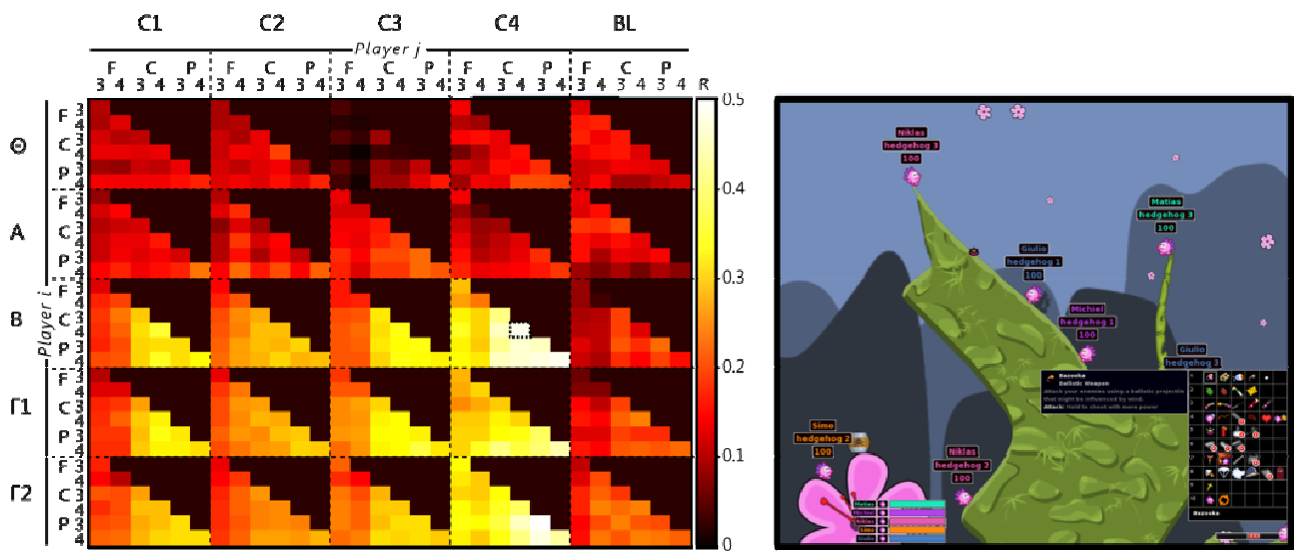
- Finding: Even a simple vibration increased the likelihood of a deal being struck, mimicking the real-world "Midas Touch" effect where physical touch increases generosity.
3. Affective Virtual Humans (VH)
Interaction with avatars expressing anger or neutrality.
- Finding: Angry avatars evoked less "approach motivation" in human participants (measured via frontal EEG asymmetry), proving that we project social norms onto non-human agents.
Experiments & Results: Beyond Reaction Times
The paper moves from simple "clicking" to continuous gesture tracking using Microsoft Kinect (Paradigm 5).
- SOTA Comparison: Traditional cognitive psychology uses "Reaction Time" to measure conflict (e.g., the Stroop Task). The authors show that when we share a task space with a virtual partner, our brains incorporate their "response space" into our own.
- Critical Result:
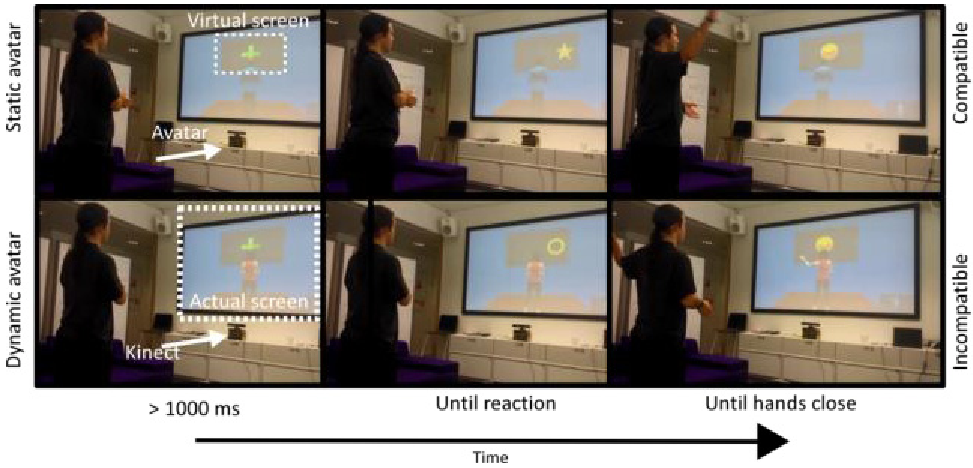 The Kinect data reveals that conflict isn't just a delay in time; it's a physical "tugging" of the hand toward the wrong stimulus, a metric much richer than simple millisecond counts.
Critical Analysis & Conclusion
Takeaway
The "presence" of another person is a psychological construct that can be triggered by surprisingly sparse data. Mediated technology provides a "control laboratory" that direct interaction cannot—allowing us to swap avatars, synchronize rhythms perfectly, and isolate variables like touch.
Limitations
While the paradigms are robust, the paper notes that the Mirror Neuron System paradox (how do we distinguish "self" from "other" if we always mirror?) remains partially unsolved in mediated contexts. Furthermore, the long-term effects of "ubiquitous smartphone use" on our baseline ability to synchronize in the physical world are yet to be fully mapped.
Future Work
The authors foresee a future where we don't just use interfaces; we "inhabit" them. By applying these neuroscience insights to HCI, we can build systems that implicitly foster trust through subtle haptic or visual synchrony—turning the "digital divide" into a new form of neural connection.