
Social Reader: Unveiling the Hidden Social Fabric of the Blogosphere
Social reader : following social networks in the wilds of the blogosphere
This paper introduces Social Reader, a novel web-based feed reader that transforms the blogosphere from an information-centric list into a user-centric social graph. By mining the latent network of comments, it visualizes relationships between bloggers and readers using a center-periphery metaphor to facilitate community exploration and discovery.
TL;DR
Social Reader is a experimental feed reader that moves beyond the "list of articles" paradigm. By treating comments as the primary source of connection, it builds a live, interactive social graph. Users can see not just what was written, but who is talking to whom, allowing them to discover new bloggers through a "central-peripheral" visual interface.
Background: Beyond the Static Blogroll
In the mid-2000s, blogs were often analyzed through blogrolls (static links between sites). However, the real "pulse" of the blogosphere lived in the comments section. The authors of this paper recognized that feed readers were stuck in an information-retrieval mindset, ignoring the social potential of these interactions. They positioned Social Reader as a Casual Information Visualization (CIV) tool—designed for everyday curiosity rather than professional data analysis.
The Problem: Identifying the "Who" in the "What"
The blogosphere is fragmented. A user might be "Bob" on one site and "Robert_S" on another, making it difficult to track real human influence. Furthermore, standard RSS readers offer no way to see the "neighborhood" of a blog—the regular commenters who actually form the community.
Methodology: Engineering the Social Graph
The system architecture of Social Reader relies on three pillars:
- Identity Consolidation: Heuristic crawlers parse HTML comments (author name, URL, timestamp) and map them to a unified "Identity" dictionary. This creates a bridge between different blogs that a single person might visit.
- Center/Periphery Metaphor: The UI splits the world into two zones. The Center contains your explicit subscriptions. The Periphery is populated by the "friends of friends"—people who have commented on your subscribed blogs but whom you don't follow yet.
- Mixed-Initiative Interaction: The system suggests connections (automation), but the user decides who to "drag" into their inner circle (direct manipulation).
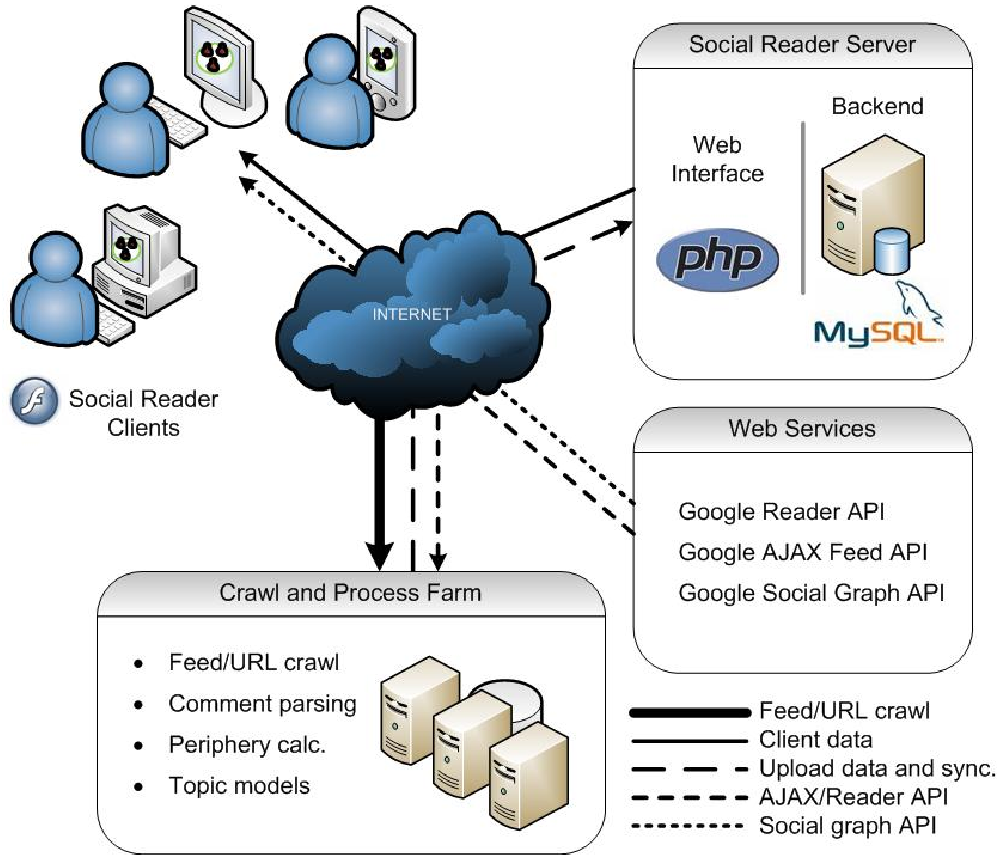 Figure 1: The system pipeline from Google Reader API to heuristic comment parsing and final visualization.
Experiments & Results: Do People Actually "Social-Hop"?
The authors conducted a 6-week field study. The quantitative logs showed a high degree of "Exploration" maneuvers, where users clicked on peripheral nodes to see who they were.
- Awareness Insights: Users reported that the graph helped them realize which posts were "hot" based on the thickness of interaction edges.
- Social Insights: This was the highest-rated category. Users enjoyed the "bird's eye view" of their blog microcosm, discovering that two of their favorite bloggers actually knew each other.
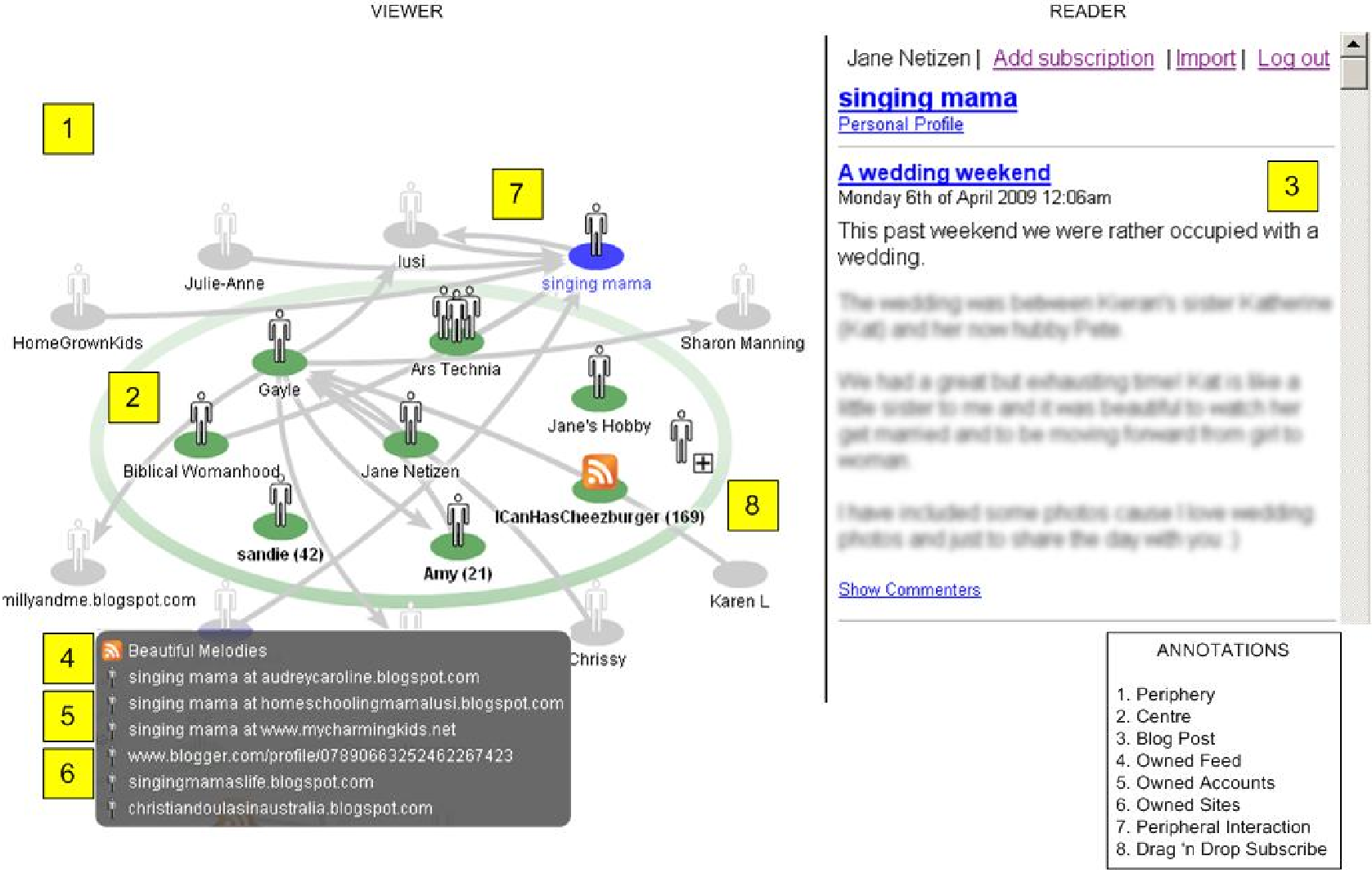 Figure 2: The Social Reader interface. Central nodes are surrounded by a green band; peripheral interactors float outside, visible as potential new connections.
Critical Insight: The Value of "Noisy" Data
While some users complained about "visual clutter" when their networks grew too large, the majority found that the graph representation reduced "information overload" by prioritizing people over content.
However, a key limitation identified was Reflective Insight. The system could show that someone was active, but not how their style changed across different communities. Future work would likely involve sentiment analysis or topical profiling to add "flavor" to the nodes.
Conclusion
Social Reader proves that the "Killer App" of Web 2.0 wasn't just the content, but the latent relationships buried in the metadata. While the blogosphere has shifted toward centralized platforms like X (Twitter) or Substack, the core logic of using interaction streams to build ego-centric discovery tools remains more relevant than ever in our era of algorithmic feeds.
Takeaway for Researchers
If you are building social discovery tools, look for the "weak ties" in the comments. Direct follows are obvious, but the users who show up in the same comment sections are the true indicators of an emerging community.