
SoERec: Capturing the Pulse of Social Networks for Smarter Recommendations
Social Recommendation in Heterogeneous Evolving Relation Network
The paper introduces SoERec, a novel social recommendation model that leverages a Heterogeneous Evolving Relation Network. By combining temporal decay functions with Large-scale Information Network Embedding (LINE), the model captures dynamic user-user influence to achieve SOTA performance on Weibo and Last.fm datasets.
TL;DR
Static social graphs are a simplification of a moving reality. SoERec (Social Recommendation in Heterogeneous Evolving Relation Network) moves beyond static snapshots by modeling user relationships as dynamic entities that evolve over time. By combining time-decayed influence with advanced network embedding (LINE), this model significantly reduces error rates (MAE/RMSE) and improves recommendation relevance on massive datasets like Sina Weibo.
Problem & Motivation: The Static Graph Fallacy
Most existing social recommenders assume that a "friend" link created three years ago carries the same weight as a "mention" from three minutes ago. In reality, social influence is a decaying signal. Previous SOTA methods faced two main hurdles:
- Temporal Neglect: They ignore that human relationships are fluid and event-driven.
- Data Sparsity: User-item interaction matrices are often over 99% empty, making it hard for traditional Matrix Factorization to find meaningful patterns.
The authors' insight is simple yet powerful: The current behavior of a user is a weighted sum of all historical interactions, where recent events carry more weight than distant ones.
Methodology: From Events to Finely-Grained Embeddings
SoERec operates in three distinct phases to bridge the gap between historical raw events and final item predictions.
1. Modeling Evolving Strength
The model first defines a Heterogeneous Evolving Network. For every interaction (like, mention, or retweet), it applies a decay function: This ensures that the "strength" of a relation is the cumulative influence of historical events, adjusted for how long ago they happened.
2. Heterogeneous Network Embedding
To solve the sparsity problem, the model uses LINE (Large-scale Information Network Embedding). This transforms the weighted graph into a low-dimensional vector space:
- First-order Proximity: Captures direct links (explicit relations).
- Second-order Proximity: Captures "friends of friends" or users with similar interaction patterns (implicit relations).
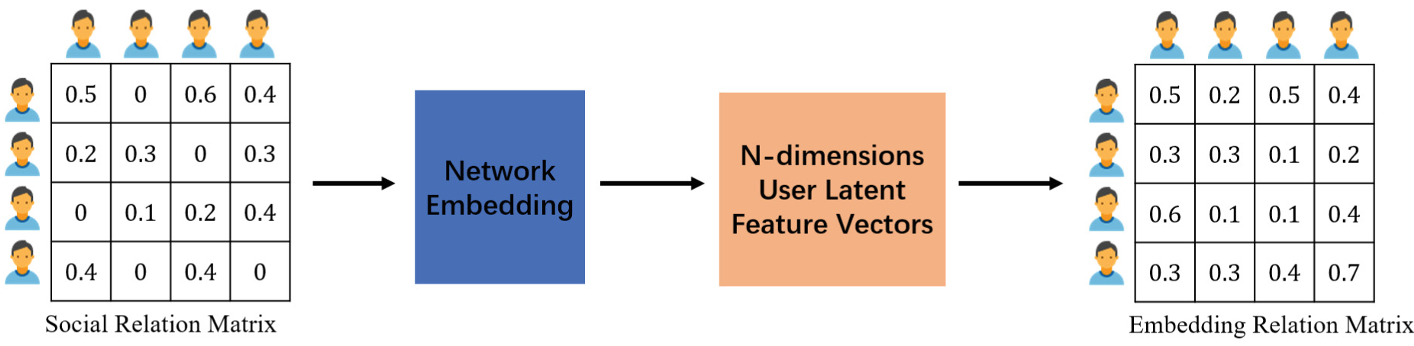 Figure 1: The framework for learning first-order and second-order proximity in evolving networks.
3. Unified Recommendation Logic
The final prediction is a hybrid of the user's specific latent preference and the preferences of their most "intimate" friends (calculated via the embeddings):
Experiments & Results: Proving the Value of Time
The researchers tested SoERec against a battery of baselines including PMF, SoRec, and TrustMF.
Quantitative Edge
On the Weibo dataset, which features over 154 million user-user relations, SoERec achieved:
- MAE Improvement: Reduced error from 0.9110 (PMF) to 0.7495 (SoERec) at 80% training data.
- RMSE Improvement: Outperformed the strongest baseline (SoDimRec) consistently.
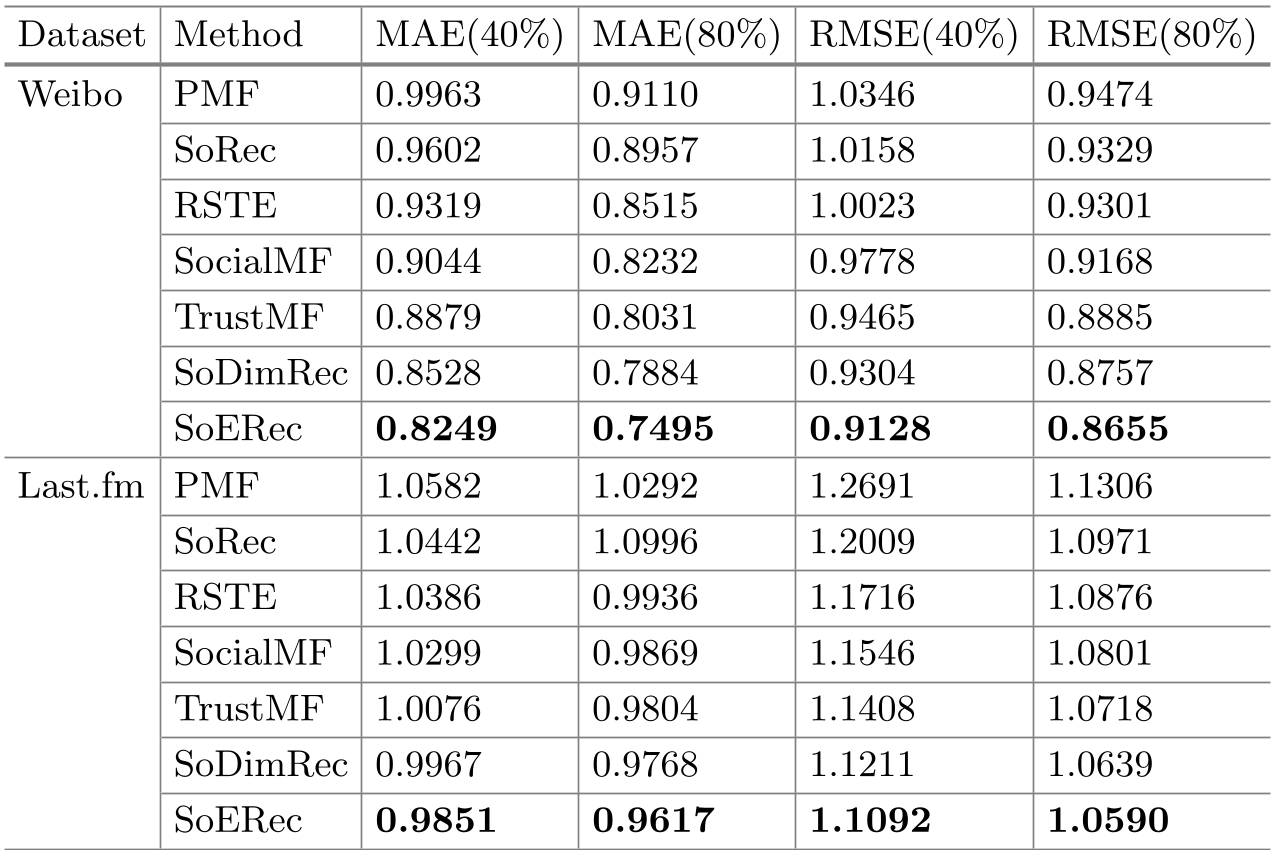 Table 1: Comparison of MAE and RMSE across different training ratios.
Precision at K
The Top-K recommendation results confirm that by considering the "evolving" nature of the graph, the system suggests items that users are actually likely to consume in the immediate future, rather than relying on stale historical preferences.
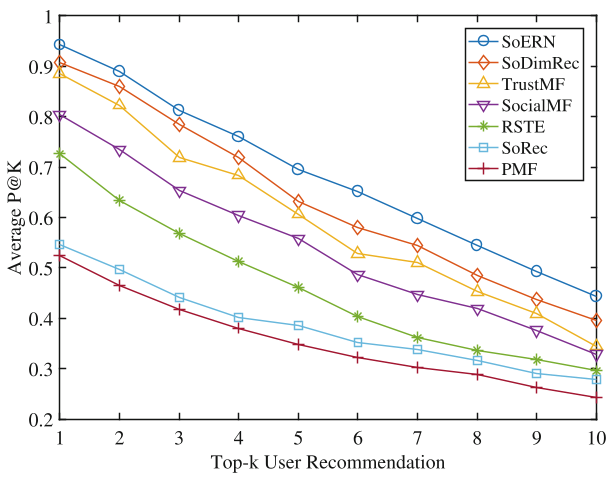 Figure 2: Average Precision @ K on Weibo Dataset.
Critical Analysis & Conclusion
Summary: SoERec effectively demonstrates that "when" an interaction happened is just as important as "what" happened. By embedding this temporal logic into a heterogeneous network framework, the authors provide a scalable solution for modern social platforms.
Limitations:
- The decay rate is treated as a global constant (set to 0.6). In reality, different types of interests (e.g., breaking news vs. music taste) decay at different rates.
- The model assumes the importance of all event types () is equal, which might not hold true (a "following" is usually more significant than a "like").
Future Outlook: The next step for this line of research is likely the integration of Temporal Graph Networks (TGNs) or Dynamic Graph Attention Mechanisms, which could learn the decay rates and event importance weights automatically from the data.