
SPR: Bridging the Trust Gap in P2P Currency Exchange via Social Intelligence
A Social Recommendation Mechanism for P2P Currency Exchange
The paper proposes the Social P2P Currency exchange Recommendation mechanism (SPR), a novel fintech solution for peer-to-peer foreign exchange. It integrates social network data, trust evaluation, and location-based services (LBS) to match users for face-to-face currency trading.
TL;DR
The paper introduces SPR (Social P2P Currency exchange Recommendation), a mechanism designed to disrupt traditional foreign exchange markets. By leveraging social network analysis and location-based data, it transforms the "risky" act of trading money with strangers into a trusted peer-to-peer interaction, significantly boosting transaction willingness and platform precision.
Problem & Motivation: The High Cost of Trust
While the demand for foreign currency is rising due to global travel, the traditional banking system remains inefficient and expensive for small-scale exchanges. The "Sharing Economy" offers a solution by utilizing individuals' idle currencies, yet it faces a fundamental roadblock: Uncertainty.
Most users are unwilling to perform physical, face-to-face transactions with anonymous peers due to safety and fraud concerns. Prior work often focused on either pure reputation systems or simple location matching, failing to capture the complex social nuances that drive human trust.
Methodology: The Four Pillars of Trust
The authors propose a comprehensive framework that analyzes candidates through four distinct lenses:
- Location Fitness: Using Euclidean distance and resident country data to ensure convenience.
- Individual Similarity: Calculating cosine similarity between users' personal backgrounds (age, hometown, travel history) and exchange preferences.
- Social Relationship: Evaluating "tie strength" through mutual friends and interaction frequency (likes, tags, comments) on social media.
- Social Trust: A composite score of human appraisal (ratings) and platform-verified credentials (identity authentication).
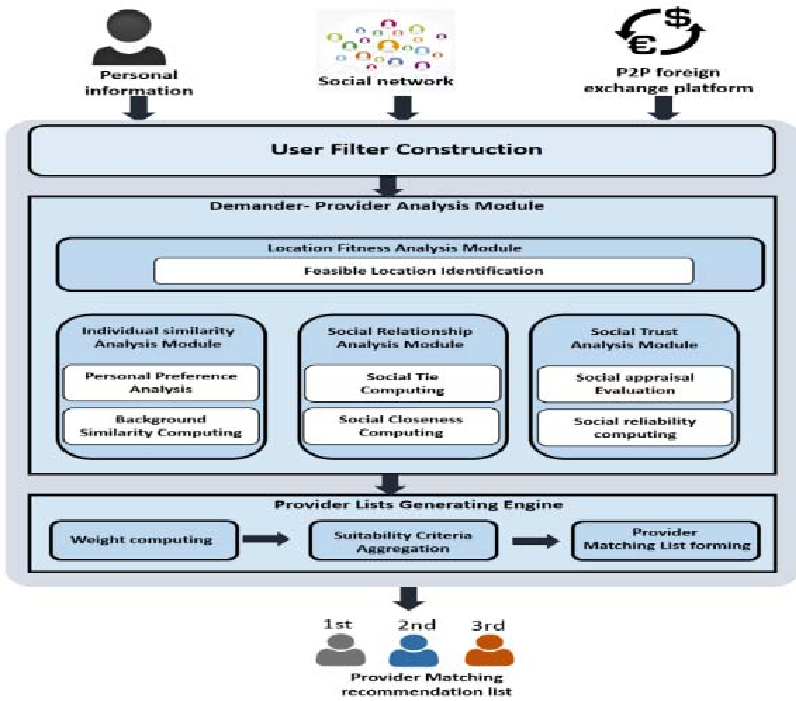
The core logic follows an Aggregation Process: once a user filters for a specific currency (via the "FilterTree"), the engine weights these four pillars to generate a personalized recommendation list.
Experiments and Results
The study utilized real-world data from 123 participants, scraping over 79,000 social reactions. The system was compared against four other strategies, including Random Recommendation and Location-only models.
Key Finding: The SPR mechanism outperformed all baselines in terms of precision (click-through rates and willingness to trade).
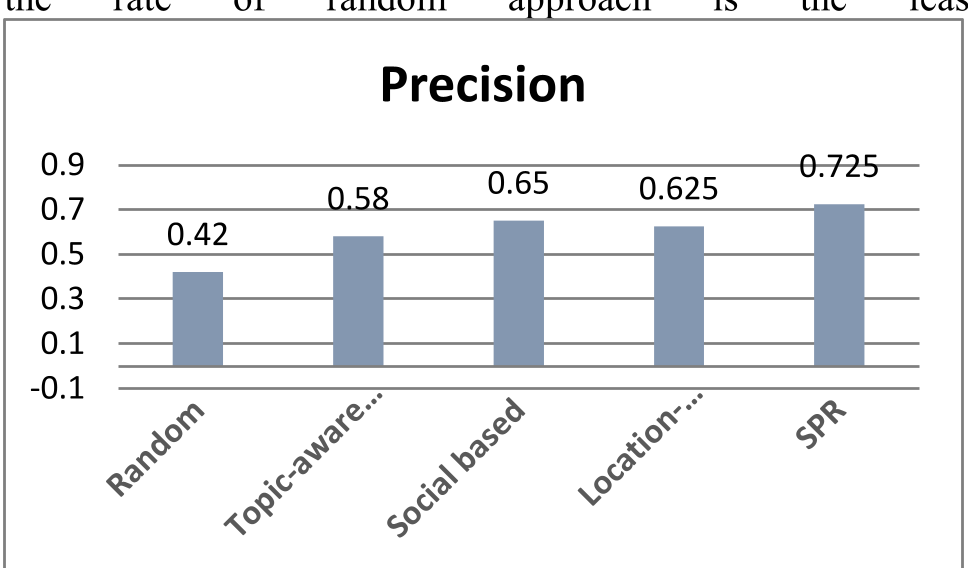
The results indicate that while location is a "necessary" filter, the "social" components (Similarity and Trust) are the "sufficient" conditions that actually convert a recommendation into a successful exchange.
Critical Analysis & Conclusion
Takeaway
The SPR model proves that Fintech is not just about moving numbers; it is about managing Social Capital. By turning a financial transaction into a social event—where users might share travel tips along with currency—the platform increases its "Network Externality."
Limitations & Future Work
While the social integration is strong, the current mechanism relies heavily on Facebook API data, which poses privacy concerns and data access challenges in the current regulatory environment (GDPR etc.). Future iterations could explore Zero-Knowledge Proofs or decentralized identity (DID) to maintain trust without compromising privacy. Furthermore, integrating real-time exchange rate volatility into the "Similarity" score could further optimize the economic outcome for users.