
TBPR: Decoding the "Strength of Weak Ties" in Social Recommendation
Social Recommendation with Strong and Weak Ties
This paper introduces TBPR (Bayesian Personalized Ranking with Strong and Weak Ties), a social recommendation framework that distinguishes between strong and weak social ties. It leverages Jaccard coefficients to approximate tie strength and employs an EM-based algorithm to simultaneously classify ties and learn latent features, achieving significant SOTA improvements on datasets like DBLP, Douban, and Epinions.
TL;DR
Most social recommendation engines assume "all friends are created equal," but human sociology suggests otherwise. This paper introduces TBPR, a ranking model that classifies social ties into Strong and Weak. By optimizing the preference order between items consumed by these different tie types, TBPR achieves a massive performance leap—improving Precision@5 by up to 24% and providing significantly better results for cold-start users.
Problem & Motivation: The Granovetter Insight
In 1973, sociologist Mark Granovetter famously argued for the "Strength of Weak Ties." His insight was counter-intuitive: while we trust our close friends (strong ties), our acquaintances (weak ties) are actually the ones who provide us with new information, such as job leads or novel interests, because they belong to different social circles.
In the context of Recommender Systems, current SOTA methods like SBPR (Social BPR) treat social influence as a monolith. They assume that if any friend consumed an item, you are more likely to prefer it over a random item. However, they fail to distinguish between the redundant information from your inner circle and the novel discoveries from your outer circle.
Methodology: Engineering Social Nuance
The authors propose TBPR (BPR with Strong and Weak Ties). The methodology consists of three core components:
1. Defining Tie Strength via Network Topology
Instead of requiring private interaction frequency data, the authors use Jaccard’s Coefficient to measure neighborhood overlap. If you and your friend share many mutual friends, the tie is likely "Strong"; if your circles overlap very little, it's a "Weak" tie.
2. The Five-Category Hierarchy
TBPR redefines the ranking objective by splitting items into a 5-level preference hierarchy for every user :
- Consumed Items: Highest preference.
- Joint-Tie-Consumed (JTC): Consumed by both strong and weak ties.
- Weak-Tie-Consumed (WTC) / Strong-Tie-Consumed (STC): The paper tests two variants (TBPR-W and TBPR-S) to see which one users prefer.
- Non-Consumed Items: Lowest preference.
3. Latent Threshold Learning (The EM Approach)
Instead of picking an arbitrary threshold to separate strong and weak ties, the authors treat the threshold as a model parameter. They use an Expectation-Maximization (EM) algorithm:
- E-Step: Classify items into the five categories based on the current threshold.
- M-Step: Update user/item latent vectors and the threshold to maximize the likelihood of the observed consumption ranking.

Experimental Breakthroughs
The researchers evaluated TBPR on four datasets: DBLP (Academic), Ciao (DVDs), Douban (Movies), and Epinions (Consumer Reviews).
Key Results:
- Massive Gains in Douban: TBPR-S achieved an improvement of 24.0% in Precision@5 and 27.9% in MAP.
- Academic Discovery (DBLP): TBPR-W (preferring weak ties) performed best here, confirming that researchers find new papers through "weak" acquaintances in diverse fields.
- Cold-Start Salvation: For users with almost no history, TBPR outperformed baselines by up to 52.3% (MRR on Douban), proving that social ties are the ultimate proxy for user interest when data is sparse.
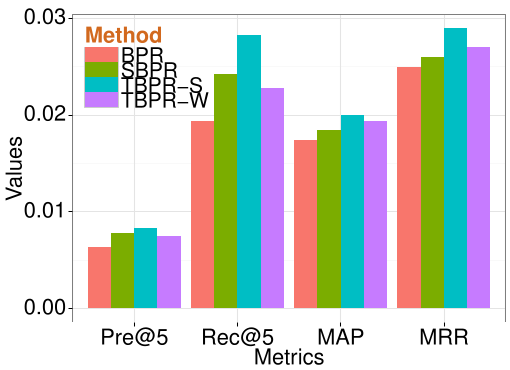 Figure: Precision vs. Recall curves showing TBPR variants dominating traditional BPR and SBPR.
Critical Insights & Conclusion
A fascinating finding is that the "best" tie type depends on the domain. In DBLP (knowledge-sharing), Weak Ties are superior (TBPR-W), confirming Granovetter’s theory of information spread. In Douban (entertainment), Strong Ties (TBPR-S) were more influential, likely because movie tastes are often shared within close-knit friendship groups.
Takeaway: TBPR demonstrates that "Social Recommendation" is not just about having a social graph; it's about understanding the structural role of each connection. By allowing the model to learn the optimal threshold between strong and weak ties, we can significantly sharpen the accuracy of personalized rankings.
Future Work: The next frontier is Personalized Tie Thresholds—recognizing that for some users, every acquaintance is a source of inspiration, while for others, only the inner circle matters.