
Beyond Content: Building Human Connections via Multirelational Social Networks
Social Recommendations within the Multimedia Sharing Systems 1
The paper introduces a social recommender system for Multimedia Sharing Systems (MSS) that suggests new interpersonal connections using a Multirelational Social Network (MSN) framework. By extracting 11 distinct layers of direct and object-based relationships from platforms like Flickr, it provides a personalized and adaptive mechanism for expanding user communities.
TL;DR
In the era of Web 2.0, systems like Flickr and YouTube are often viewed as silos of content. However, this paper argues they are actually "hidden" social networks. By introducing a Multirelational Social Network (MSN) framework, the authors demonstrate how to recommend people to other people by analyzing 11 different layers of interaction—from shared tags to author-commentator dynamics. Their system doesn't just suggest friends; it learns which types of interactions you value most and adapts in real-time.
Problem & Motivation: The "Object-Based" Gap
Most users in Multimedia Sharing Systems (MSS) interact with objects—photos, videos, or tags—rather than directly with each other. While a user might comment on a hundred photos, they might only have five "friends" in their contact list.
The authors identified that existing recommender systems were excellent at finding more photos you might like (Content-based filtering) or tags others liked (Collaborative filtering), but they were poor at identifying the latent social structure built upon these interactions. The challenge was: How do we convert these indirect, object-based interactions into high-quality social recommendations?
Methodology: The Core of MSN
The breakthrough of this work lies in treating a social network not as a single flat graph, but as a multilayered structure.
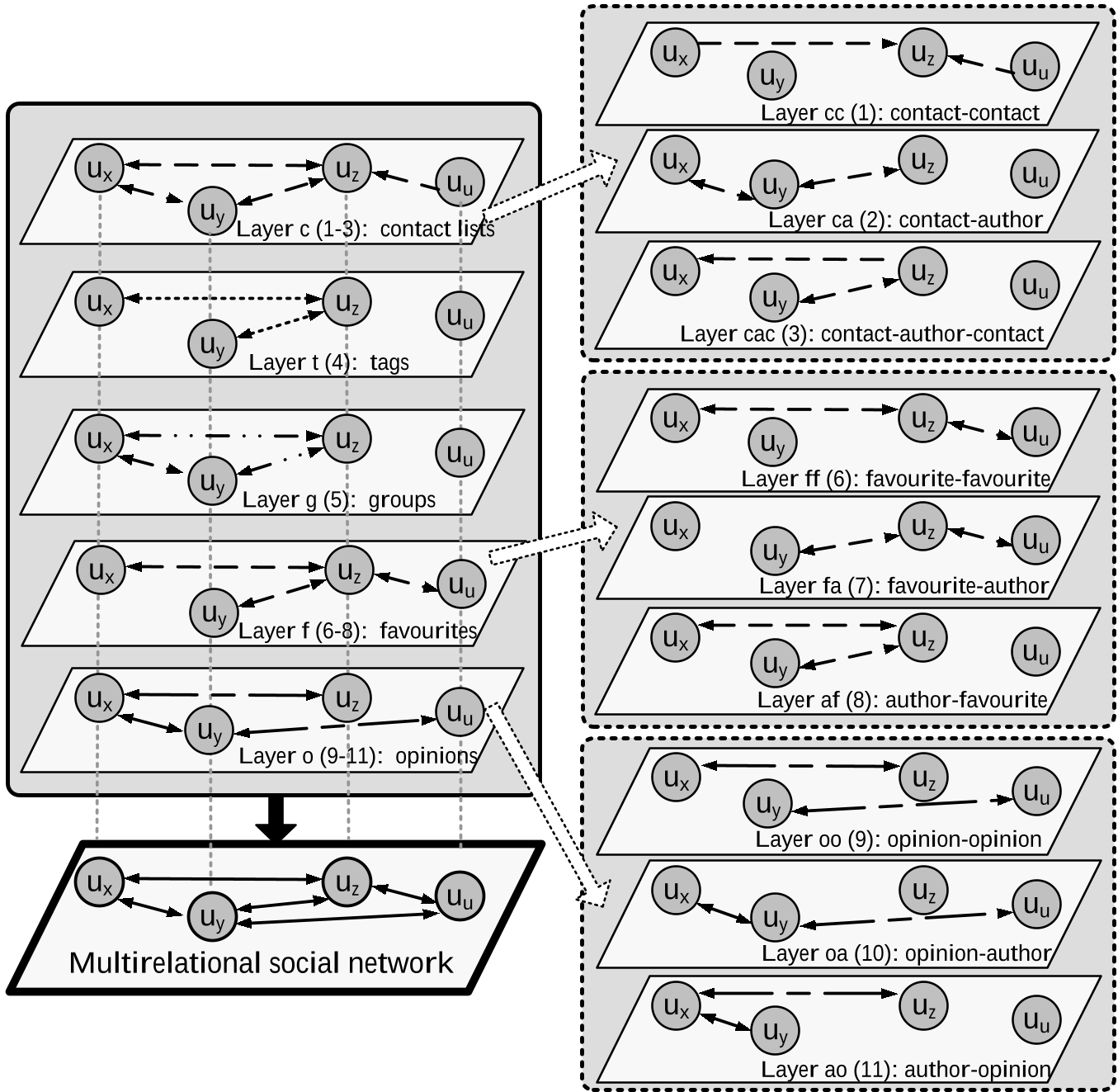
1. The Three Tiers of Interaction
The researchers categorized relationships into three fundamental types:
- Direct Intentional Relations: Adding someone to a contact list.
- Object-Based (Equal Roles): Two users who both "favorite" the same picture.
- Object-Based (Different Roles): A user who comments on a photo versus the author of that photo.
2. The 11-Layer Architecture
Specifically for Flickr, the authors extracted 11 distinct layers, including tag-based (), group-based (), and various permutations of favorite and opinion interactions.
3. Adaptive Weighting Mechanism
The recommendation engine uses a sophisticated formula to calculate the similarity between user and user :
Where:
- : Global importance of a layer (system weight).
- : Personal preference for a layer (personal weight).
- : Strength of connection in a specific layer.
As a user interacts with recommendations (e.g., clicking a profile or adding a friend), the system updates the personal weights using an auto-balancing feedback loop.
Experiments & Results
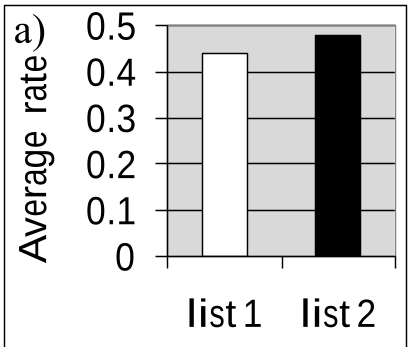
The authors conducted experiments using over 21,000 Flickr profiles. Users were presented with two sets of recommendations. The results were clear:
- Iterative Improvement: The second list (generated after the system "learned" from the first list's ratings) received higher satisfaction scores.
- Layer Significance: Interestingly, layers based on "Contact Lists" and "Author-Opinion" relations saw the biggest gains in importance after adaptation, while "Tag-based" relations were less critical than expected.
Critical Analysis & Conclusion
Takeaway
The paper successfully proves that social discovery in multimedia environments is not a "one-size-fits-all" problem. By decomposing "socializing" into 11 granular dimensions, the authors created a system that respects the diverse ways people find value in communities.
Limitations
- Efficiency: Calculating 11 layers of similarity for millions of users in real-time is computationally expensive. The authors acknowledge that a production-ready version would require offline pre-calculation.
- Cold Start: New users still rely on system-wide averages () until they provide enough feedback for personalization to kick in.
Future Outlook
This research pre-dates the modern "interest graph" used by platforms like TikTok, but the core intuition is the same: inter-user relationships are best inferred through shared passion for content. Future iterations of this work could involve deep learning embeddings to capture the semantic meaning of tags and comments, providing even deeper social matching.