
Bridging the Gap: Enhancing Forum Knowledge Sharing via Social-Network Markov Chains
A social recommender mechanism for improving knowledge sharing in online forums
This paper proposes a social recommender mechanism designed for online forums to facilitate knowledge sharing through two phases: discussion thread recommendation and expert finding. The system integrates semantic similarity, expertise level (Z-score), social intimacy, and a Social Network-based Markov Chain (SNMC) model to connect help-seekers with the most relevant content and willing experts.
TL;DR
Online forums are gold mines of knowledge, but finding the right answer—or the right expert—is often like finding a needle in a haystack. This paper presents a social recommender system that moves beyond simple keyword matching. By combining Semantic Analysis with a Social Network-based Markov Chain (SNMC) model, the system predicts not just who knows the answer, but who is willing to give it through social proximity.
Context: Moving from "Know-What" to "Know-Who"
In the era of massive virtual communities, we have shifted from a "post-and-wait" (anonymous queries) and "know-what" (keyword databases) culture to a "know-who" paradigm. The authors argue that the success of knowledge transfer lies in social relationships rather than just documentation. The core problem is efficiency: "Who is the right expert? How do I reduce response time?"
The Multi-Dimensional Methodology
The proposed framework doesn't rely on a single metric. Instead, it synthesizes four sophisticated analysis modules:
1. The Expert Z-Score (Reliability)
Instead of just looking at the number of posts, the system calculates a Z-score for each user: This distinguishes true experts (those who answer more than they ask) from active seekers.
2. Social Intimacy and Popularity (SIP)
The system measures "Social Intimacy" (SI) through mutual interactions and "Popularity" (P) via global reputation. This ensures recommendations aren't just accurate but reside within the user's reachable social circle.
3. The Secret Sauce: SNMC Model
The most innovative part of the research is the Social Network-based Markov Chain. It models the forum as a series of states. If a requester asks a direct friend who cannot answer, the "transition probability" (TP) helps find the next most likely expert in the social chain.
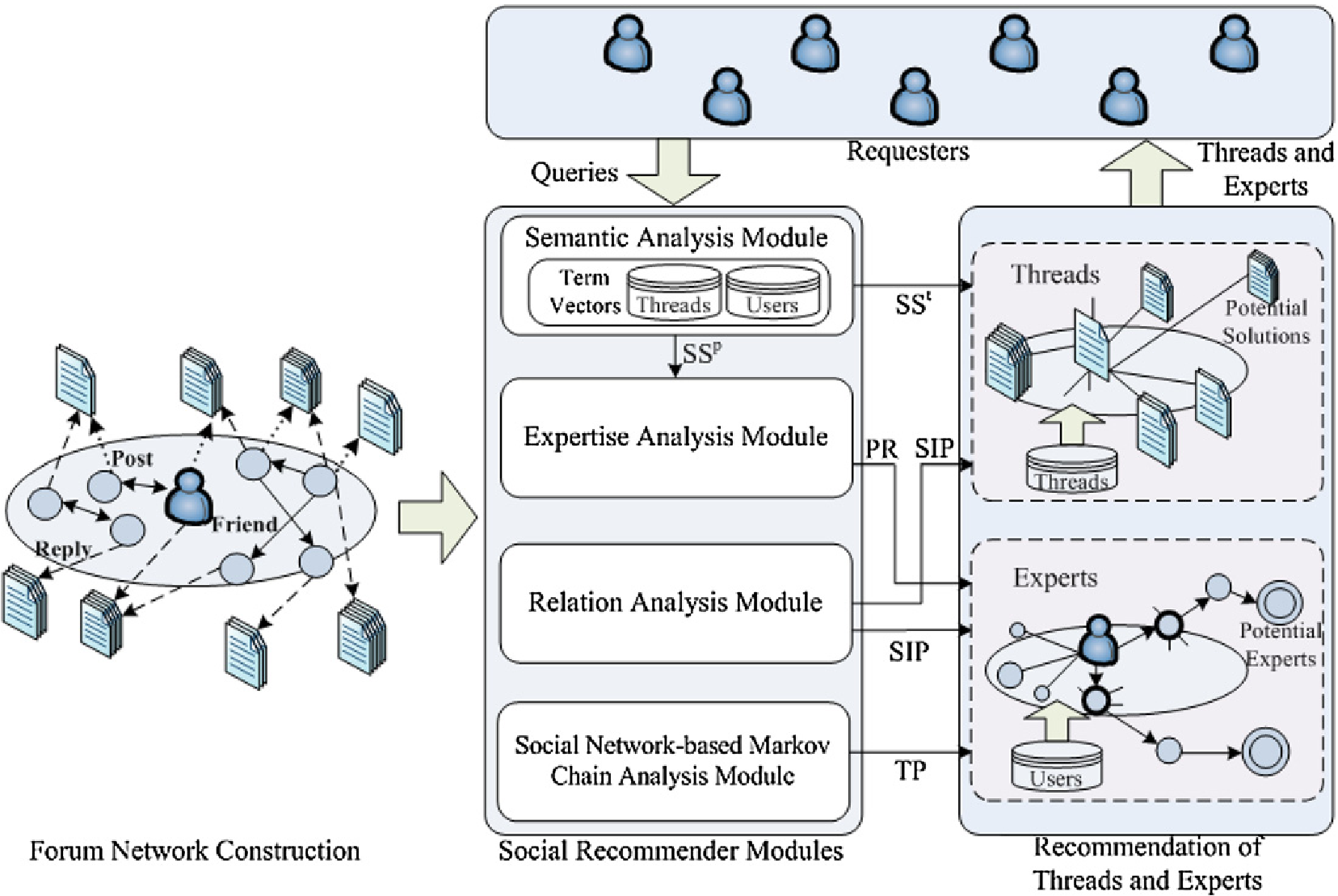 Figure 1: The proposed recommender framework involving semantic, expertise, and social relation analysis.
Experimental Insights: Real-World Legal Data
The authors tested their system on the FreeAdvice Legal Forum, crawling thousands of threads across different domains like "Auto Accidents" and "Child Custody."
Finding the "Bow-Tie"
By analyzing social links, they visualized the forum structure using a Bow-Tie model. They discovered that only about 12.6% of users constitute the "Core" (actively asking and answering), while over 50% are in the "In" component (mostly seeking help). This structural sparseness is exactly why a social recommendation engine is necessary.
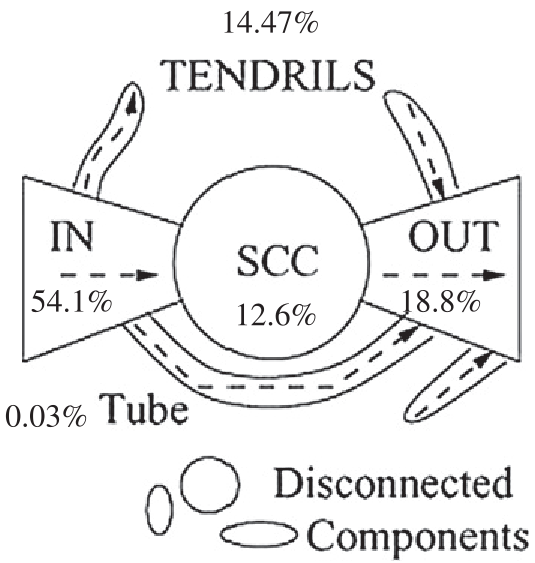 Figure 2: The Bow-Tie structure of the legal forum reveals the distribution of seekers vs. experts.
Performance Boost
The inclusion of the SNMC model significantly improved precision.
- Thread Recommendation: Combining Semantic Similarity (SS) with Social Intimacy (SIP) outperformed pure keyword search.
- Expert Finding: The "PR + SIP + SNMC" strategy was the clear winner, proving that experts who are "socially closer" are more likely to provide high-quality, timely answers.
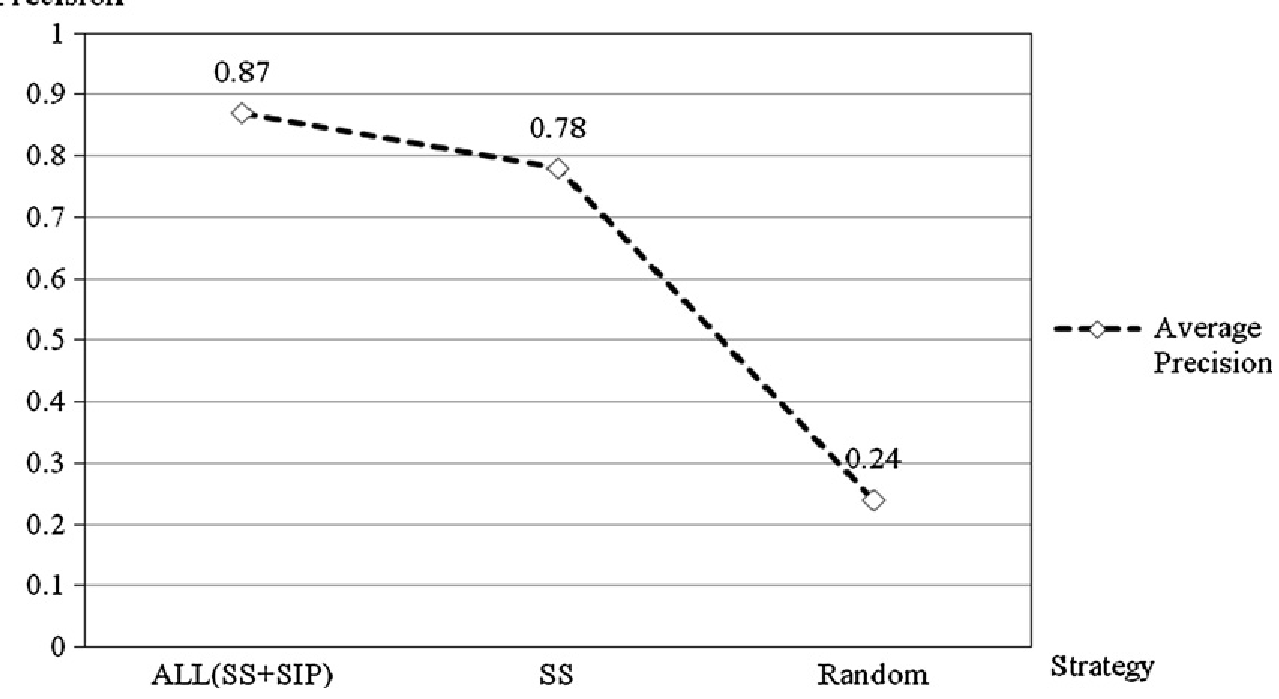 Figure 3: Average precision rates for thread recommendation across different strategies.
Critical Analysis & Future Outlook
While the Markov Chain approach is brilliant for navigating sparse networks, it does have limitations. The current model relies heavily on historical "reply" behavior. Future improvements could involve semantic-expansion (using ontologies to understand that "car" and "vehicle" are related) and dynamic weight updating based on real-time user feedback.
Takeaway: This paper is a masterclass in how to turn "static data" into a "living network." By mapping social intimacy onto mathematical transition probabilities, we can build communities that don't just store knowledge, but actively share it.