
IAC: Boosting Recommendation Accuracy through Item Asymmetric Correlation
A social recommender system using item asymmetric correlation
This paper introduces Item Asymmetric Correlation (IAC), a social recommender system framework that leverages implicit item relationships to mitigate data sparsity and cold start issues. By fusing an asymmetric item correlation matrix with standard Matrix Factorization (MF), the system achieves state-of-the-art accuracy on sparse datasets like Last.fm.
TL;DR
The paper "A social recommender system using item asymmetric correlation" introduces a method to solve the perennial "Data Sparsity" problem in recommendations. By moving beyond symmetric similarity (like Cosine similarity) and focusing on Asymmetric Correlation (IAC) between items, the authors show that we can significantly improve prediction accuracy—even when social network data (like friends or groups) is completely absent.
The "Friendship" Fallacy in Social Recommenders
Most social recommender systems operate on a simple intuition: "If User A is friends with User B, they probably like the same things." However, the authors argue this is often false. Friendships are frequently formed based on kinship, being classmates, or geographic proximity, rather than shared artistic or commercial tastes.
Furthermore, many platforms simply do not have social graphs. To bridge this gap, the authors look at Implicit Item Relationships. Instead of asking "Who is your friend?", the system asks "If people buy Item X, how likely are they to also buy Item Y, and is the reverse also true?"
Methodology: The Power of Asymmetry
The heart of the paper is the Item Asymmetric Correlation (IAC). Traditional metrics like Cosine Similarity are symmetric: . But real-world behavior is often one-way. For example, almost everyone who buys a niche "Expansion Pack" for a game also owns the "Base Game," but only a fraction of "Base Game" owners buy that specific "Expansion Pack."
1. The IAC Formula
The authors define IAC by combining standard Cosine Similarity with a cost metric based on the ratio of common users:

The formula captures how strongly Item X implies Item Y by looking at the overlap of their user sets, normalized by the total number of users who interacted with each.
2. Matrix Factorization Fusion
The calculated asymmetric similarities are then injected into a Matrix Factorization (MF) model as a regularization term. This forces the latent factors () of an item to be close to the weighted average of its correlated neighbors:
This ensures that even if an item has very few ratings (sparse data), its features are "informed" by the features of items it is closely related to.
Experimental Battleground: Last.fm
The authors tested their approach using data from Last.fm, a dataset notorious for its sparsity. They created four levels of sparsity—from 95.71% (Train-60) to 98.88% (Train-90).
SOTA Comparison
The proposed MF+IAC was compared against:
- Basic MF: No side information.
- MF+M: Fusing user membership/group data.
- MF+IAR: Fusing association rules (e.g., "if Bread and Butter, then Milk").
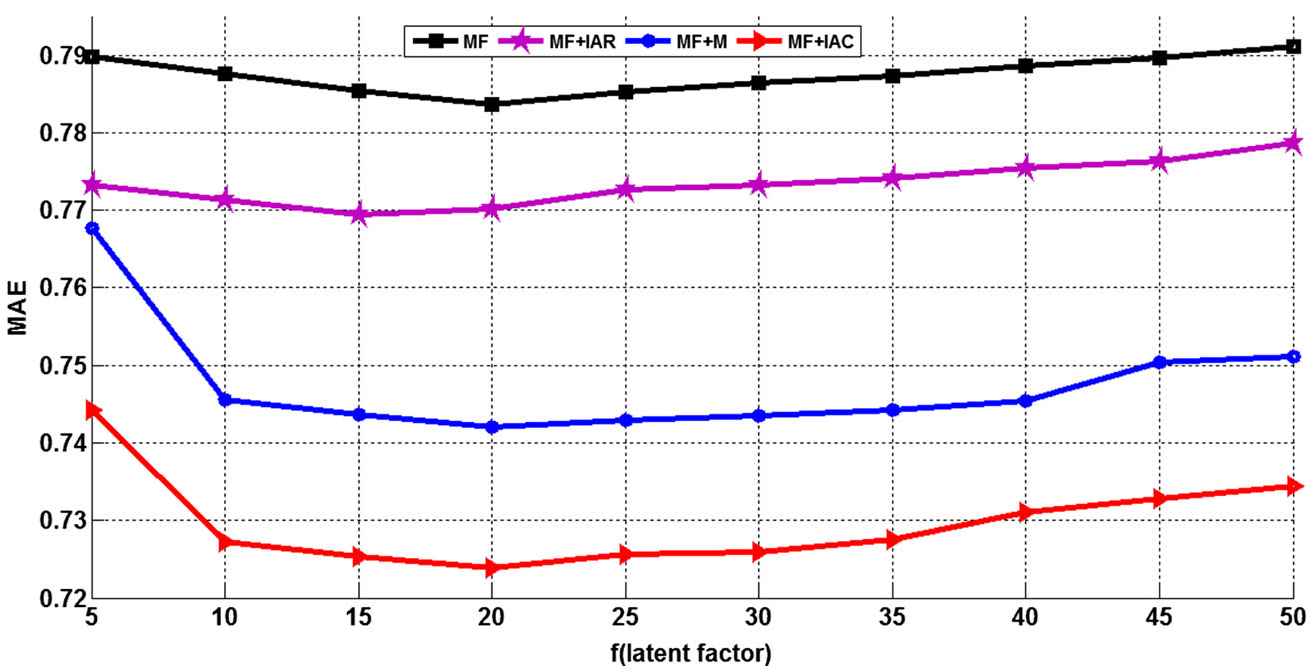
The results (measured in MAE and RMSE) consistently Showed that MF+IAC provided the lowest error. Crucially, the advantage of IAC became more pronounced as the data became sparser, proving its robustness in "Cold Start" scenarios.
Optimization Insight: SGD vs. ALS
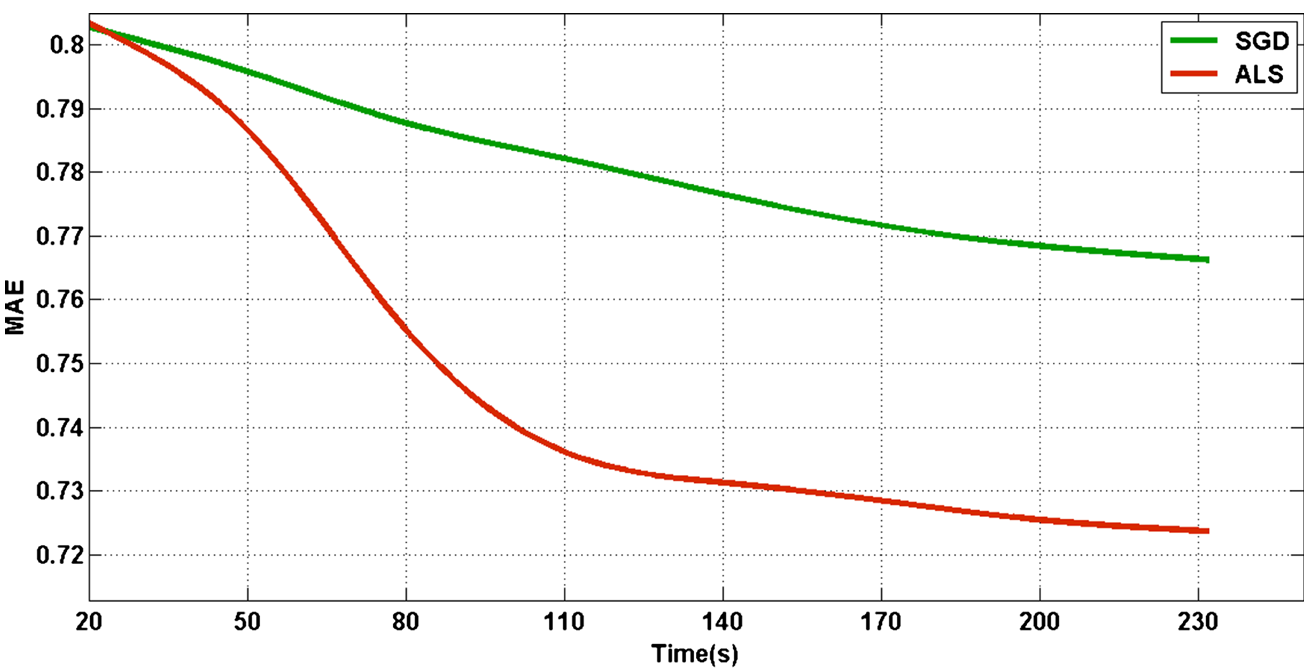
The study also compared two optimization solvers: Stochastic Gradient Descent (SGD) and Alternating Least Squares (ALS). While SGD is often easier to implement, the authors found that ALS converged much faster and achieved better accuracy in fewer iterations for this specific IAC-regularized objective.
Deep Insight & Conclusion
The true value of this work lies in its universality. By generating "social-like" constraints from the item interactions themselves, the authors provide a pathway for high-accuracy recommendations in privacy-conscious or social-lite environments.
Takeaway for Engineers: If your user-item matrix is sparse and you don't have a social graph, don't just settle for basic MF. Calculate the asymmetric relationships between your items. It effectively acts as an "Item-Side Inductive Bias" that guides the model toward more logical latent representations.
Limitations: The preprocessing complexity of IAC is , which might be intensive for catalogs with millions of items. Future work should look into parallelized graph-based approaches or localized correlation clusters to scale this insight to "Big Data" levels.