
Social Referral: Why the Messenger Matters More than the Algorithm
Social referral: leveraging network connections to deliver recommendations
This paper introduces "Social Referral," a novel recommendation delivery paradigm that uses a user's trusted social connections as the channel for content distribution. Implemented at LinkedIn, the system prompts active users to refer specific content to algorithmically selected peers, achieving a significantly higher acceptance rate compared to traditional direct delivery.
TL;DR
LinkedIn researchers have demonstrated that how a recommendation is delivered is just as critical as what is being recommended. By turning users into "referrers" who deliver system-generated suggestions to their friends, the Social Referral paradigm achieved a 22.5% acceptance rate—over 2.3x higher than standard direct system emails.
Context: Beyond Social Proof
Most recommender systems use social data to tweak their ranking algorithms or add a "Your friend liked this" label—a tactic known as Social Proof. While effective for relevance, it doesn't solve the "unsolicited noise" problem. Users are fatigued by system-generated notifications. This paper, published at RecSys '12, shifts the focus from social filtering to social delivery.
The Problem: The "Cold" Delivery Gap
The core friction in modern platforms is trust and attention.
- Direct Delivery: The system sends an email. It’s "cold," impersonal, and often ignored as spam.
- Manual Sharing: A user manually picks friends to share with. It’s high-effort and often inaccurate, as users might miss peers who would actually be interested.
The authors argue that the missing link is an automated system that assists humans in the referral process, acting as an "intelligent nudge."
Methodology: The Social Referral Architecture
The proposed system bridges the gap between Collaborative Filtering (CF) and Social Networks. When a user (the Referrer) joins a group, the system doesn't just say "thanks." It identifies potential Target Users in the referrer's network who:
- Have a high affinity for that specific group (Relevance Score ).
- Have a strong relationship with the Referrer (Connection Strength ).
Selection Strategy
The system uses three primary logic gates to decide what to promote:
- Better GRP: Prioritizing groups with high recent activity (quality).
- Stronger CONN: Prioritizing targets with the highest average connection strength.
- Hybrid (RQ): A combination of group quality and connection strength.
 Conceptual visualization of social ties acting as delivery channels.
Experiments & Results: The Power of Human Filtering
LinkedIn conducted a massive field study with 85,000 emails sent to referrers. The findings were revealing:
1. The Trust Correlation
The data showed a definitive trend: the closer the bond, the higher the engagement. Referrers were significantly more likely to click the "refer" button if they had a high connection strength with the suggested friend.
2. Doubling the Acceptance Rate
The "Social Referral" group saw a 22.5% join rate. In contrast, the control group—which received the exact same group recommendations but directly from the LinkedIn system—saw only 9.6%.
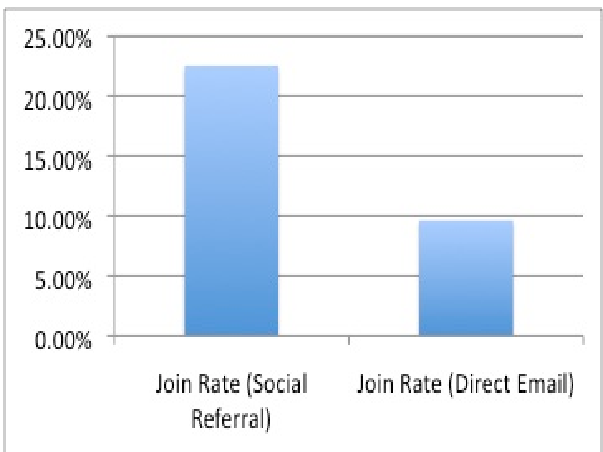 Figure 2: Social referral nearly triples the effectiveness of recommendation delivery compared to direct system outreach.
3. The Referrer’s Intuition (or Lack Thereof)
Interestingly, the researchers found that while referrers are great "delivery vehicles," they aren't necessarily better than the algorithm at picking who is interested. The distribution of relevance scores remained the same before and after referrer selection. This suggests that the system should handle the relevance filtering, while the human provides the trust layer.
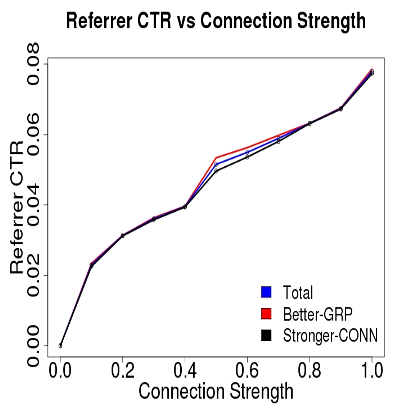 Figure 4: Higher connection strength (CS) and relevance score both contribute to the final conversion rate.
Critical Insight: Quality Over Quantity
One might argue that Social Referral is "inefficient" because it requires two people to say "yes" (the referrer and the target). Indeed, the overall viral conversion is lower (2.2%) than direct email reach (9.6%).
However, the authors point out a vital product lesson: User Experience Preservation. Direct emails annoy 90% of users. Social referrals, even if ignored, are viewed as "warm" suggestions from friends, significantly reducing platform fatigue and churn.
Conclusion
This paper serves as a fundamental blueprint for modern "growth hacking" and social commerce. It proves that in an era of algorithmic abundance, the most scarce and valuable commodity is peer-to-peer trust. By algorithmically assisting social referrals, platforms can drive high-quality growth without sacrificing user sentiment.
Future Outlook: While this study used email, the principles apply today to WhatsApp sharing, Slack integrations, and "share to story" prompts that dominate the current mobile ecosystem.