
Mining the Social Web: Social Relation Extraction from Chinese Wikipedia
Social Relation Extraction Based on Chinese Wikipedia Articles
This paper presents a social relation extraction system specifically designed for Chinese Wikipedia articles. By utilizing a semantic parser and POS-tagging-based "context codes," it extracts interpersonal relationships to construct dynamic social networks centered on specific individuals.
TL;DR
This study develops a system to extract social relationship networks from Chinese Wikipedia. By transforming Chinese sentences into Context Codes (sequences of Part-of-Speech tags), the system identifies and extracts interpersonal links with an impressive 82.2% extraction accuracy, enabling the automated construction of historical and contemporary social graphs.
The Challenge: From Unstructured Text to Social Graphs
Social networks are usually hidden within vast amounts of biographical text. While Wikipedia is a goldmine for this data, extracting it automatically is difficult because:
- Informal Structure: Unlike structured "Infoboxes," the most valuable "deep" information (family details, hidden alliances) is buried in prose.
- Linguistic Complexity: Chinese grammar requires specialized tools for word segmentation (like ICTCLAS) and POS tagging to make sense of relational descriptions.
- Scalability: Manually creating rules for every way a relationship can be described is impossible.
Methodology: The Power of Context Codes
The core innovation of this paper is the Context Code approach combined with an iterative extraction workflow.
1. Context Code Generation
The system doesn't just look for words; it looks for patterns. By stripping away specific words and leaving only POS tags (e.g., /nr for person names, /rel for relation words), the system creates a structural "fingerprint" of a sentence.
- Example: "Sanmao's sister Chen Tianxin" becomes
/nr /rel /nr.
2. Iterative Regex Refinement
Instead of hardcoding rules, the authors used an iterative feedback loop to generate Regular Expressions (Regex).
- Seed Expansion: Starting with basic words like "father" or "teacher," the system uses the Tongyici Cilin (a Chinese synonym lexicon) to expand the relationship vocabulary.
- Template Matching: The system proposes Regex templates based on the Context Codes and tests them against the corpus to evaluate their effectiveness.
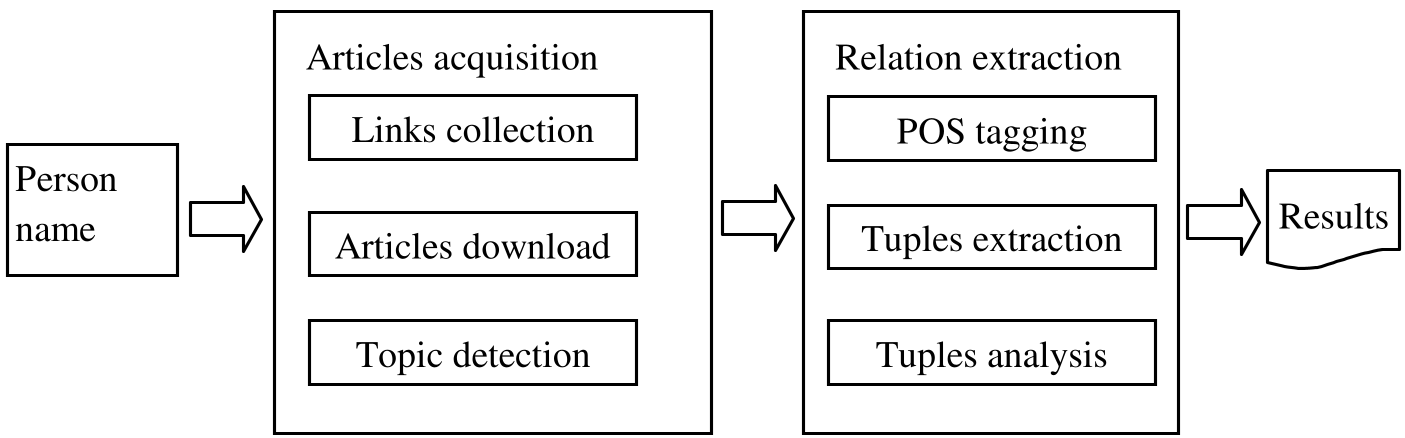 Figure 1: The overall workflow from Wikipedia collection to social relation extraction.
Experiments & Results
The researchers tested the system on a diverse set of over 700 figures, including historical icons like Cao Cao and modern figures like Chen Duxiu.
| Metric | Achievement |
|---|---|
| Relationship Recognition Accuracy | 100% |
| Extraction Accuracy | 82.2% |
| Sentence Localization Accuracy | 73.7% |
The study found that while the system is highly accurate at identifying that a relationship exists, it occasionally struggles with name recognition errors (mistaking titles for names) and co-reference resolution (knowing that "he" refers to the subject mentioned two sentences ago).
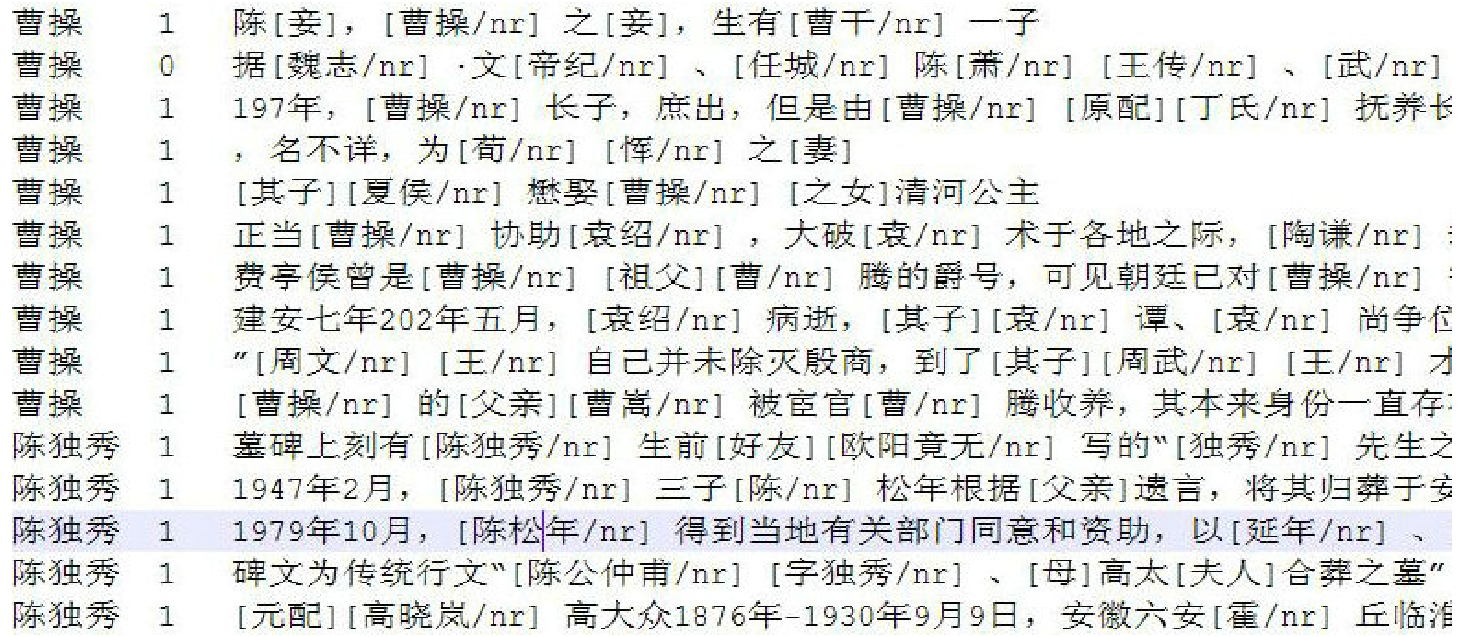 Figure 2: Sample extraction results showing the subject, relation validity, and the source text.
Critical Insights
The success of this method proves that for structured sources like Wikipedia, syntactic patterns are often more reliable than purely statistical models. Because biographical writing follows certain conventions, the "Context Code" serves as an effective bridge between raw text and semantic meaning.
However, the authors acknowledge a critical limitation: Visibility Bias. The system's effectiveness is tied to how much information is available on Wikipedia. For less famous individuals, the relationship network remains sparse.
Conclusion and Future Directions
This work provides a solid foundation for automated biography analysis. The next logical steps—already hinted at by the authors—include:
- Co-reference Resolution: Implementing logic to handle pronouns (he/she/they).
- Graph Visualization: Moving from tuples to interactive SVG/Canvas-based social maps.
- Improving Segmentation: Enhancing the underlying ICTCLAS integration to reduce name recognition errors.
As NLP moves toward LLMs, these pattern-based insights remain vital for verifying facts and anchoring generative models in structured reality.