
Social P2P Streaming: Leveraging Human Closeness for Better Bandwidth Allocation
Resource allocation algorithm based on social relation for video streaming services over P2P network
This paper introduces a social relation-aware resource allocation algorithm for SVC-based P2P video streaming. It leverages SNS data to build sociability and trust models, optimizing the trade-off between current video quality and long-term network reputation.
TL;DR
This research moves beyond the cold, mathematical "Tit-for-Tat" logic of traditional P2P networks by injecting social intelligence into resource allocation. By analyzing Social Networking Services (SNS), the algorithm prioritizes peers based on "Sociability" and "Trust," achieving a superior balance between high-quality video streaming (via SVC) and network fairness.
Background: The Failure of Anonymity
In a standard Peer-to-Peer (P2P) network, the Tit-for-Tat (TfT) policy is the gold standard for cooperation. However, TfT is myopic—it only cares about what you are giving me right now. This creates a massive loophole for "free-riders" who consume resources without contributing. In the context of high-bandwidth Video Streaming (SVC), where every bit counts, this lack of long-term trust leads to degraded video quality for honest users.
The Core Insight: Sociability and Trust
The authors argue that human society already has a built-in trust mechanism: we do more for our friends than for strangers. They translate this into an engineering framework through two interconnected models:
1. The Sociability Model
Based on SNS data (like Facebook), peers are grouped into clusters () based on their "degree of friendship."
- 1st Degree: Direct friends.
- 2nd Degree: Friends of friends.
- Sociability () is defined as a non-increasing function of distance: . Essentially, the closer the social tie, the higher the sociability value.
2. The Trust Model
Instead of a simple ratio, trust is updated using an Autoregressive-Moving Average (ARMA) model. The "Sociability" acts as a smoothing factor: trust with close friends remains stable even if they can't upload much temporarily, whereas trust with strangers fluctuates wildly based on their immediate performance.
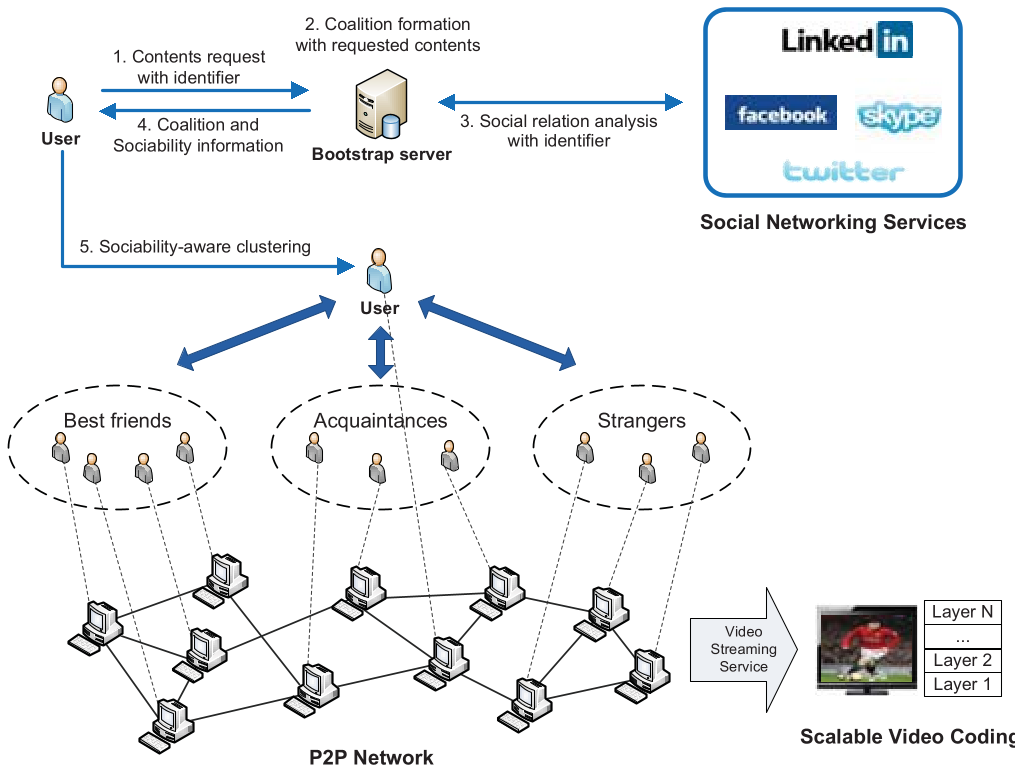 Figure 1: The proposed hybrid decentralized system architecture where a bootstrap server extracts SNS relations.
Technical Methodology: Managing the Trade-off
The paper utilizes Scalable Video Coding (SVC), which splits video into a base layer and multiple enhancement layers. The challenge is: How many layers should a peer request, and to whom should it upload?
The problem is formulated as a utility maximization: Where is the weighting factor between Video Quality (VQ) and Total Trust ().
To solve this efficiently, the authors employ a Branch and Bound algorithm with a state-space tree. This prevents the system from wasting computational cycles on sub-optimal resource allocation paths.
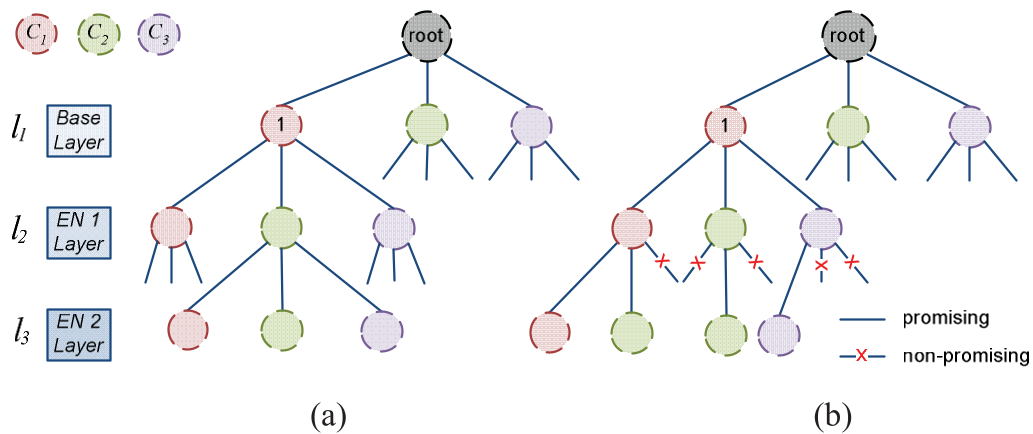 Figure 2: The state space tree used to determine the optimal layer-to-cluster mapping.
Experimental Validation
Using NS-2 simulations and real Facebook datasets (60k users), the authors proved:
- Trade-off Control: By increasing , users can get higher PSNR (video quality) but will see their "Total Trust" in the network decrease as they consume more than they contribute.
- Anti-Free-Riding: In a comparison with Bit-Torrent, the proposed algorithm successfully identified and throttled free-riders. While Tit-for-Tat allowed free-riders to achieve high download rates by exploiting the "initial interest" phase, the social model effectively excluded them based on their low sociability and trust scores.
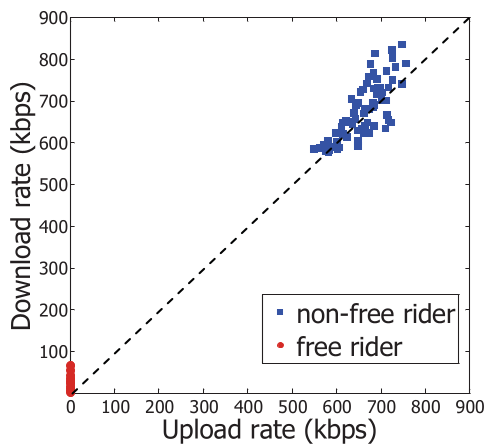 Figure 3: Comparative results showing that the proposed model (b) significantly discourages free-riders compared to Tit-for-Tat (a).
Critical Insight & Conclusion
The brilliance of this work lies in recognizing that P2P networks are social networks in disguise. By mathematically modeling "forgiveness" for friends and "strictness" for strangers, the system achieves a level of robustness that purely technical protocols lack.
Limitations: The reliance on a centralized Bootstrap server to extract SNS data introduces a potential single point of failure and privacy concerns (accessing friend lists). Future iterations might look into decentralized identity (DID) or Zero-Knowledge Proofs to verify "friendship" without exposing the entire social graph.
Takeaway: For future P2P architectures, the "who you know" is just as important as "what you have."