
SRCE: Bridging the Gap Between Human Sociality and IoT Service Discovery
Research on social relations cognitive model of mobile nodes in Internet of Things
The paper proposes a novel social relations cognitive model (SRCE) for mobile nodes in the Internet of Things (IoT) to facilitate trusted service discovery. It integrates location, interaction, service evaluation, and feedback factors, utilizing information entropy and rough set theory to dynamically assign weights to these decision factors. Experimental results using the MIT dataset demonstrate superior performance in network density and robustness compared to existing HGSM and AM models.
TL;DR
Researchers have developed a Social Relations Cognitive Model (SRCE) that transforms how mobile IoT devices interact. By treating humans not just as data carriers but as social entities with specific patterns, the model uses Rough Sets and Information Entropy to quantify trust and social ties. The result? A service discovery mechanism that is more robust, adaptive, and efficient than traditional mobile-aware models.
The Problem: The "Social Blindness" of Traditional IoT
Most early Internet of Things (IoT) frameworks operated on a simple premise: if Node A is within range of Node B, they can exchange data. However, in the real world, human mobility is not random—it is driven by social roles and intent. Furthermore, people are hesitant to provide services to strangers.
Prior works (like HGSM or AM) suffered from two major flaws:
- Single-Dimensionality: They relied solely on one factor (e.g., just GPS tracks or just call records).
- Subjective Weighting: They assigned importance to factors based on human "guesses" rather than the data's inherent volatility and value.
Methodology: The Core Mechanics of SRCE
The authors identify four "Decision Factors" (DF) that define the strength of a social tie:
- Location (L): Do we meet often and for how long?
- Interconnection (I): How frequently do we call or message each other?
- Service Evaluation (S): Does this node provide high-quality information?
- Feedback (F): Does my "friend of a friend" trust this node? (Transitivity).
Architecture & Weight Distribution
Instead of saying "Location is always 40% important," the model uses Information Entropy. If the data in one factor (like call logs) is highly varied and informative, the model automatically increases its weight. This is achieved through a Rough Set knowledge representation system that analyzes the resolution power of each attribute.
 The workflow from service request to trusted chain construction via decision factor quantification.
Experiments: Proving the Social Advantage
Using the famous MIT Reality Mining dataset, the authors compared SRCE against the Hierarchical Position Trajectory Model (HGSM) and the Affinity Model (AM).
Key Metrics:
- Network Overall Density (NOD): SRCE showed a much faster growth in relationships as nodes were added, proving it finds connections others miss by looking at multiple factors.
- Robustness: The Degree Center Potential (DCP) was lower in SRCE, meaning the network isn't dependent on just one or two "celebrity" nodes. It is decentralized and resilient.
- Dynamic Adaptability: When the network became "unstable and busy" (high node churn), SRCE's success rate dropped significantly less than its competitors.
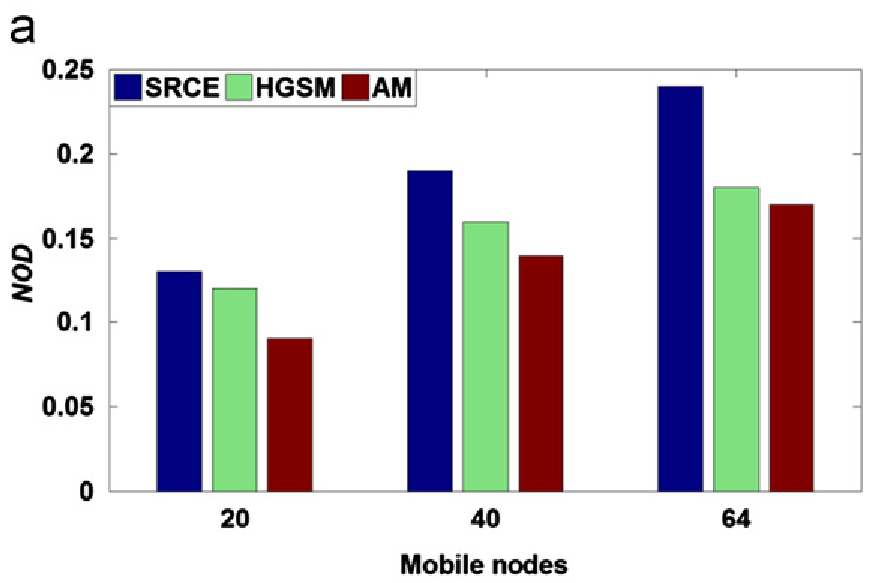 Comparison of Network Structure indicators (NOD, DCP, EI, BCP) showing SRCE's superior internal structure.
Deep Insights & Critical Analysis
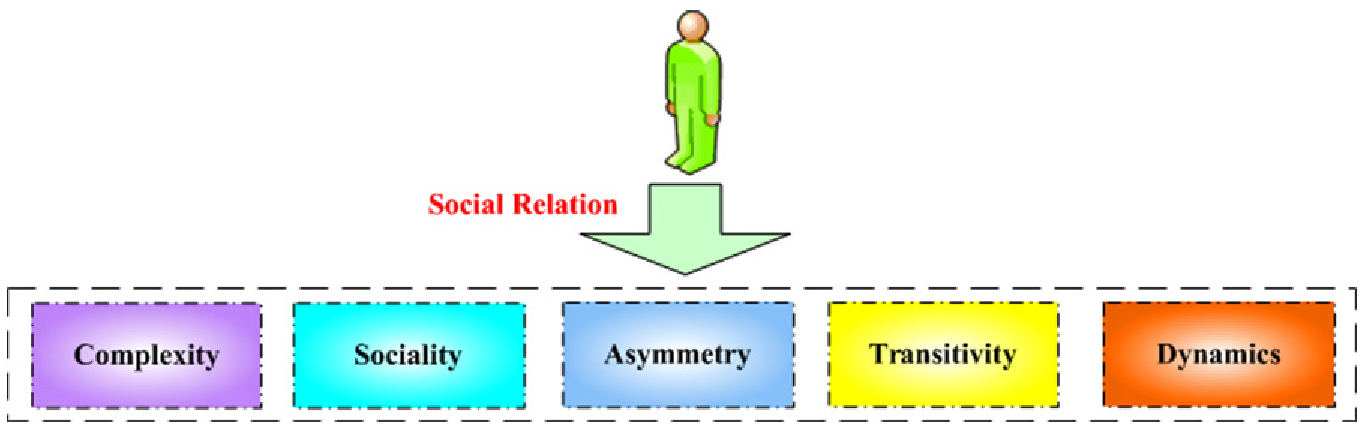
The brilliance of SRCE lies in its Asymmetry and Transitivity. In human society, trust isn't always a two-way street (Asymmetry), and we often trust people because of a mutual friend (Transitivity). By embedding these sociological truths into a mathematical model, the authors created a system that "thinks" like a human community.
Limitations: While the model is robust, it relies on centralized service centers for weight calculation. In a truly decentralized IoT (like Edge Computing), calculating Rough Set reductions might be computationally expensive for individual mobile devices.
Future Outlook
The move toward "Social IoT" (SIoT) is inevitable. This research provides a mathematical foundation for building Trust-as-a-Service. Future iterations might integrate this into Smart City architectures where your phone can autonomously find a trusted local "provider" for traffic data or environmental sensing without ever needing a central authority.
Takeaway for Practitioners: When building mobile networks, don't just optimize for signal—optimize for sociality. Use multi-factor entropy to let the data tell you what is important.