
The Autopsy of Friendster: Why Social Networks Collapse Despite Deep Connectivity
13674_Social resilience in online communities the autopsy of friendster.
This paper presents a quantitative "autopsy" of Friendster and a comparative study of five major OSNs to define and measure "social resilience." Using k-core decomposition and rational user models, the authors demonstrate how cascades of user departures are triggered when the cost-to-benefit ratio of membership becomes unfavorable, leading to community collapse.
TL;DR
Why do digital empires fall? This paper provides a forensic analysis of Friendster and four other OSNs to uncover the "physics" of social decline. By rejecting the popular "power-law" myth and applying k-core decomposition, researchers from ETH Zurich found that community collapse is a rational reaction to a shifting cost-to-benefit (c/b) ratio. Paradoxically, high topological resilience cannot save a network if the user experience cost becomes too high.
Background: The Archaeology of the Internet
The digital world moves so fast that a site from 2003 feels like an ancient civilization. When Friendster faced its demise in 2011, the Internet Archive preserved a snapshot—a treasure trove for "Internet Archaeologists." This paper treats this data as a post-mortem to answer a critical question: Is a network's survival encoded in its structure, or is it at the mercy of its environment?
Motivation: Moving Beyond Random Failures
Prior work often treated user departures like a "virus" or a random failure in a power-law network. However, the authors argue that users aren't just passive nodes; they are rational agents.
- The Rational Intuition: Users stay if the benefit (interactions with active friends) outweighs the cost (effort to use the site, privacy risks).
- The Ripple Effect: If one person leaves, their friends lose benefit. If their benefit drops below the cost, they leave too—triggering a departure cascade.
Methodology: The Power of the k-Core
To model these cascades, the authors look at the k-core of a network—a sub-network where every user has at least k friends.
Why k-core and not Degree?
A user might have 1,000 friends (high degree) but if those friends are all in the "fringe" of the network and leave quickly, that high-degree user is suddenly isolated. The coreness () of a user tells us how deep they are in the social structure.
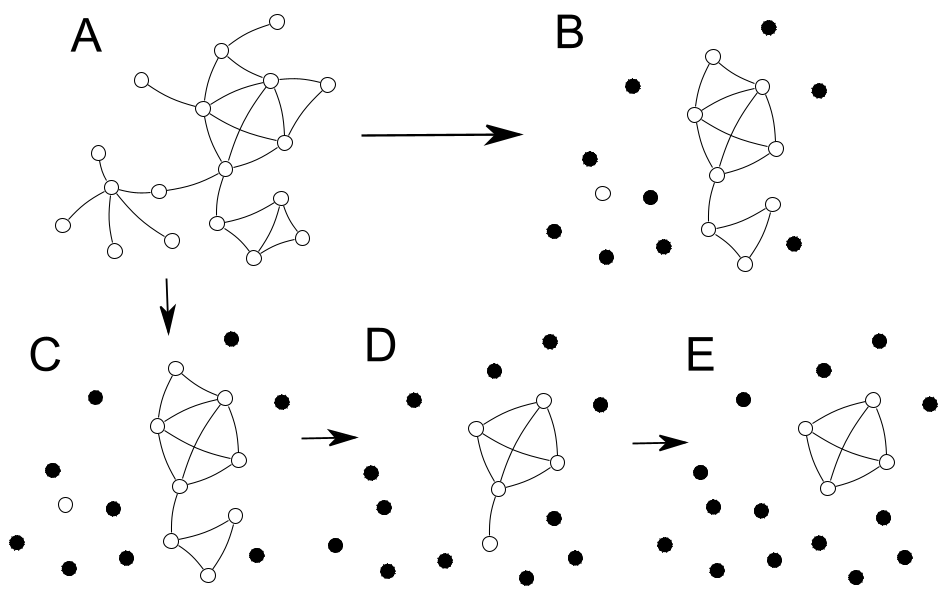 Figure 1: Traditional node removal (A→B) only shows direct effects. K-core decomposition (A→C→D→E) captures the full cascading impact of departures.
Key Findings: Debunking the Myths
1. The Power-Law is a Lie
For years, the "scale-free" nature of social networks was taken for granted. This study performs a rigorous Maximum Likelihood test and rejects the power-law hypothesis for nearly all major OSNs. Real human networks are more nuanced; they don't follow the "rich-get-richer" math as cleanly as we thought.
2. The Success Paradox
The researchers compared the Social Resilience (how much of the network remains as costs increase) of Facebook, LiveJournal, Orkut, and Friendster.
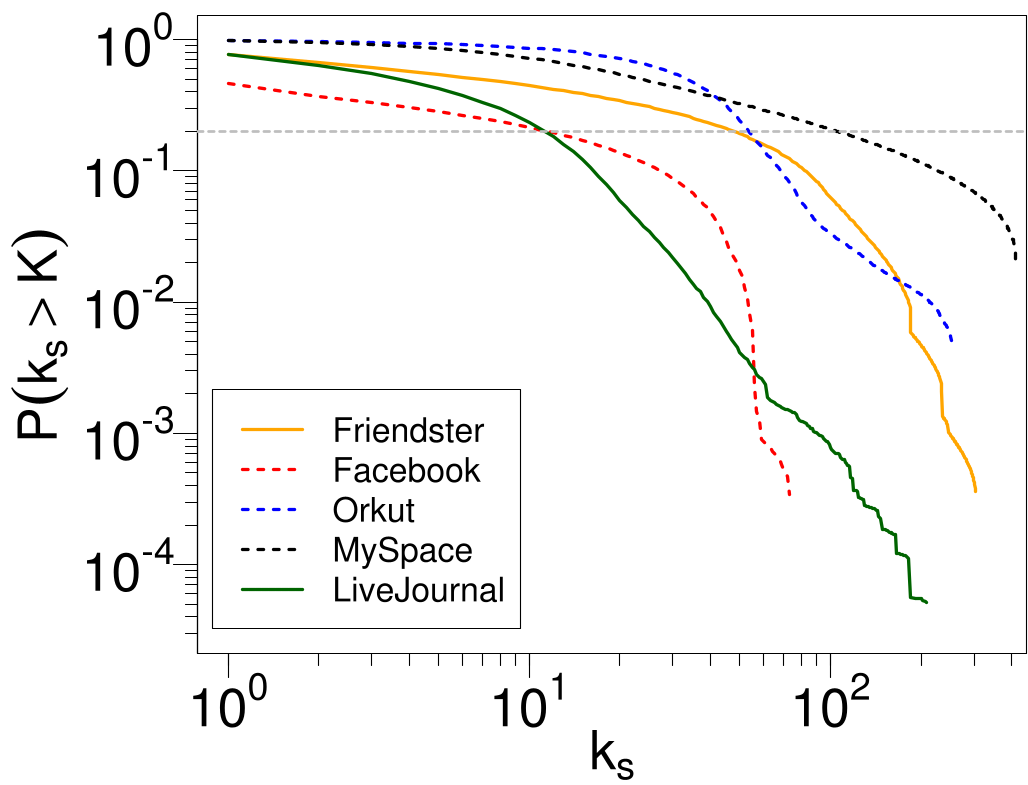 Figure 2: The CCDF of coreness. Interestingly, "unsuccessful" networks like Friendster and Orkut often had deeper, more resilient cores than the "successful" Facebook.
The Insight: Friendster was actually too well-connected in its core. Its failure wasn't due to poor topology; it was due to a massive spike in user "cost" (interface changes and competition) that was so high it cleared out even the most resilient cores.
The Case Study: Friendster’s Final Days
By tracking user IDs over time, the authors noticed a "precursor" to collapse: New users were joining only at the fringe.
- In early Friendster history, users joined the high-core center.
- By the end, new users had low coreness—they weren't becoming "embedded" in the community.
- When a UI change increased the "cost" of being on the site in 2009, the fringe users vanished, and the cascade ate its way to the center.
Conclusion and Future Outlook
The "Autopsy of Friendster" teaches us that community health is a function of both topology and utility.
- Takeaway for Product Managers: Resilience is a double-edged sword. A deep core can spread information efficiently, but if you alienate your core users through high "costs" (bad UI, privacy scandals), the same connectivity allows the collapse to spread just as fast.
- Limitations: The study assumes "constant costs" for all users. In reality, some users are more "expensive" to keep than others (e.g., influencers vs. lurkers).
Future research must dive into passive activity (viewing without posting) to truly understand the benefits that keep a digital society alive.