
SRBM: Deep Learning Meets Social Dynamics to Predict Human Health Behaviors
Social restricted Boltzmann Machine: Human behavior prediction in health social networks
The paper introduces the Social Restricted Boltzmann Machine (SRBM), a deep learning framework designed to predict human physical activity levels in health social networks. By extending the classical RBM with historical and social influence layers, the model achieves a high average prediction accuracy of 88.7% on real-world wellness data.
TL;DR
Human behavior—specifically physical activity—is contagious. However, modeling this "social contagion" alongside personal motivation is a massive technical challenge. This paper presents the Social Restricted Boltzmann Machine (SRBM), a deep learning model that fuses individual longitudinal features (like BMI and goal setting) with social influence metrics to predict whether a user will increase or decrease their exercise levels with nearly 89% accuracy.
Context: Why is Health Prediction Hard?
Predicting whether someone will hit the gym or stay on the couch isn't just about their past habits. It is a multi-causal problem involving:
- Self-Motivation: Internal drive reflected in goal-setting and biometrics.
- Implicit Influence: The "vibe" of the community or unobserved relationships.
- Explicit Influence: Direct pressure or inspiration from added "friends" in a social network.
- Environmental Events: Competitions or meetups organized by health providers.
Current State-of-the-Art (SOTA) models often struggle because they either treat individuals in isolation or use static social graphs. In the real world, social networks grow "from scratch," and their influence on us changes over time.
Methodology: The SRBM Architecture
The authors extend the standard Restricted Boltzmann Machine (RBM) into a more sophisticated three-layer structure:
- Visible Layer (): Represents current individual features (30 features including BMI, steps, and messages).
- Hidden Layer (): Captures high-level latent correlations between features and social forces.
- Historical Layer (): Acts as a memory bank, storing data from previous time steps to account for temporal dependencies (Auto-regressive influence).
The Secret Sauce: Statistical Explicit Social Influence
The most innovative part of the SRBM is how it calculates social pressure. Instead of simple friendship ties, it uses an Exponential Similarity Average based on a Cumulative Distribution Function (CDF). This accounts for how similar a user is to their neighbors in both visible behavior and hidden latent traits.
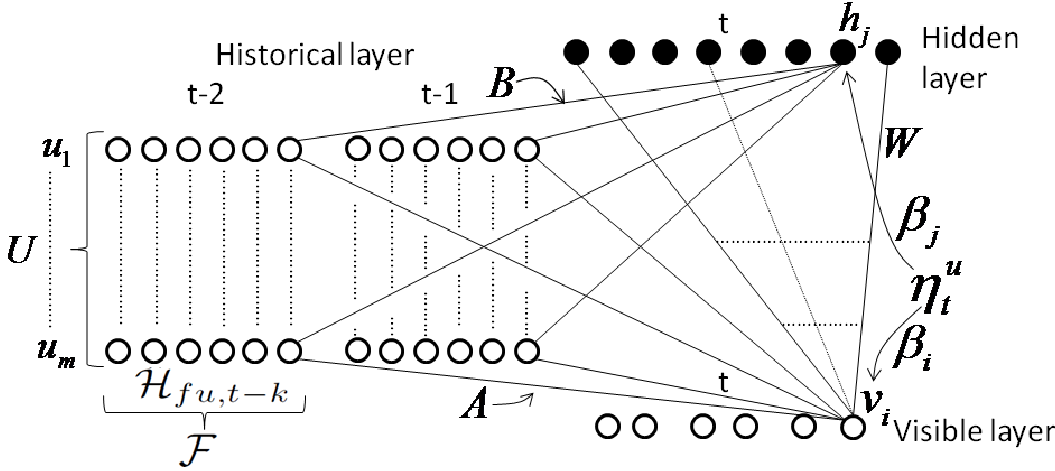
Figure 1: The SRBM architecture shows the bipartite connections between visible and hidden units, augmented by the historical layer and social influence biases.
Experiments and "The Win"
The model was tested on the YesiWell dataset, a unique 10-month study of 254 individuals using mobile trackers and medical tests.
Performance vs. Baselines
SRBM was compared against Gaussian Processes (SGP/PGP) and Logistical Autoregression (SLAR).
- Accuracy: SRBM achieved an average accuracy of 0.887, significantly higher than the competitors which often dipped during high-activity periods.
- Stability: As the social network grew (more friends added), SRBM's performance actually improved and stabilized, whereas other models struggled with the increasing complexity of the graph.
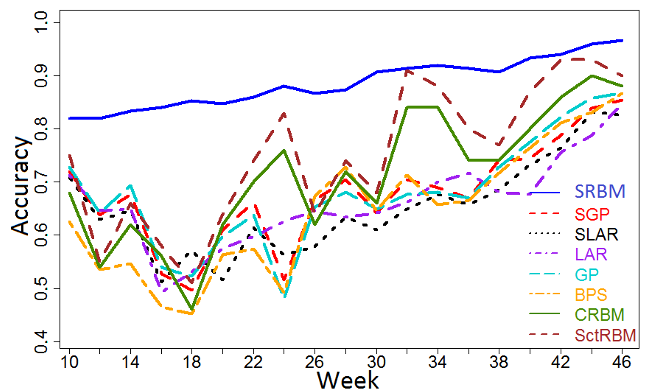
Figure 2: Performance validation shows that SRBM maintains high accuracy across 37 weeks compared to traditional socialized models.
Critical Analysis & Takeaways
The SRBM's success lies in its Integrative Bias. By treating social influence as a dynamic bias () that adjusts the activation energy of the neural network, the researchers successfully modeled the "fluidity" of human behavior.
Key Insights for the Field:
- Temporal Context Matters: The use of (time decay) and (smoothing) proved that recent behaviors have a exponentially higher predictive value than distant ones.
- Hidden Features are Essential: By calculating similarity in the latent space (hidden layer), the model found "behavioral twins" even when their raw step counts differed.
Limitations: The model is trained for each user independently. While this allows for high personalization, it may be computationally expensive to scale to millions of users without a distributed training framework.
Conclusion
The SRBM represents a major step forward in "Social AI" for healthcare. It moves beyond simple correlation to a generative understanding of how we influence each other. For health tech companies, this provides a blueprint for building "nudge" engines that know exactly when a user's motivation is flagging based on their social surroundings.