
Social Roles: Solving the "Fairness Trap" in Opportunistic Networking
Social roles for opportunistic forwarding
This paper introduces "HopRole," an opportunistic forwarding scheme that leverages social roles derived from "regular equivalence" to route messages in delay-tolerant networks. By identifying nodes with equivalent social functions rather than just central individual nodes, the method aims to improve both efficiency and energy fairness.
TL;DR
In the world of Opportunistic Networks (OppNets), we usually rely on "popular" nodes to carry the heavy lifting of message forwarding. But what happens when these popular nodes run out of battery? Greg Bigwood's research introduces HopRole, a scheme that uses Social Roles to find "equivalent" substitutes for busy nodes, ensuring the network stays alive longer without sacrificing message delivery performance.
The "Fairness Trap" in Social Routing
Most state-of-the-art opportunistic protocols (like BUBBLE Rap) are built on a simple intuition: give the message to someone more "central" or "popular" than you. While efficient, this creates a catastrophic bottleneck. A small percentage of nodes (the "social butterflies") end up doing 90% of the work. In a battery-constrained environment, these nodes die quickly, leading to network fragmentation.
The author's core insight is that social networks have roles, not just individuals. Just as any "Assistant Manager" in a company can pass instructions to "Employees," any node playing a specific social role can potentially replace another node in that same role for routing purposes.
Methodology: The Power of Regular Equivalence
To identify these replaceable nodes, the paper employs Regular Equivalence. Unlike "Structural Equivalence" (where nodes must share the exact same neighbors), Regular Equivalence groups nodes that have similar relations with other roles.
The HopRole Mechanism
- Role Partitioning: Nodes are initially partitioned based on metrics like Betweenness Centrality.
- Refinement: The Kanellakis-Smolka algorithm is used to refine these into stable "roles."
- Forwarding Logic: A node forwards a message if the encountered node's role is within x hops of the destination's role in the social hierarchy.
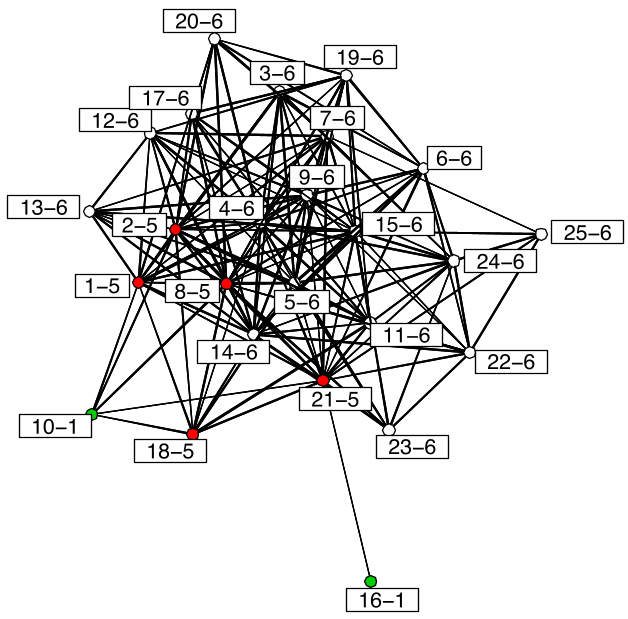 Figure 1: Visualization of role assignments from the SASSY dataset. Nodes are grouped into roles (e.g., Role 1, Role 5) based on their connectivity patterns.
Experimental Validation
Using the SASSY dataset (proximity traces of 25 individuals over 79 days), the author compared HopRole against the industry-standard Epidemic routing.
- Delivery Efficiency: HopRole (range 0) achieved nearly the same delivery success as Epidemic routing but with 75% less overhead (delivery cost).
- Fairness Potential: By identifying multiple nodes in Role 5 that can connect to Role 1, the protocol can distribute the energy burden across the entire "role" rather than a single node.
Critical Insight & Future Directions
The true value of this work lies in moving away from identity-based routing toward function-based routing. In dynamic human networks, knowing "who" someone is matters less than knowing "what kind of connections" they typically maintain.
Limitations: The current evaluation is on a relatively small trace (25 nodes). As the author notes in the "Future Work" section, defining a universal "fairness metric" for opportunistic networks remains an open challenge. Furthermore, the computational overhead of calculating regular equivalence on-the-fly in a distributed manner needs more exploration.
Conclusion
Social roles offer a sophisticated path toward sustainable opportunistic networks. By treating nodes as replaceable functional units rather than irreplaceable individuals, HopRole paves the way for networks that are not just fast, but fair.