
Social Semantics: Bridging Lexical Chains and Open Topic Models via Wikipedia
Social Semantics and Its Evaluation by Means of Semantic Relatedness and Open Topic Models
This paper introduces an approach for automated topic labeling and semantic relatedness measurement using "Open Topic Models" (OTM) derived from social ontologies like Wikipedia. The authors propose the Wiki Semantics Distance (WSD), a feature-frequency-based measure that utilizes both article and category concepts to align documents within a social network, achieving state-of-the-art performance in semantic relatedness and compound splitting.
TL;DR
This research presents a robust framework for Open Topic Modeling (OTM) and Semantic Relatedness by tapping into the "Social Semantics" of Wikipedia. By combining vector-based article representations with hierarchical category trails, the authors create a system that doesn't just cluster words, but aligns documents with evolving, human-defined taxonomies. The result is a highly accurate labeling system (up to 79% accuracy) and a word-relatedness measure that outperforms traditional Latent Semantic Analysis (LSA).
The Core Challenge: The Labeling Bottleneck
In traditional NLP, topic identification is often a choice between two evils:
- Static Categorization: Using a small, fixed set of labels that quickly becomes obsolete.
- Unsupervised Clustering: Grouping documents without providing meaningful, human-understandable names for those groups.
The authors argue that the "Social Ontology" of Wikipedia—which is constantly updated by thousands of volunteers—offers a third way. This "Open" model allows for categories to change over time, but the problem lies in Complexity and Alignment: how do we mathematically map a raw text fragment to the most relevant nodes in a massive, noisy graph of 55,000+ categories?
Methodology: From Lexical Chains to Taxonomic "Uphill Walks"
The proposed system architecture operates in three distinct phases:
1. The Wiki Feature Vector
The authors build two types of vectors. The first () maps words to article concepts using a TF-IDF scheme. The second () connects those article concepts to category concepts. This dual-layer approach allows the system to find relatedness even if two words never appear in the same article, provided they share "category trails."
2. Lexical Chaining for Dimensionality Reduction
To avoid processing every single word in a document (which is computationally expensive), the authors use Lexical Chaining. They represent the document as a graph where edges are weighted by semantic relatedness scores.
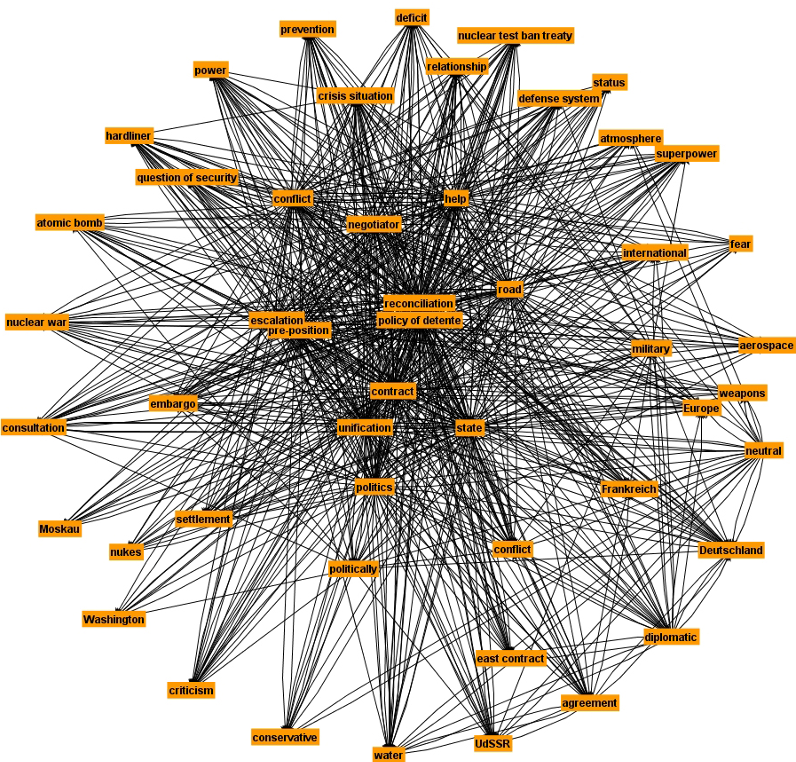 Figure: The process of decomposing a text into "lexeme clouds" to focus on the primary topic information.
3. Topic Generalization
Once the key lexemes are identified, the system performs an "uphill walk" in the Wikipedia category tree. Starting from specific articles, it traverses hypernym edges to reach broader categories (e.g., from "Dirk Nowitzki" to "Basketball Player" to "Sports").
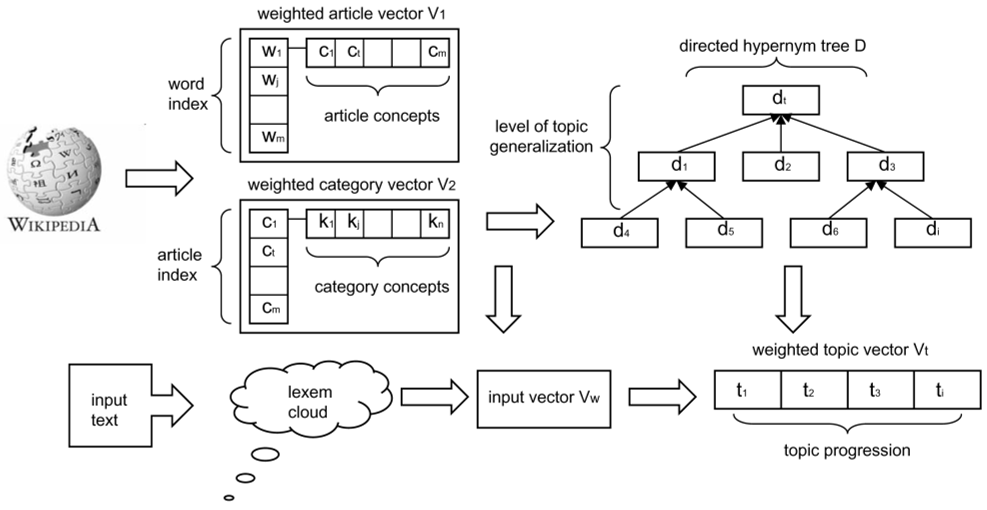 Figure: The system architecture illustrating the alignment between article concepts and the category taxonomy.
Performance and SOTA Comparison
The evaluation focused on two main areas: Semantic Relatedness (how well the model mimics human judgment of word pairs) and Topic Labeling.
- Semantic Relatedness: The proposed Wiki Semantics Distance (WSR) achieved a correlation of .77, significantly higher than Lexical Networks like WordNet (.48) or distributional models like LSA (.64).
- Topic Identification: In testing against the Meyer-Lexikon and Wikipedia datasets, the system successfully identified the correct top-level categories with high precision ( level accuracy reaching .73 for general topics).
 Table: Comparison of WSR against other state-of-the-art measures across different datasets.
Critical Analysis & Takeaways
The brilliance of this work lies in its use of Implicit Information. By utilizing category trails, the model handles "zero-co-occurrence" scenarios—where two words are related but never appear together in the same text—by finding their common ancestor in the social ontology.
Limitations: The authors acknowledge the risk of "over-generalization." If the "uphill walk" goes too far, a specific article about a "CD Burner" might be labeled as "Hardware" or "Informatics," which might be too broad for certain applications.
Future Outlook: This approach pre-dates the modern LLM era but provides a vital lesson for Retrieval-Augmented Generation (RAG). Using structured social ontologies can help anchor "hallucinating" AI models to verified, human-organized knowledge structures.