
Social Sensing: Transforming Twitter Feeds into Personalized Tourist Itineraries
Social Sensing for Improving the User Experience in Orienteering
The paper introduces a "Social Sensing" framework for customizing tourist itineraries in the Orienteering Problem (OP) with category constraints. It utilizes Latent Semantic Analysis (LSA) and Latent Dirichlet Allocation (LDA) to map user interests from Twitter posts and POI descriptions into a joint semantic space, achieving personalized route recommendations.
TL;DR
Researchers have developed a way to make tourist trip planning much more personal by "listening" to a user's Twitter profile. By combining social sensing (using LSA and LDA) with existing orienteering algorithms, the system can automatically boost the scores of museums, libraries, or landmarks that match a user's digital footprint. The result? Custom routes that are more satisfying than generic "shortest path" suggestions, achieved with high computational efficiency.
Context: Why Generic Routes Fail
The Orienteering Problem (OP) is a classic challenge in logistics and tourism: given a fixed time budget and a city full of attractions, which path maximizes your total "reward"? Historically, these rewards were fixed values—everyone was assumed to like the Eiffel Tower equally. However, a tech enthusiast and a history buff have fundamentally different ideas of a "perfect day."
Previous works like Bolzoni et al. (2017) handled the complexity of the route calculation using probabilistic methods, but they still relied on pre-assigned, static scores. The authors of this paper identify this lack of personalization as the primary bottleneck in user satisfaction.
The Core Methodology: Bridging Social Media and Physical Space
The authors propose a six-layer pipeline to bridge the virtual and physical worlds:
- OSN Crawler: Pulls recent tweets (using Twitter APIs).
- Topic Extraction: Pre-processes text (lemmatizing, removing URLs).
- Semantic Space Mapping: Projects both user interests and POI descriptions into a shared mathematical space.
- Similarity Matrix Building: Uses LSA/LDA to find the "distance" between what a user talks about and what a location offers.
- Integration: Re-injects these scores into the OP solver.
Architecture Overview
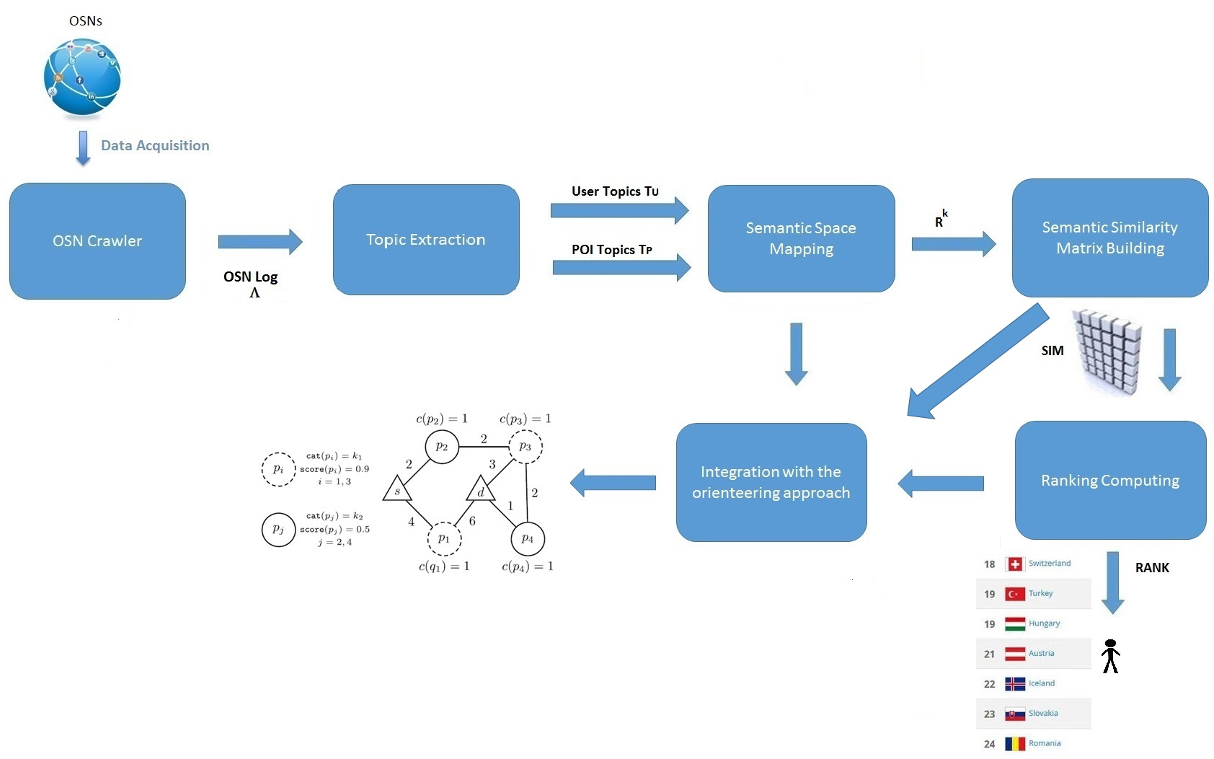
The brilliance lies in the Score Function Adjustment. Instead of a static reward, the reward for a POI becomes: This simple substitution allows the algorithm to prefer a niche library over a popular church if the user’s tweets are full of "physics" and "projects."
Experiments: Performance vs. Accuracy
The authors tested their system using the top-200 most-followed Twitter accounts (including figures like Elon Musk and Bill Gates) against POIs in the Bolzano region.
Accuracy Comparison
The study compared three semantic engines: LDA, LSA, and a spaCy baseline (using GloVe vectors).

Key Finding: While spaCy is a more "modern" NLP tool, LSA with 120 components actually outperformed it when looking at the top-11 POI rankings.
Efficiency: The Real Winner
In a mobile tourism context, battery and speed are king. The proposed LDA/LSA approach involves a significantly lower number of operations. While spaCy requires operations (which can reach over 114,000 for a single user), the proposed method reduces this to a mere (19 operations in the test set).
Case Study: Elon Musk in Bolzano
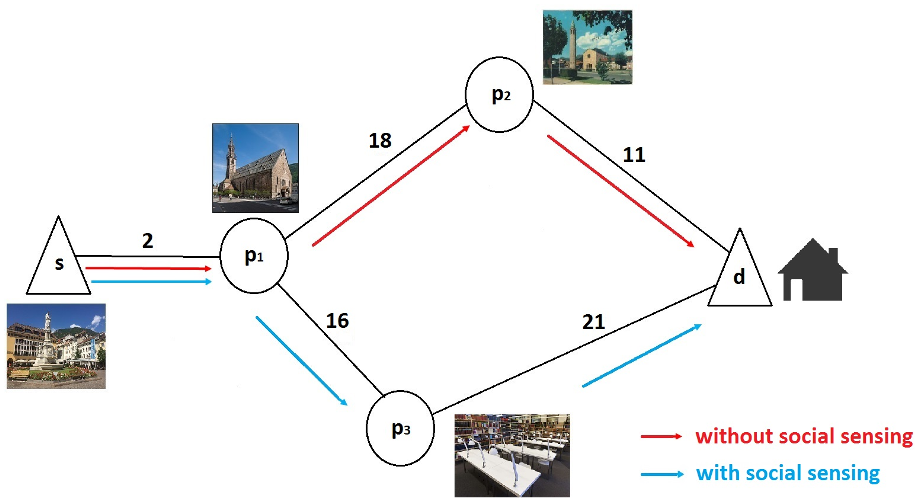 Without social sensing, the algorithm takes Musk on a standard path through local churches based solely on "centrality" (shortest detour). With social sensing, the system detects Musk's interest in "Tesla" and "physics," rerouting him to the Dr. Friedrich Tessmann Library—a detour that consumes more time but significantly increases personalized value.
Critical Insight & Future Outlook
This paper serves as a vital reminder that Domain-Specific Logic + Lightweight ML can often outperform Heavy General-Purpose NLP in specialized tasks. By using LSA/LDA as a "semantic filter," the authors successfully personalized an NP-hard optimization problem without making it computationally prohibitive.
Limitations: The system currently relies on English-only tweets and manual POI descriptions. Future work needs to automate POI data collection and handle the "cold start" problem for users without active social media profiles.
Takeaway: In the era of massive LLMs, there is still immense value in "traditional" topic modeling for real-time, personalized optimization.