
Profiling Agents by Simply Knowing How to Count: A Minimalist Approach to Social Sensing
Social Sensing With Minimal Resources: Profiling Agents by Simply Knowing How to Count
This paper introduces a nonparametric approach for profiling an ensemble of agents—estimating their conditional probability mass functions (PMFs)—using minimal computational resources. The proposed method utilizes a simple counting procedure and majority rule to estimate unknown states of nature and agent behaviors from historical action time series, achieving strong asymptotic consistency as the number of agents and tasks grow.
TL;DR
How do you profile the preferences of thousands of individuals (agents) when you don't know the external circumstances (states of nature) that influenced their past actions? This paper fundamentally proves that you don't need complex AI models or heavy iterative optimizations. By using a simple counting and majority-rule procedure, you can achieve mathematically consistent profiling that converges to the truth as your dataset grows.
Problem & Motivation: The "Blind" Profile Challenge
In markets, social networks, or sensor grids, we often see a history of actions: an investor buys a stock, a user "likes" a post, or a sensor reports a target. However, these actions are conditional. A "like" depends on both the user's personality and the global quality of the content (the "state of nature").
Usually, to separate the individual's profile from the global state, researchers use:
- Parametric Models: Assuming we know the "shape" of the user's behavior.
- Prior Knowledge: Assuming we know how often certain global events happen.
- High Computation: Using EM algorithms that iterate thousands of times.
The authors ask: What is the absolute minimum we need? They aim for a nonparametric solution requiring "minimal resources"—essentially just the ability to count.
Methodology: The Power of the "Type"
The core insight is that if we have enough agents, the "majority" will likely reflect the true state of nature (following the logic of Condorcet’s Jury Theorem). Once the state is estimated, we can group an agent's actions by that state and calculate their Type (empirical distribution).
The Two-Step counting Estimator:
- State Estimation: For every time step , count which action category the majority of agents chose. Label the state of nature as that majority category.
- Agent Profiling: For a specific agent , look at all the times the majority said the state was . Calculate the frequency of agent 's actions during those specific times.
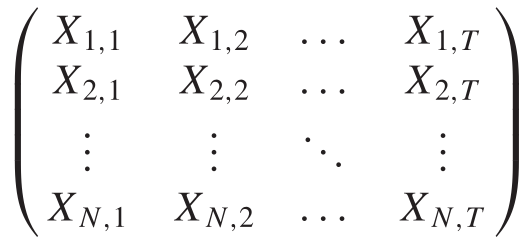 Figure 1: The data matrix where rows are agents and columns are tasks/time. The challenge is that the state of nature characterizing each column is unknown.
Theoretical Breakthroughs
The authors provide three major theorems:
- Theorem 1 (Large T): Shows that as the record length grows, the estimator converges to a deterministic value (though potentially biased if the number of agents is small).
- Theorem 2 (Large N): Shows that as the number of agents grows, the state estimation becomes perfect, and the agent profiling becomes an unbiased reflection of their true behavior history.
- Theorem 3 (The Anchor): Proves Strong Consistency. In the limit of both , the simple counting estimator is guaranteed to reach the true probability mass functions of the agents.
Experiments: Does Counting Actually Work?
The simulations validate the math. Even when agents are only slightly "correct" (e.g., a 40% chance to pick the right action in a 3-choice scenario), the error drops exponentially as more agents are added to the system.
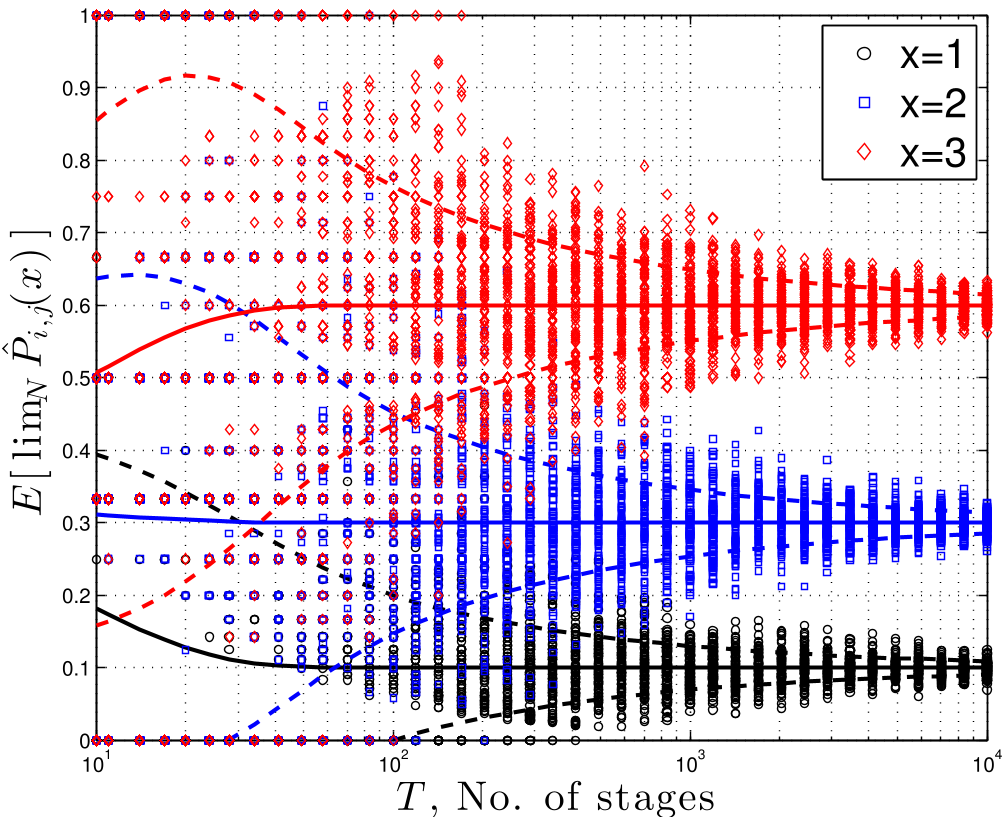 Figure 2: Performance (Error) vs. Number of Agents. Notice how quickly the error falls as increases, especially when the agents are "higher quality" (larger ).
Remarkably, the error follows a scaling law of . This suggests that doubling the number of observations reduces the error by a factor of about 1.41, a standard result in statistical power but impressive given the total lack of prior state information.
Critical Analysis & Conclusion
The "Minimum" Catch
The method relies on "Assumption A": all agents must have some preference for the "correct" action. If agents are systematically deceptive or entirely random, the counting logic collapses. However, in most social sensing contexts (where "correct" simply means the action aligned with the global trend), this assumption is mild.
Future Outlook
This work is a reality check for the "over-engineering" of social sensing. It shows that for large-scale platforms like X (Twitter) or financial tracking, we can build highly accurate profiles of thousands of users using simple counters rather than black-box neural networks. This has massive implications for privacy-preserving analytics and edge computing, where processing power is limited.
Final Takeaway: In the era of Big Data, sometimes the most robust solution isn't the most complex one—it's simply knowing how to count.