
Social Sensors: Reconstructing Public Safety via Real-Time Online Attention Computing
Social Sensors Based Online Attention Computing of Public Safety Events
This paper proposes an online attention computing framework for public safety events using social media users as "social sensors." By integrating a mobile crowdsensing crawler with a psychological distance-based analysis model, it achieves real-time monitoring and storytelling of events like the Tianjin Explosion on the Weibo platform.
TL;DR
In the wake of catastrophic events like the Tianjin Explosion, traditional physical monitoring falls short of capturing the "human pulse" of a crisis. This paper introduces a sophisticated framework that treats social media users as Social Sensors. By computing Online Attention based on psychological, spatial, and temporal distances, the authors provide a system that doesn't just track what is happening, but how the collective consciousness is reacting in real-time.
Problem & Motivation: Beyond Physical Sensors
When a public safety event occurs, we usually look to surveillance cameras or seismic sensors. However, these "hard" sensors are blind to human psychology—the panic, the spreading of information, and the risk awareness that drives social stability.
Existing social media tools like Twitter Trends or Weibo Hot Topics often suffer from two extremes:
- Data Sparsity: Early-stage events are buried under noise.
- Data Eruption: During an outbreak, massive redundancy (retweets/copy-pasting) overwhelms management systems.
The authors' insight is to bridge the gap between Physical Space (the event) and Cyber Space (the reaction) by quantifying the "Psychological Distance" of the crowd.
Methodology: The Social Sensor Framework
The core of the research lies in a three-stage pipeline designed to turn raw microblogging data into actionable intelligence.
1. Intelligent Crowdsensing Crawler
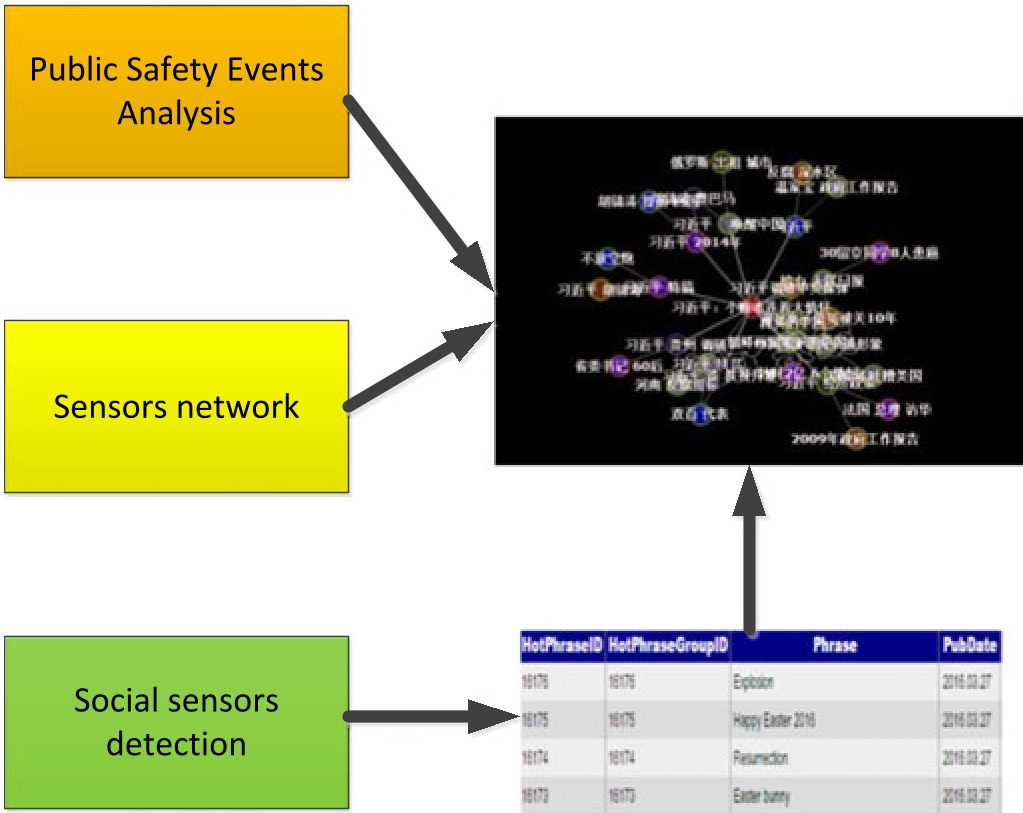
Unlike universal crawlers that indiscriminately download data, this system uses a "Social Sensor Network" approach.
- Sparse Data Handling: It uses semantic similarity to find "similar sensors" that might be reporting on an emerging, low-volume event.
- Redundancy Filtering: It prunes the sensor network by identifying highly similar posts in both content and geography to prevent system overload during "information eruptions."
2. Computing Psychological Distance
The paper posits that Online Attention is not random but governed by three dimensions of distance:
- Spatial Distance: The physical highway distance between the user’s registered location and the event.
- Temporal Distance: The travel time (via high-speed rail or plane) to the scene.
- Social Distance: The baseline interest a region has in another region's affairs under "normal" circumstances.
By applying Multiple Linear Regression, the researchers can predict the "Online Attention" (risk awareness expressed online) for any given region.
Experiments: The Tianjin Case Study
The effectiveness of the model was tested against the 2015 Tianjin Port Explosion.
Crawler Performance
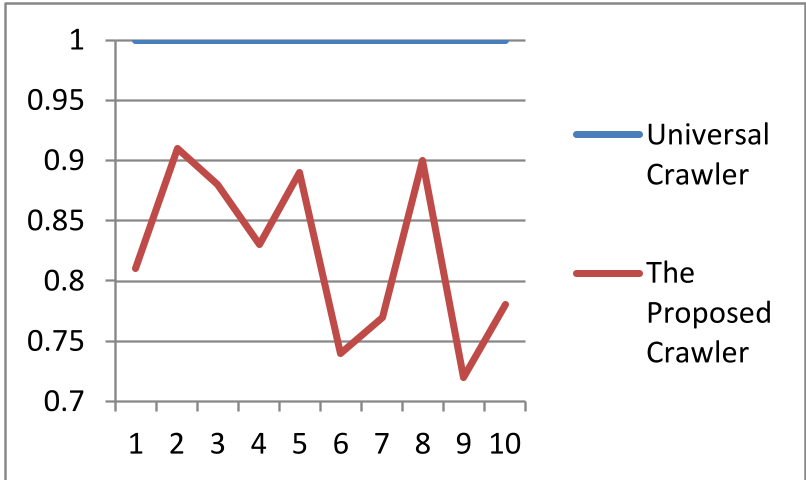
The proposed crawler demonstrated superior performance in Semantic Recall. While universal crawlers pull more raw data, the authors' method filtered out the "noise" of duplicates without losing the core narrative of the event.
Attention Mapping
The data revealed a clear correlation: cities like Beijing (spatially close) and those with strong social ties to Tianjin exhibited significantly higher online attention. Interestingly, "Social Distance" (baseline interest) often proved just as critical as physical distance in determining how much a local population would "panic" or engage with the event.

Critical Analysis & Conclusion
Takeaway
This work transforms social media from a mere "commentary board" into a distributed sensor system. It provides authorities with a tool to identify which regions are most psychologically impacted by a disaster, allowing for targeted information intervention and resource allocation.
Limitations & Future Work
The study relies on the "registered location" of users, which may not reflect their actual location at the moment of an event (e.g., travelers). Future iterations could leverage real-time GPS data. Furthermore, as AI evolves, the "social sensing" could be enhanced by LLM-driven emotion analysis to distinguish between "concern," "fear," and "misinformation."
By quantifying the invisible threads of psychological distance, this research paves the way for a more empathetic and efficient approach to public safety management.