
Social Similarity: The Hidden Engine of Network Cooperation
Social Similarity Favors Cooperation: The Distributed Content Replication Case
The paper investigates how social similarity within networking groups influences content placement strategies, comparing Selfish, Self-aware Cooperative, and Optimally Altruistic schemes. It introduces a "Tightness" metric based on Kullback-Leibler divergence to quantify interest similarity, showing that high tightness makes altruism a win-win for both groups and individuals.
TL;DR
Is being "nice" in a network always a losing game for the individual? Not if you’re among friends—or at least, people with similar tastes. This paper explores the relationship between Social Similarity and Cooperation in content replication. It introduces a Tightness metric and proves that in highly similar groups, altruism isn't just good for the group; it's the best move for every single node.
The Dilemma: Selfishness vs. Altruism
In distributed systems like P2P or mobile opportunistic networks, nodes have limited storage. A Selfish node fills its cache with its own favorite items. This is simple but leads to massive redundancy—everyone stores the same popular files, leaving no room for the "long tail" of content.
Conversely, an Optimally Altruistic strategy maximizes the global good by specialized storage. However, this often leads to mistreatment: Node A might be forced to store content it doesn't want just to help Node B, actually increasing Node A's individual access cost.
Methodology: Measuring "Tightness"
The authors define Tightness () as the inverse of the average symmetrized Kullback-Leibler (K-L) divergence between the preference distributions of all node pairs in a group.
- High Tightness: Everyone wants the same thing.
- Low Tightness: Diverse, scattered interests.
They analyze three strategies:
- Selfish: Store what you like most.
- Self-aware Cooperative: Start selfish, then sequentially adjust to store non-replicated items (ensuring no node is worse off than being selfish).
- Optimally Altruistic: Solve an ILP (Integer Linear Program) to minimize total group cost.
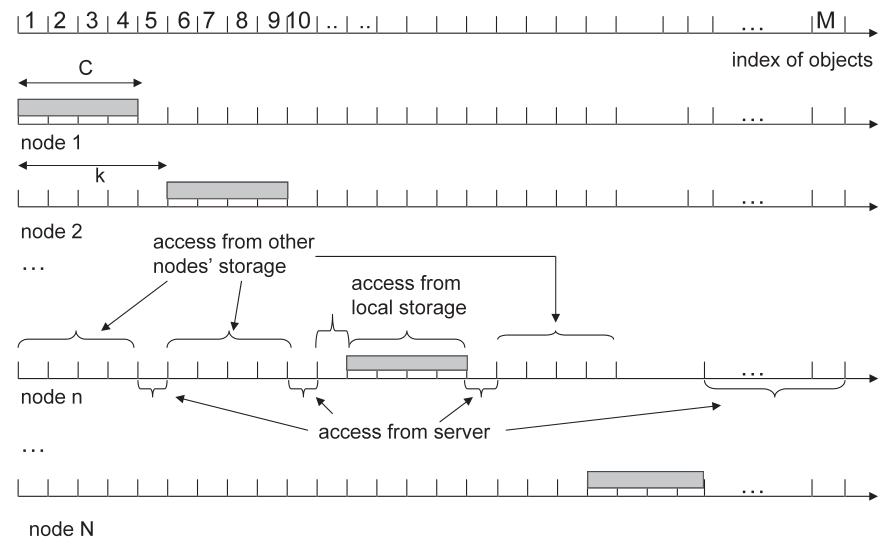 The figure illustrates the overlap and differentiation in content storage based on preference shifts ().
Key Insights: When Does Cooperation Pay Off?
The study reveals a fascinating socio-technical bridge.
1. The Win-Win of Tight Groups
When a group is "tight" (high ), the Optimally Altruistic strategy becomes the best choice for everyone. Because preferences are so similar, any object stored by any node is likely useful to others. The "mistreatment" risk vanishes because the group's interests are perfectly aligned.
2. The Simple Selfishness of Diverse Groups
As Tightness drops, the incentive to cooperate evaporates. If interests are diverse, what I store is useless to you. In these scenarios, the complex coordination required for cooperation or altruism yields marginal gains. The authors suggest that for low-tightness groups, the Selfish strategy is the rational choice due to its zero-overhead nature.
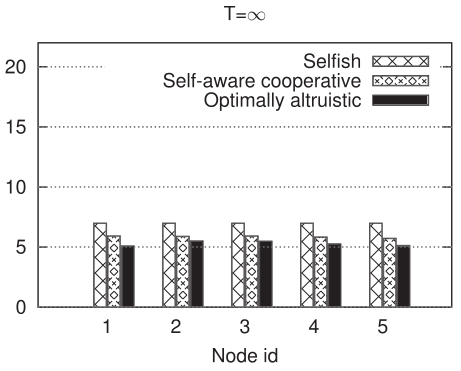 Cost Comparison: As Tightness () increases, the gap between Selfish and Altruistic strategies widens, proving the massive potential gains of cooperation in similar groups.
Real-World Validation: The Delicious Dataset
The authors tested these theories using traces from Delicious.com, a social bookmarking site. They found that:
- Random "follower" groups actually had low tightness (), showing that social links don't always mean shared interests.
- Groups formed around specific popular tags had higher tightness, confirming that interest-based grouping is a much stronger catalyst for cooperative caching than simple social adjacency.
Conclusion and Takeaways
The core takeaway is that Similarity Favors Cooperation.
- For Architects: Don't enforce complex cooperative protocols across a whole network. Instead, use similarity metrics to identify "tight" clusters where cooperation will naturally thrive.
- For Theory: This alignment between K-L divergence and game-theoretic stability provides a robust mathematical framework for understanding human-centric networking.
Limitations: The model assumes fixed costs for internal () and external () access. Future work could explore dynamic costs based on network congestion or node battery levels.