
Beyond Real Estate: Ranking People by Social and Spatial Proximity
Search by Social and Spatial Proximity
The paper introduces the Social and Spatial Ranking Query (SSRQ), a multi-objective search task that ranks social network users based on a weighted combination of Euclidean distance and shortest-path social distance. The authors propose an advanced Aggregate Index Search (AIS) algorithm that integrates social landmark summaries into a spatial partitioning structure, achieving superior scalability and performance over baseline heuristic approaches.
TL;DR
When looking for a lunch companion, location is vital, but so is your social connection. This paper formalizes the Social and Spatial Ranking Query (SSRQ), which finds the top-k users by balancing "how far they are" with "how well you know them." The breakthrough lies in the AIS algorithm, a unified indexing strategy that prunes search spaces significantly faster than traditional sequential search methods.
Contextual Positioning
In the landscape of Location-Based Social Networks (LBSNs), this work serves as a bridge between spatial databases (R-trees, k-NN) and graph theory (Shortest Paths). It moves past simple binary filters (e.g., "Find friends within 5km") to a continuous optimization problem that reflects true human preference.
The Problem: The "Proximity Paradox"
Existing systems usually prioritize one domain over the other. If you search for "nearby users," you get strangers who happen to be in the same building (Spatial First). If you search for "close friends," you might find someone across the ocean (Social First). Combining these leads to a massive search space: calculating the shortest path in a social graph is computationally expensive, and doing it for every user in a spatial radius doesn't scale.
The authors identify that the main bottleneck is the lack of mutual awareness between social and spatial indexes.
Methodology: The Aggregate Index Search (AIS)
The core innovation is the Aggregate Index Search (AIS). Instead of treating the social graph and the spatial coordinates as two separate entities, the authors "embed" social information into a spatial index.
1. The Joint Ranking Function
The ranking is determined by a linear combination: Where is the social distance and is the spatial distance.
2. AIS Architecture
The algorithm utilizes Landmarks—pre-calculated social distances to anchor nodes.
- Spatial Partitioning: The space is divided into a tree structure.
- Social Summary: Each node in the spatial tree stores a "summary" of the landmark vectors of all users within its boundaries.
- Branch-and-Bound: During a search, the algorithm calculates a lower bound for a node. If the best possible joint distance in a node is still worse than the current top-k results, the entire branch (thousands of users) is pruned immediately.

Experiments & Results
The authors tested their algorithms on the Gowalla (196K users) and Foursquare (1.88M users) datasets.
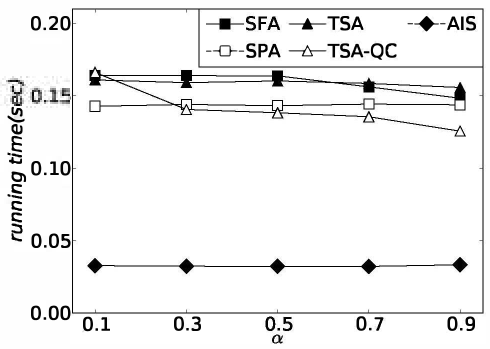
- Robustness: Unlike the Social-First (SFA) or Spatial-First (SPA) approaches, which fail when the user changes their preference (alpha value), AIS remains consistently fast.
- Scalability: AIS demonstrates a clear lead in processing time across all test cases.
Critical Insight & Conclusion
The elegance of this paper lies in the Pruning Power. By augmenting spatial nodes with social summaries, the AIS algorithm effectively "sees" the social landscape through a spatial lens.
Takeaway: For any multi-domain search problem (e.g., matching drivers to riders, or products to shoppers), performance is gained by aggregating domain-specific metadata into a unified hierarchical structure rather than trying to join results after the fact.
Limitations: The model assumes a static social graph. In highly dynamic environments where friendships change by the minute, the cost of updating the landmark-augmented index could be significant. Future work might explore dynamic landmark updates or embedding-based approximations (like Node2Vec) for even faster distance estimation.