
Social Stream: Bridging the Gap Between Graph Theory and Data Streams
Social Stream Data: Formalism, Properties and Queries
The paper introduces a formal data model for "Social Streams," defined as data streams recording entities and their evolving inter-relationships created by various producers. It establishes a mathematical framework using partial orders and provides a set of core operators (Merge, Join, Filter, Project, Aggregation) for querying complex graph-stream hybrids.
TL;DR
Social media behavior is more than just a sequence of posts; it's a living, growing graph. This paper provides the first formal mathematical definition of a "Social Stream," distinguishing it from flat streams and static graphs. By modeling social data as a series of linked items created by producers, the authors define core query operators—like "Project" for lineage tracking—and reveal through 700M+ data points that social streams are defined by extreme skewness and temporal locality.
Problem & Motivation: The Identity Crisis of Social Data
In the world of big data, "Social Stream" has long been a buzzword used loosely to describe anything from a Twitter feed to a list of emails. However, from a database perspective, these datasets are orphans of two worlds:
- Graph Theory: Studies the structure (nodes/edges) but often treats time as a mere label, ignoring the "always-on" arrival of news items.
- Stream Processing: Handles high-velocity data but typically assumes a flat structure (like sensor logs), failing to account for how one tweet replies to another.
The authors argue that without a formal model, we cannot build efficient query engines to handle real-life scenarios like "find all descendants of a viral tweet within the last 5 minutes."
Methodology: The Formalism of the Social Item
The paper defines a Social Item as a 5-tuple: identifer, timestamp, producer, linkage set, and content.
The Linkship Network
The most critical insight is the Linkship Network. Unlike a followship network (which is about people), the Linkship Network is about the items themselves.
- Single-link streams: A retweet only points to one original tweet (Tree structure).
- Multi-link streams: A patent cites multiple older patents (DAG structure).
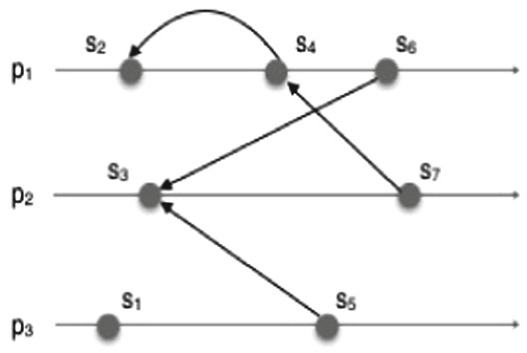
The authors prove via reductio ad absurdum that because of temporal partial order (), a social stream can never contain a cycle. It is, by definition, a set of growing Directed Acyclic Graphs (DAGs).
Query Operators
The paper moves beyond standard SQL-like operations to define "Social-Native" operators:
- Filter: Adds specific Structural Constraints (e.g., "select only root items").
- Project: This is not just column selection. In social streams, Project expands the stream to include all ancestors or descendants of an item, enabling complex impact analysis.
Experiments: Real-World Skewness
The researchers analyzed three massive datasets: Sina Weibo, US Patents, and the CALO Email set.
The Power-Law Dominance
Across all datasets, property after property followed a Power-Law distribution ().
- In-degree: A few "celebrity" items are cited millions of times, while most are ignored.
- Inter-item time: Users don't post at a steady rhythm; they post in bursts (high temporal locality).
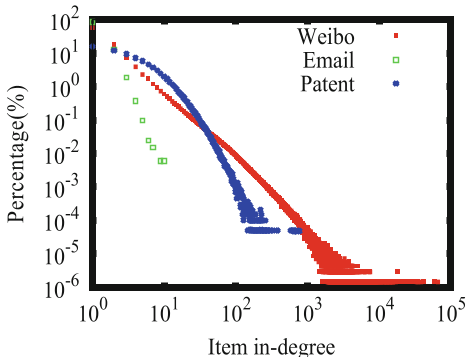
The "Celebrity" Bottleneck
The experiments highlight why social stream queries are hard. Because the Connected Component Size (CCS) follows a power law, a "Project" operator triggered on a viral item will suddenly demand massive CPU and memory resources to traverse thousands of links, which can cause system-wide latency spikes.
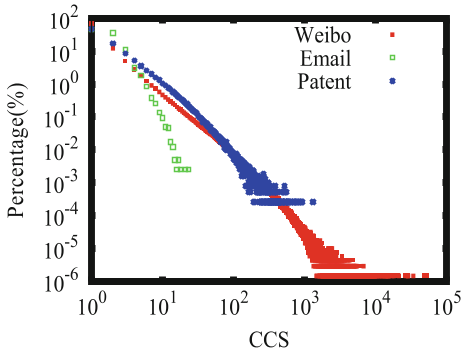
Critical Analysis & Conclusion
Takeaway
This paper succeeds in providing a rigorous foundation for social stream analytics. It moves the conversation from "how to store tweets" to "how to query evolving graphs." The identification of temporal locality and skewness as the primary enemies of query performance is a crucial guiding light for system architects.
Limitations & Future Work
While the formal model is robust, the paper remains primarily theoretical and exploratory. It does not provide a specific indexing algorithm to solve the "celebrity item" bottleneck it identifies. The logical next step for the community is to build Social-Aware Distributed Partitions that can predict these bursts of activity and spread the load before the system crashes.
As we move toward 2026 and beyond, where real-time social analytics drive everything from financial markets to emergency responses, this formal understanding of the Linkship Network will be the bedrock of high-performance social databases.