
The Architecture of Lies: Decoding Deceptive Behavior through Social Networks
Social structural behavior of deception in computer-mediated communication
This study investigates the structural behaviors of deception in computer-mediated communication (CMC) using Social Network Analysis (SNA). By analyzing interaction data from a gaming platform, the authors identify key social structural metrics—specifically centrality, cohesion, and similarity—that significantly distinguish deceivers from truth-tellers.
TL;DR
Online deception isn't just about what you say, but whom you talk to and how you position yourself in a group. This research reveals that deceivers in computer-mediated communication (CMC) strategically manipulate their social network position—acting as high-influence brokers with tight alliances—to balance the dual goals of persuading victims and avoiding detection.
Background: Beyond Verbal Cues
For decades, lie detection research has obsessed over "leakage" in words or body language. However, in our digital age, communication is often text-based and involves multiple people simultaneously. This paper shifts the focus from the individual to the social structure, arguing that deceptive intent fundamentally warps the way a person embeds themselves within a digital network.
Problem & Motivation: The Deceiver's Dilemma
Deceivers face a unique conflict defined by two competing strategies:
- Persuasive Strategy: They must be influential and central enough to spread their agenda and gain trust.
- Protective Strategy: They must be distant or ambiguous enough to avoid being caught in inconsistencies.
Prior work has struggled to quantify how these conflicting motivations manifest when a deceiver interacts with multiple receivers.
Methodology: Mapping the Network of Deceit
The researchers used a unique dataset from a "Mafia" game website. In this environment, roles (Deceiver vs. Truth-teller) are clearly defined, and the interaction is entirely text-based.
1. Constructing the Network
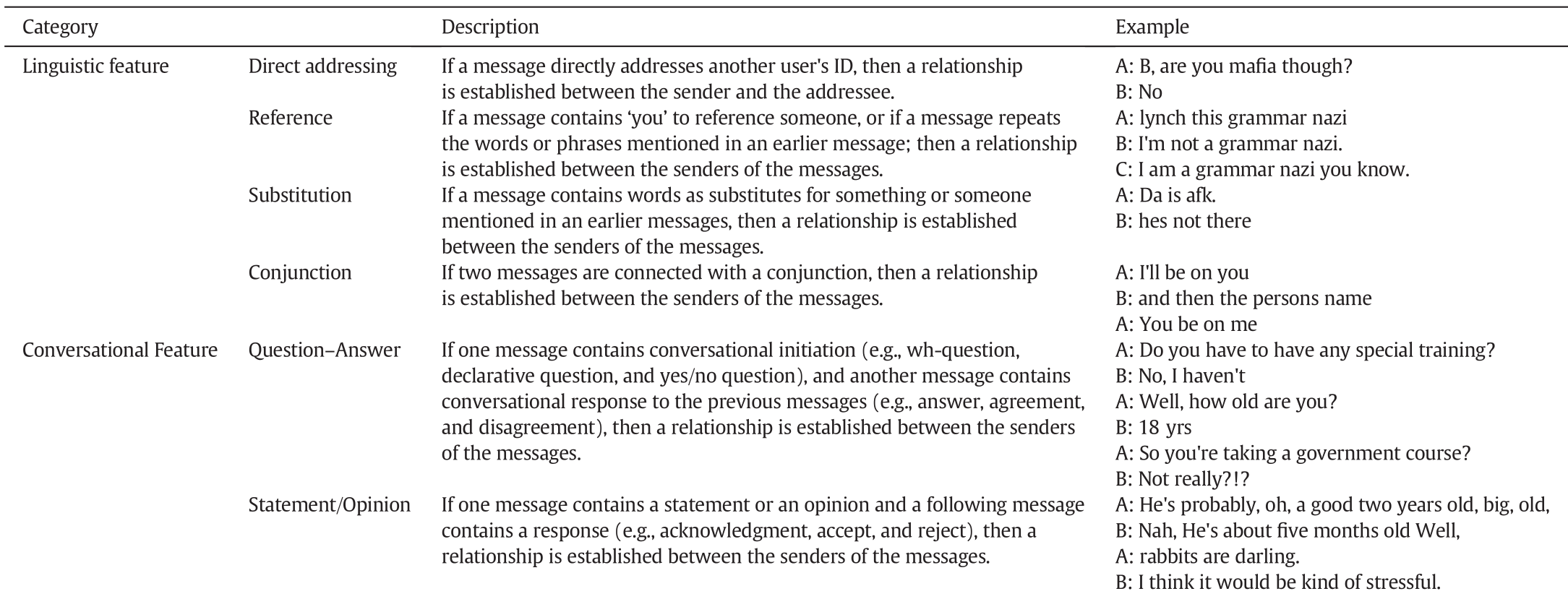
To turn a chat log into a mathematical graph, the authors developed "Interactional Coherence" rules. They didn't just look at who spoke after whom; they used linguistic markers (direct addressing, substitution, lexical cohesion) to map real relationships.
2. The Structural Metrics
The core of the model is based on three pillars:
- Centrality: How much power and visibility does the actor have?
- Cohesion: Does the actor belong to a tightly knit subgroup?
- Similarity: How much does the actor's connection pattern mimic the "average" user?
Results: The Profile of a Digital Deceiver
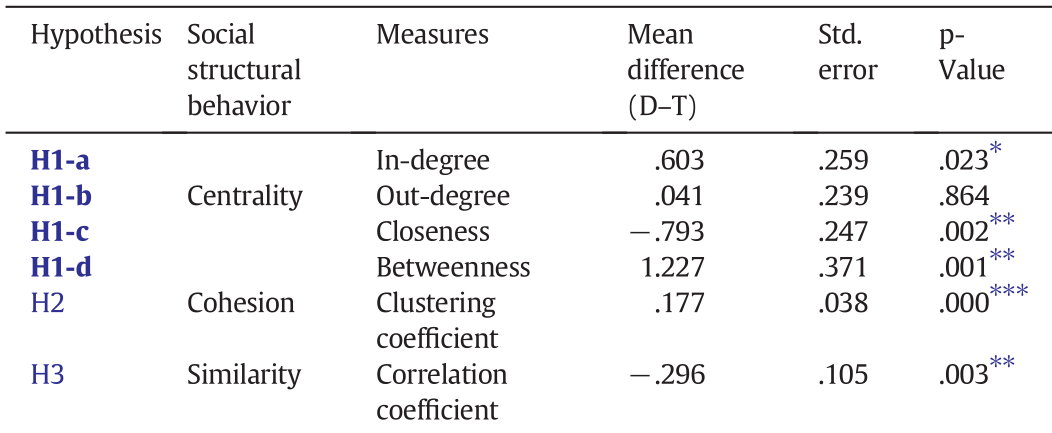
The empirical evaluation of 72 game networks yielded clear structural "signatures" for deception:
- High Betweenness Centrality: Deceivers act as bridges. By sitting between other groups, they control the flow of information, allowing them to distort or withhold facts effectively.
- Lower Closeness Centrality: They stay "distant" in terms of path length. This represents the protective strategy—remaining somewhat independent to preserve cognitive resources and avoid oversight.
- Higher Cohesion (Clustering): Deceivers team up. They are more likely to be part of a "clique," using local trust to give their lies more weight.
- Lower Similarity: Their overall structural "footprint" is distinct from regular users, making it a viable metric for detection.
Deep Insight: Deception as Strategic Brokerage
The most fascinating takeaway is that deceivers behave like strategic brokers. They utilize "In-degree" prominence to appear as experts or leaders (authoritative) but avoid "Out-degree" productivity to minimize the traces they leave behind. They are structurally distinct because they are "juggling" mental loads that truth-tellers don't have.
Critical Analysis & Conclusion
Takeaway
Social structure is a powerful, non-obvious channel for deception detection. It is much harder for a deceiver to fake a "natural" social network position than it is to fake a polite tone.
Limitations
- Static vs. Dynamic: The paper treats the network as a single snapshot. Real-world deception often unfolds in phases.
- Medium Specificity: Results from a game website might differ from professional environments like Slack or LinkedIn.
Future Outlook
The next frontier is combining these structural insights with modern NLP (like Transformers) to create real-time monitors that can flag malicious actors in corporate or social networks based on their "structural anomalies."