
To Add or Not to Add? The Science Behind Facebook Friend Requests
The Effects of Social Structure Overlap and Profile Extensiveness on Facebook Friend Requests
This study investigates the factors influencing the acceptance of Facebook friend requests from unfamiliar individuals through a 2x2 quasi-experimental design. It introduces a Research Model combining interpersonal cognition and privacy calculus to demonstrate how social structure overlap and profile extensiveness determine acceptance intentions.
TL;DR
Why do we accept some friend requests from strangers while ignoring others? This study reveals that our decision is a calculated trade-off between Privacy Risks and Social Capital Gains. By manipulating "mutual friend" counts (Social Structure Overlap) and profile detail (Profile Extensiveness), the researchers found that providing more information is the key to overcoming the "stranger danger" barrier, especially when shared social links are missing.
Background Positioning
This work sits at the intersection of Interpersonal Communication and Information Systems (IS). It moves beyond simply listing privacy concerns to creating a predictive model of social connectivity, acting as a foundational study for understanding how "First Impressions 2.0" are formed in the digital age.
The "Privacy Calculus" Insight
The core motivation of this research is the paradox of social networks: we join them to connect, yet we fear the vulnerability that connection brings. The authors argue that humans act as "Calculators of Privacy." We weigh:
- Cost: Threats to personal information.
- Benefit: Accumulation of social resources (Social Capital).
The "Aha!" moment of the paper is that our "calculation" is fueled by two types of information: Category-based (who do we both know?) and Attribute-based (what does this person like?).
Methodology: The 2x2 Experiment
The researchers created a mock-up Facebook environment and tested four scenarios on 76 participants, varying the social cues:
- Social Structure Overlap (SSO): Low (5% mutual friends) vs. High (50% mutual friends).
- Profile Extensiveness (PE): Low (5 timeline items) vs. High (20 timeline items).
Conceptual Framework
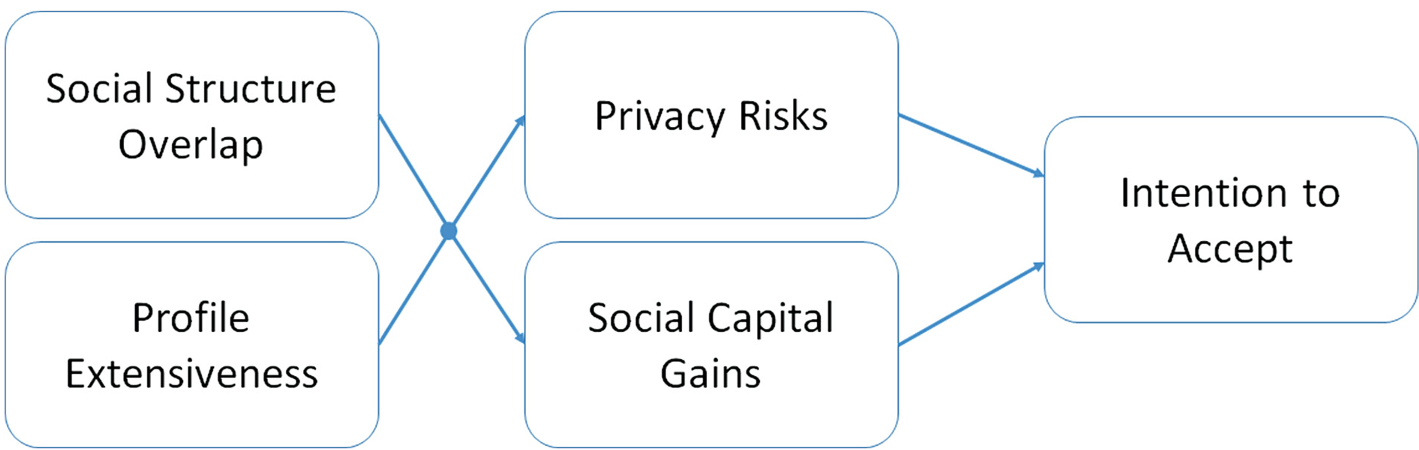
The model below illustrates how these external cues feed into our internal risk-reward assessment:
Key Findings & Visual Evidence
The data provided several high-impact insights:
1. The Power of Mutual Friends
Higher social overlap dramatically reduces perceived risk. If you have "friends in common," the requestor is categorized as "part of the tribe," which triggers a social cohesion effect.
2. The Interaction Effect
This is the paper's most significant contribution. As shown in the mean plots below, Profile Extensiveness matters most when Social Overlap is LOW.
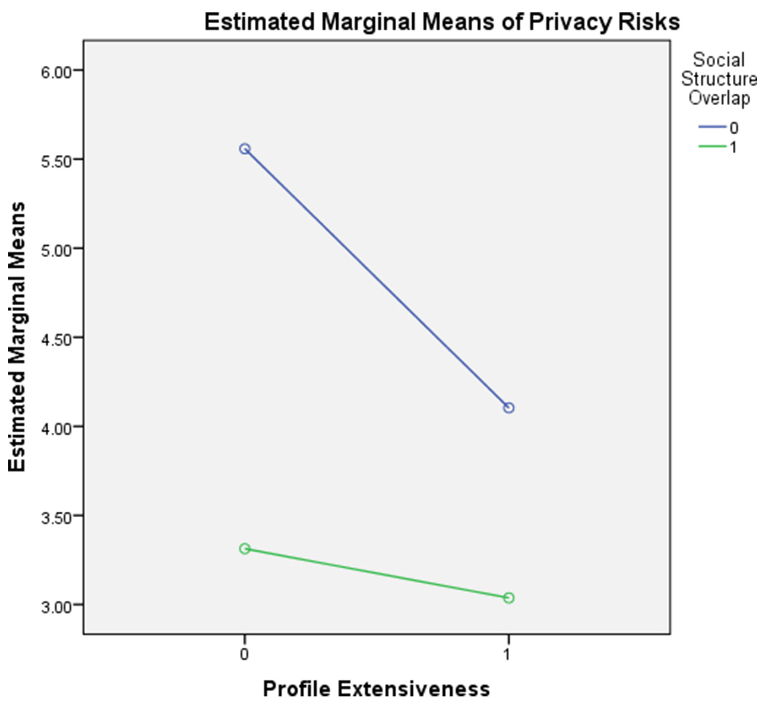 When you don't know the same people (Low SSO), having a detailed profile (High PE) is the only thing that drops the privacy risk significantly.
3. Gains Outweigh Risks
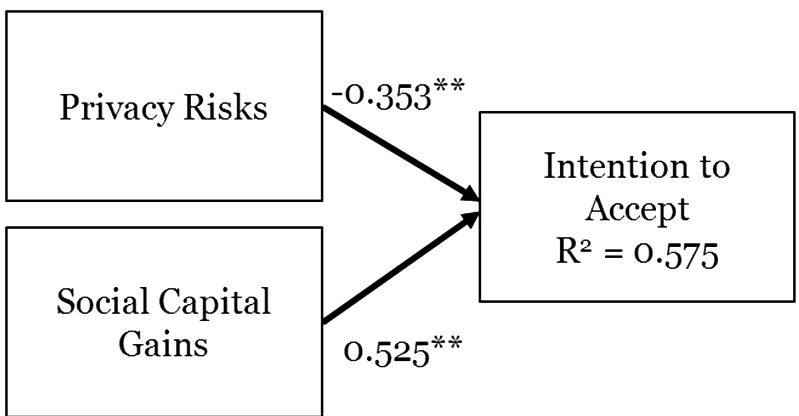
Using Partial Least Squares (PLS) analysis, the study found that the potential for Social Capital Gains (β = 0.525) is actually a stronger driver for clicking "Accept" than Privacy Risks (β = -0.352) are for clicking "Ignore."
Critical Analysis & Future Outlook
Takeaway: If you want to expand your network, don't hide your profile behind a wall of anonymity. Detailed self-disclosure acts as a "trust signal" that compensates for a lack of mutual connections.
Limitations:
- The sample size (N=76) is relatively small and limited to university students (ages 19-22).
- It measures intention rather than actual clicking behavior.
Future Directions: As social networks evolve into the "Metaverse" or decentralized spaces, we need to ask: Do these same rules apply when our "profiles" are avatars or wallet addresses? This paper provides the baseline logic for those future investigations.
Conclusion
Social connectivity is the lifeblood of platforms like Facebook. By understanding that acceptance is a logical trade-off, designers can create better "Preview" features—like showing photo abstracts or common interests—to help users bridge the gap from strangers to friends safely and effectively.