
Social Radar: Mapping Hidden Influence via Stubborn Probes
The social system identification problem
The paper introduces the Social System Identification (SSI) problem, aiming to estimate the social graph and mutual trust weights among agents. By injecting "stubborn agents" as probes into a network following DeGroot-style dynamics, the authors formulate a "Social Radar" that identifies system parameters from noisy opinion samples.
TL;DR
Understanding who influences whom in a social network is notoriously difficult because "trust" is invisible. This paper proposes a Social System Identification (SSI) framework—a "Social Radar"—that injects stubborn agents (probes) into a network. By observing how opinions settle around these fixed points, the authors use sparse optimization to reconstruct the entire social graph and quantify influence levels, even when interactions occur randomly.
The "Invisible Trust" Problem
Most social network analysis focuses on the graph (who is friends with whom). However, a graph doesn't tell you the trust magnitude. You might have 500 Facebook friends, but only three actually sway your opinion.
Existing research often hits a wall:
- Observational Latency: We rarely know exactly when an interaction changed someone's mind.
- Trivial Consensus: In standard models, everyone eventually agrees, making it impossible to distinguish individual influences once the system stabilizes.
Methodology: The Stubborn Agent as a Probe
The authors' core "aha!" moment is using stubborn agents—individuals who refuse to change their minds regardless of peer pressure.
1. System Model
The network follows the DeGroot model where agent 's opinion at time is a weighted average of their neighbors' opinions: By fixing a subset of agents (stubborn agents) such that their trust matrix row is an identity vector (), the system is prevented from reaching a single consensus. Instead, it reaches a steady state (or steady expectation) driven by these "probes."
2. The Radar Logic
By treating the stubborn agents' opinions as known inputs () and the resulting network opinions as outputs (), the authors frame the problem as an inverse regression: Where represents internal trusts and represents trust toward stubborn agents.
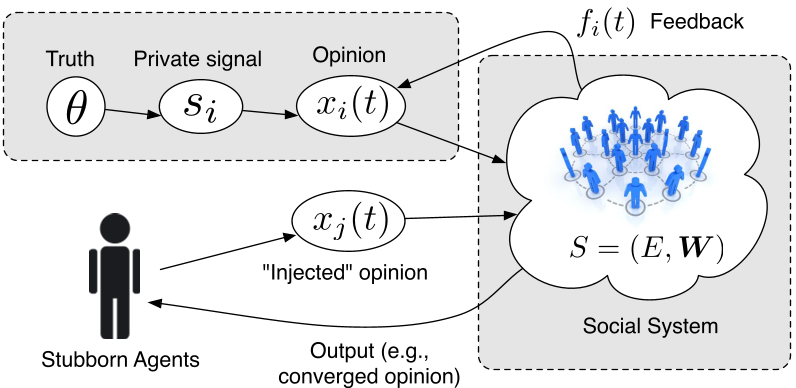 Fig 1: Using stubborn agents as 'probes' to stimulate the social system and observe the output.
Solving for the Social Graph
Since social networks are typically sparse (most people don't know most people), the authors employ -minimization to solve the underdetermined system. This allows them to "fill in the blanks" of the trust matrix using relatively few observations.
Dealing with Randomness
In real life, interactions are stochastic. The paper proves that a simple temporal average of noisy opinion snapshots is a consistent and unbiased estimator of the ensemble mean opinion. This means you don't need a high-speed camera for opinions; a few periodic "polls" are enough.
Experimental Validation
The authors tested their model on Erdos-Renyi graphs. The results (Fig 2) show a clear "phase transition": as you increase the number of stubborn agents (), the error in trust estimation (MSE) and support recovery drops sharply.
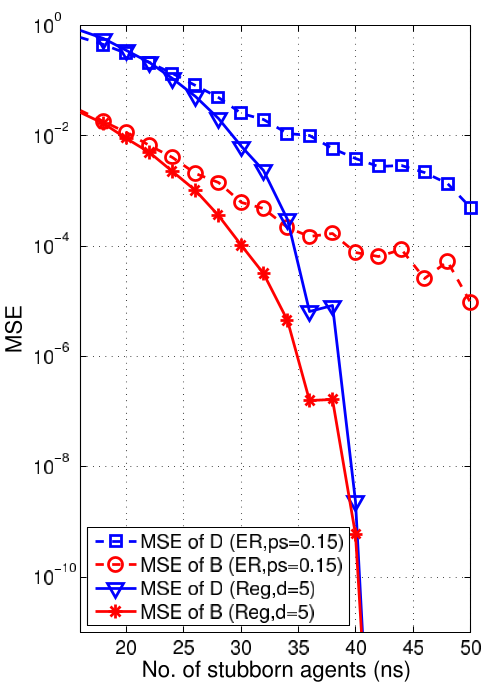 Fig 2: Relative MSE and Support Recovery Error. Note how randomized bipartite placement of stubborn agents (blue line) outperforms naive placement.
In the randomized gossip model (Fig 3), the "estimated" trust matrix (right) effectively mirrors the "actual" latent trust matrix (left), proving that the "Social Radar" can see through the noise of random interactions.
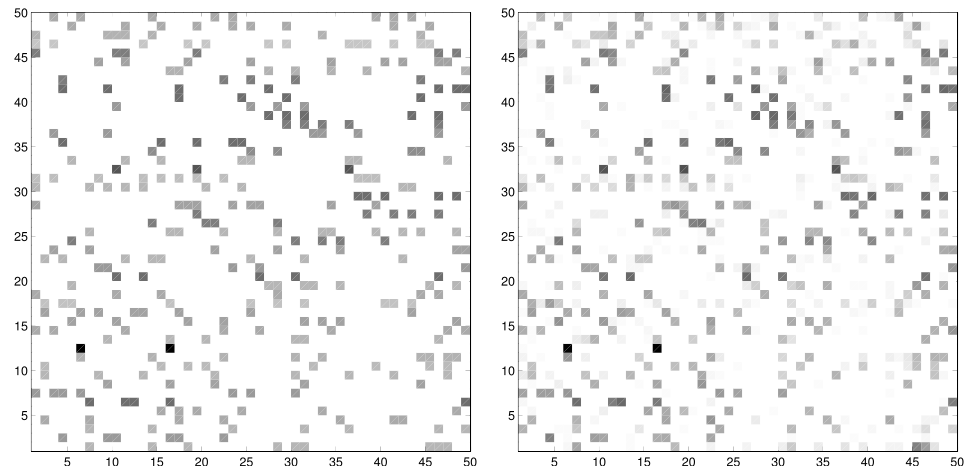 Fig 3: Visualization of the actual (left) vs. estimated (right) trust matrix D. The density of the dots represents influence strength.
Critical Insight: Why Does This Matter?
The value of this paper isn't just in the math; it's in the controllability it implies. If you can inject "probes" (which could be bots, influencers, or specific news feeds) into a system, you can map the hidden loyalties and trust structures of that population without ever asking them a direct question.
Limitations:
- The model assumes a degree of linearity in how opinions are shared (DeGroot model), which may not account for "backfire effects" where people become more stubborn when exposed to opposing views.
- It requires the identification of who the stubborn agents are in advance.
Conclusion
The "Social System Identification" problem moves us closer to a world where social influence is as measurable as air pressure. By combining control theory with sparse optimization, the researchers have provided a mathematical blueprint for "pinging" a network to see what's inside.