
Social Tagging Revamped: Solving "Facebook Fatigue" Through Persuasive Peer Commentary
Social tagging revamped: Supporting the users’ need of self-promotion through persuasive techniques
The paper introduces "Social Tagging Revamped," a framework that utilizes persuasive techniques and mutual modeling within social networks to elicit high-quality metadata. By shifting the focus from generic crowdsourcing to peer-based interactions, the authors developed "Social Games With A Purpose" (SGWAP) to improve content discovery and self-promotion.
TL;DR
Social media users are drowning in content—a phenomenon the authors label as "Facebook Fatigue." This paper proposes a transition from generic tagging to Social Tagging, where the implicit "Mutual Model" shared between friends is leveraged through persuasive games. By turning metadata creation into a social reward system, the authors demonstrate that peer-curated signals significantly boost engagement and help users better promote their digital lives.
The Problem: The "Market for Lemons" in Social Media
In 1970, George Akerlof described the "Market for Lemons," where the inability to distinguish quality leads to a market collapse. The authors argue social networks face a similar crisis: Adverse Selection. Because users can easily flood networks with "low photo-worthy" content, high-quality stories spread slowly and are often overlooked.
Current metadata solutions fail because:
- Automatic Filters: Often miss the "inside jokes" or context that makes a photo valuable.
- General Tagging: Users find it boring. Furthermore, games like the ESP Game encourage generic tags (e.g., "building") to achieve consensus, losing the specific "flavor" of social context.
Methodology: Leveraging the "Mutual Model"
The core insight of this research is that friends know things about your photos that an AI or a stranger doesn't. This is Mutual Modeling.
The Two Signaling Mechanisms
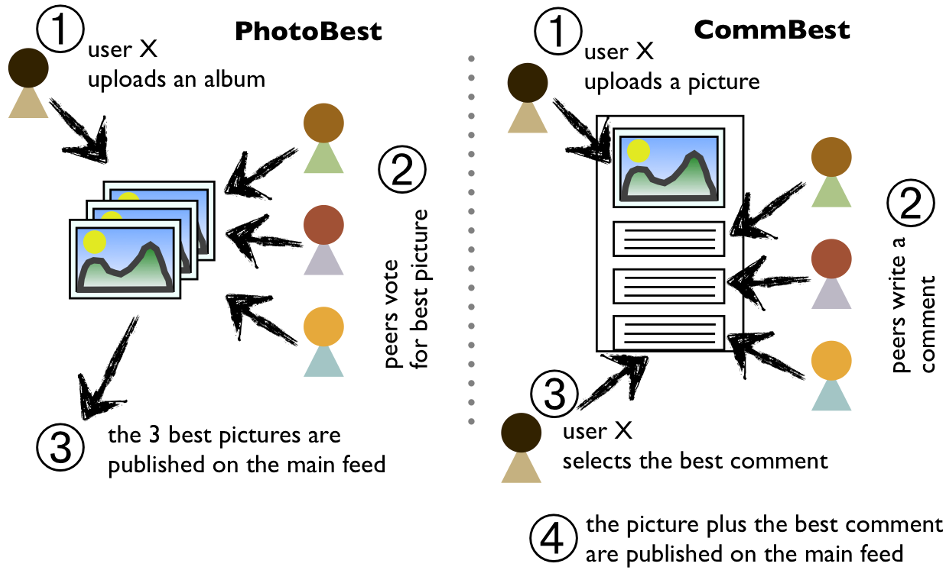
The researchers tested two persuasive structures to see which best promoted a user's album:
- PhotoBest: Peers vote on the top three images in an album. The winner is used as the "signal" in the news feed.
- CommBest: A structured game where peers compete to write the funniest or most descriptive commentary, with the owner picking the "best" one to display.
Experimental Results: Humor vs. Visuals
The study conducted across three distinct social networks (graduate students, corporate employees, and researchers) yielded striking results:
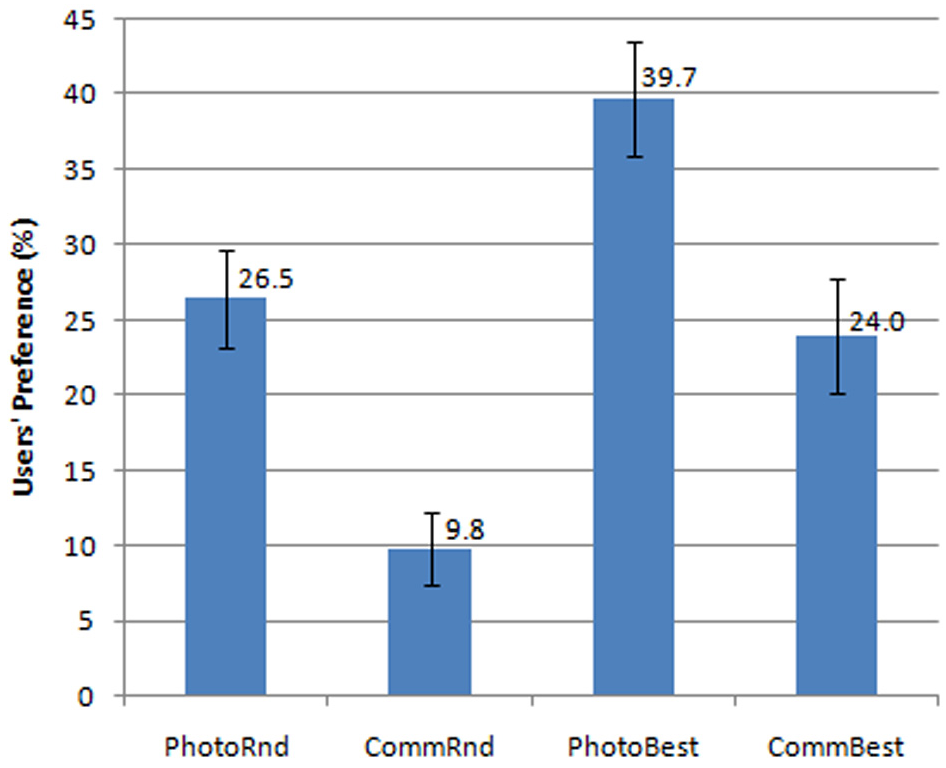
- The Power of Curation: Participants were significantly more likely to click on an album if the header images were peer-voted (PhotoBest) rather than randomly selected.
- The Commentary Triple-Threat: A "Best Commentary" (CommBest) signal was found to be as persuasive as seeing actual photos. This proves that social text—when gamified—provides interpretative value that visuals alone cannot.
- Specificity: Peers generated a significantly higher ratio of "Specific Tags" (containing temporal or contextual knowledge) than outsiders.
Critical Insight: Social Games With A Purpose (SGWAP)
The paper’s most significant contribution is the conceptualization of SGWAPs. Unlike traditional "Games With A Purpose" that rely on anonymous crowds, SGWAPs provide:
- Immediate Social Reward: Seeing a friend "like" your joke is more rewarding than earning points in a generic game.
- Rich Metadata: High-context descriptions (e.g., "Monday group meeting") are far more useful for long-term retrieval and social storytelling than generic tags (e.g., "office").
Conclusion & Future Look
The authors conclude that social tagging is not just an organizational chore—it is a signaling tool for self-promotion. By reducing the "friction" of input through storytelling and gamification, platforms can solve the information overload problem.
Limitations: The study notes that as social networks grow to include "friends of friends," the effectiveness of the Mutual Model might dilute. Future systems must account for Social Proximity—weighting the tags of close friends more heavily than those of distant acquaintances.
Takeaway for Developers: Stop asking users to "tag for the database." Start asking them to "play for their friends."