
SocialHelpers: Accelerating Trust in the Volatile World of P2P Churn
SocialHelpers: Introducing social trust to ameliorate churn in P2P reputation systems
The paper introduces "SocialHelpers," a framework designed to mitigate the impact of peer churn on reputation building in P2P systems. It combines a rigorous semi-Markov stochastic model to analyze reputation convergence with a social-trust-based mechanism to accelerate evidence collection.
TL;DR
Peer-to-peer (P2P) systems are notoriously "shaky"—users log in and out constantly (churn), making it hard for reputation systems to "stick." This paper provides a mathematical model to predict how churn delays trust and introduces SocialHelpers: a method that uses your social network friends to help "test-drive" unknown providers, cutting the time to build a reliable reputation by over 50%.
The Latency of Trust: Why Churn Kills Reputations
In a perfect P2P world, you’d transact with a provider many times to know if they are reliable. In the real world, the provider might go offline (OFF period) before you finish the 10 or 20 transactions needed for a confident prediction.
The authors identify two silent killers of P2P trust:
- Peer Churn: The continuous cycle of interruption slows down evidence collection.
- Transaction Rate Limits: Physical bandwidth or ISP caps mean you can't just "spam" transactions to learn about a provider quickly.
If the transaction rate is too low relative to the churn rate, a provider might never stay online long enough for anyone to form a valid opinion of them.
Methodology: The Math of Staying "ON"
The authors don't just guess; they build a Semi-Markov Model to track the state of a reputation process. They treat the provider as a system that fluctuates between (ON, i) and (OFF, i), where i is the number of successful transactions.
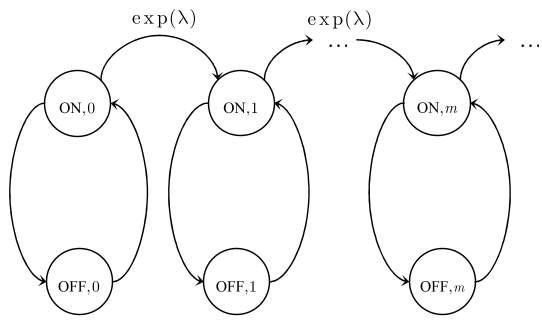
By applying Laplace-Stieltjes transforms, they derived exact formulas for the expected completion time of $ transactions. A key insight is the difference between Exponential and Pareto (heavy-tailed) lifetimes. In Pareto distributions (common in real P2P networks), most users have very short lifetimes, meaning the "average availability" statistic actually underestimates how long it takes to build trust.
The Solution: "I’ll get by with a little help from my friends"
Since a single user is limited by time and bandwidth, why not outsource the "trust-building" to friends?
- Social Trust Function: If you trust a friend (Distance 1) or a friend-of-a-friend (Distance 2), you can ask them to transact with the unknown provider.
- Superposition of Flows: Their transactions count toward the evidence you need. If you have 20 friends each doing 1 transaction, you reach your "confidence threshold" almost instantly.
The authors modeled trust as a linear decay function: , ensuring that while you favor close friends, even distant acquaintances can contribute to the aggregate reputation flow.
Experimental Results: Real-World Validation
The researchers tested SocialHelpers using snapshots from real social networks like Slashdot and Epinions.
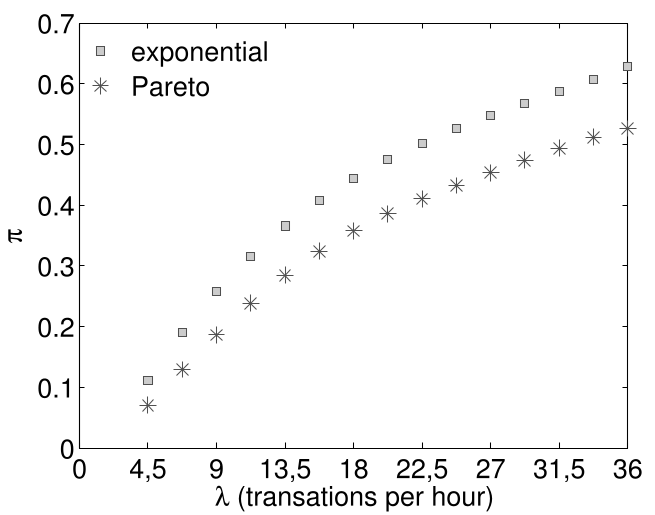
Key findings from the experiments:
- Probability of Failure: Without helpers, there is often a less than 50% chance of completing a reputation profile before a provider disappears.
- Time Reduction: With a social density of just 20% (meaning only 1 in 5 of your Facebook/XMPP friends are on the P2P system), the time to reach a "low uncertainty" state was halved.
- The Horizon Effect: Including "friends-of-friends" (Social Horizon ) provides the best balance between speed and reliability.
Critical Analysis & Future Outlook
The "SocialHelpers" approach is an elegant bridge between Sociological Trust and Algorithmic Reputation.
Strengths:
- It moves beyond "White-washing" (changing identities) and focuses on the "Inertia" problem of honest nodes.
- The math accounts for the "Heavy-tailed" reality of the internet, not just idealized distributions.
Limitations:
- Privacy: Asking friends to transact with specific providers reveals your interests to your social circle.
- Collusion: If a provider is also "friends" with your helpers, they could manipulate the results (though the trust decay function mitigates this).
Conclusion: As P2P systems move toward decentralized web (Web3) and edge computing, managing "churn" remains a top-tier challenge. Using existing social graphs to "warm up" trust is likely the most viable path forward for scalable, decentralized services.