
NaviTweet: Beyond Traffic Flow—Integrating Human Experience into Social Navigation
Social Vehicle Navigation: Integrating Shared Driving Experience into Vehicle Navigation
The paper introduces NaviTweet, a Social Vehicle Navigation system that integrates crowdsourced "voice tweets" into traditional GPS routing. By leveraging Vehicular Social Networks (VSN), the system allows drivers to share subjective road experiences (e.g., safety concerns, accident status) and provides a personalized routing engine that responds to voice commands like "avoid" or "choose" based on audio digests.
TL;DR
NaviTweet is a pioneering social navigation framework that bridges the gap between raw sensor data and human intuition. By allowing drivers to share short voice tweets within localized "Vehicular Social Networks," it transforms navigation from a passive pathfinding task into an interactive, experience-driven journey. It enables drivers to voice-control their routes based on live audio reports of road conditions like black ice or clearing accident scenes.
Background & Motivation: The Data Gap in Modern GPS
While Google Maps and Waze have revolutionized how we avoid "red lines" on a screen, they operate on a narrow definition of efficiency: the shortest time. However, a "fast" route over a slippery bridge may be less desirable to a driver than a "slow" route on a clear highway.
The authors identify a critical information asymmetry: drivers ahead know why traffic is stopped and how dangerous the road surface is, but traditional algorithms only see "0 mph." NaviTweet aims to capture this qualitative "human sensor" data without the safety risks of typing while driving.
Methodology: How Social Navigation Works
The NaviTweet system follows a sophisticated pipeline to ensure drivers aren't overwhelmed by noise while receiving the most relevant "road intelligence."
1. Vehicular Social Networks (VSN)
Drivers are organized into groups based on their Destination (e.g., JFK Airport) or Road Segments (e.g., NJ Turnpike). This ensures that the information shared is contextually relevant to the user's trajectory.
2. The Clustering Engine (DBSCAN)
To prevent redundancy (e.g., ten people tweeting about the same accident), the server uses the DBSCAN (Density-Based Spatial Clustering of Applications with Noise) algorithm. It groups tweets in a 2D space of Time and Distance.
- Insight: Only the most recent tweet from a cluster is included in the "digest," ensuring drivers hear the most up-to-date status of an event.
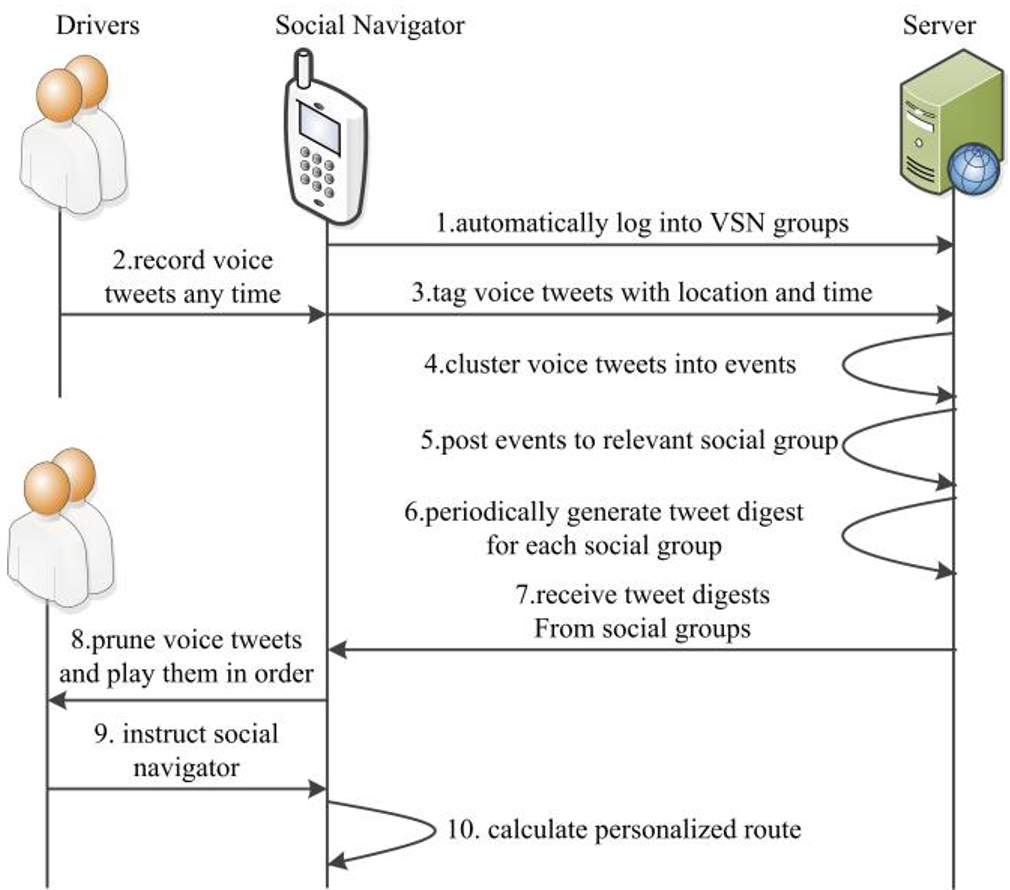 Above: The interaction loop between the driver, the NaviTweet client, and the backend server.
3. Personalized Routing with A* Search
Once the digest is played, the driver can say "Avoid" or "Choose." The system then modifies the edge weights in the A Search algorithm*.
- If a driver says "Avoid," the corresponding road segment is heavily penalized.
- If they say "Choose," the algorithm forces the path through that specific coordinate.
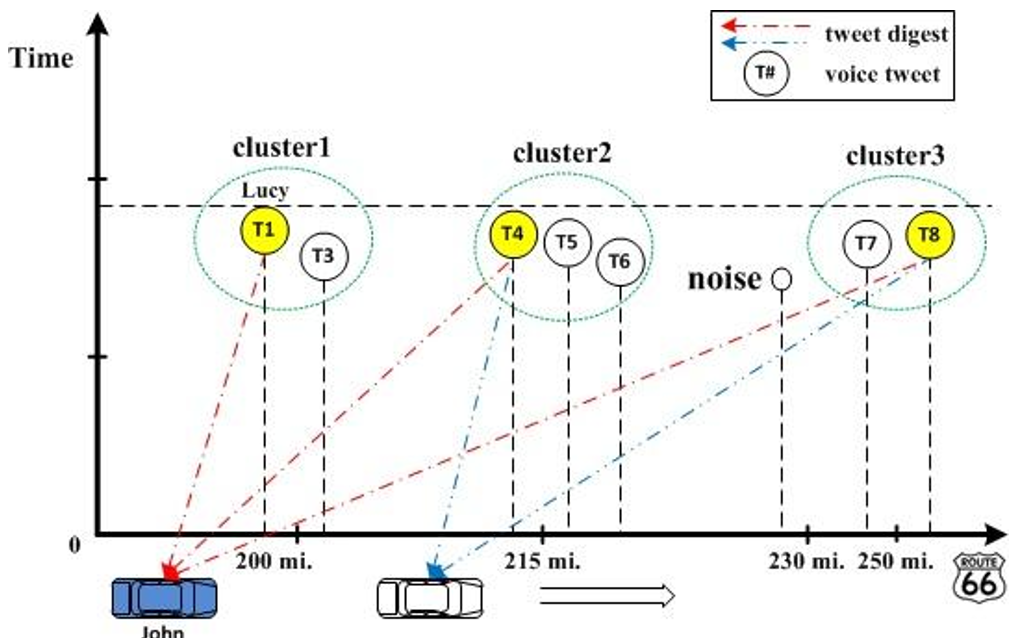 Above: Visualizing how the server clusters multiple tweets (T1-T8) into distinct road events to minimize cognitive load.
Implementation: Efficient and Safe
The prototype was developed on the OsmAnd open-source platform for Android. Key technical highlights include:
- Low Bandwidth: 3GP compression keeps voice tweets under 8KB, making the system viable even on limited data plans.
- Safety-First UI: Integration of proximity sensors (hand-waving to record) and Speech-to-Text minimizes the need for visual attention or manual touch.
Critical Analysis & Future Outlook
NaviTweet was ahead of its time in conceptualizing the vehicle as a "social entity." While apps like Waze eventually dominated the market with button-based reporting, the voice-first, qualitative approach of NaviTweet is seeing a resurgence today with AI-powered voice assistants (like Alexa or Siri) in cars.
Limitations
- The "Cold Start" Problem: Like any social network, the system's value depends on a critical mass of users.
- Malicious Content: The paper notes the need for reputation systems to filter out "trolls" or incorrect information.
Conclusion
NaviTweet proves that "Personalized Routing" is not just about avoiding traffic—it's about aggregating the collective eyes and ears of the driving community. As we move toward semi-autonomous vehicles, this logic of human-to-machine experience sharing will be vital in building trust between the navigator and the navigated.