
CodeSaw: Mirroring the Soul of Open Source to Fuel Motivation
Using Social Visualization to Motivate Social Production
This paper introduces CodeSaw, a social visualization tool designed to motivate contributors in social production projects like Open Source Software (OSS). By integrating data from code repositories and communication archives, the tool reveals hidden group dynamics and individual roles to the community itself.
TL;DR
Open source development is often a lonely endeavor fueled by intrinsic passion rather than a paycheck. CodeSaw is a pioneering social visualization tool that mines code and communication archives to create a "community mirror." By making effort visible, it transforms cold data into a social space that "vindicates" contributors and historically boosts their motivation to participate.
The "Invisible" Pulse of Social Production
Social production—the engine behind Linux, Wikipedia, and Apache—operates in a vacuum of traditional management. There are no bosses, no fixed schedules, and rarely any financial rewards. As Yochai Benkler famously noted, this system thrives on fulfilling "social and psychological needs."
However, the evidence of this fulfillment is often buried under 20,000+ code check-ins and years of mailing list archives. While researchers often peek into these archives to study "them," the contributors themselves lack a way to see "us." This lack of visibility can lead to a sense of isolation, especially in smaller projects where the "pulse" of the community is hard to feel.
Methodology: The Dual Perspectives of CodeSaw
CodeSaw moves beyond simple metrics. Its core design philosophy is that simpler is better when the audience is the community itself. It doesn't try to "calculate" performance; it reflects activity.
1. The Architecture of Awareness
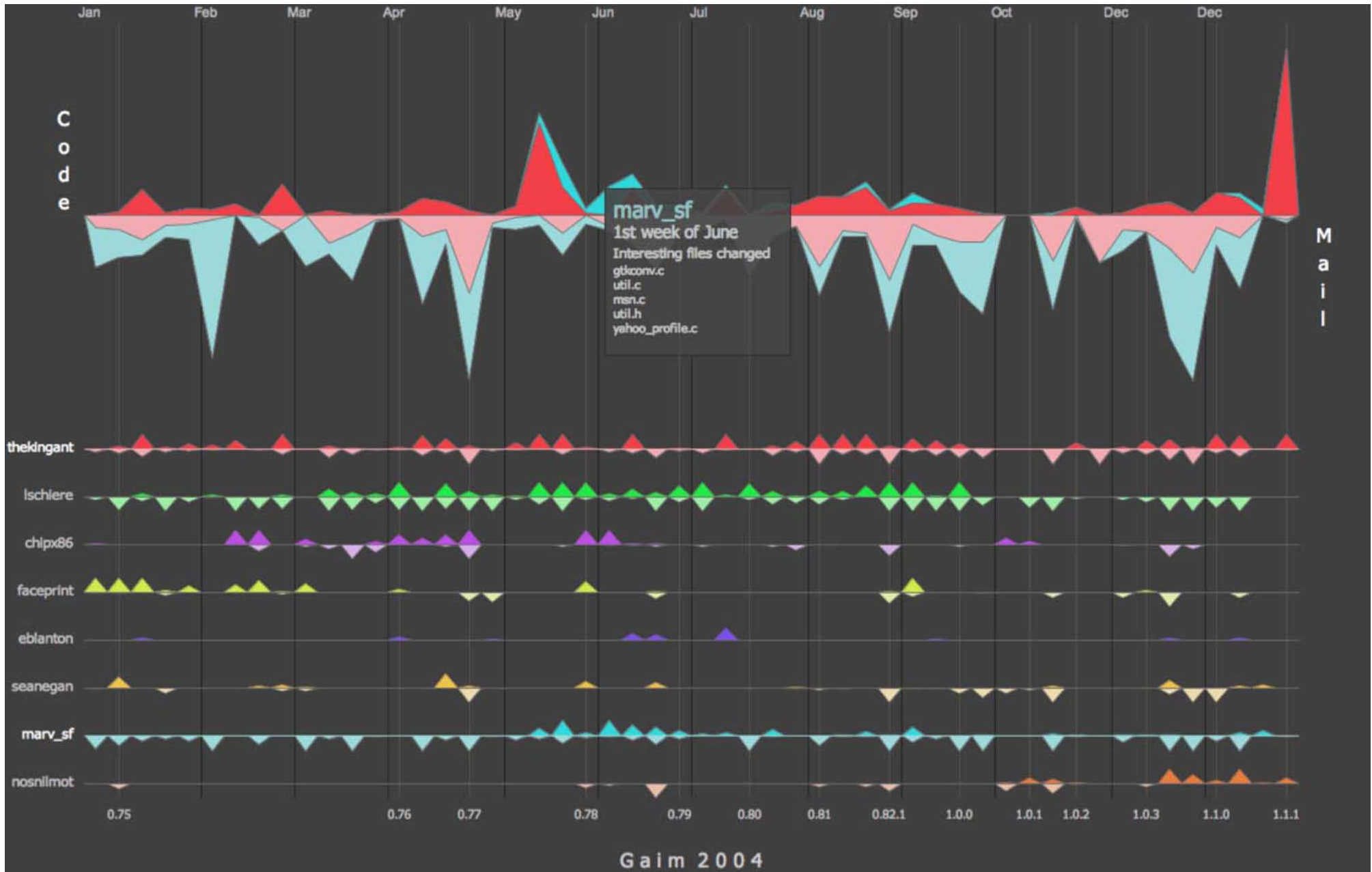
The tool visualizes a community from two independent but overlapping perspectives:
- Shared Artifacts (Code): Quantified by lines of code added.
- Social Talk (Email): Quantified by word counts in project mailing lists.
2. Narrative through Visualization
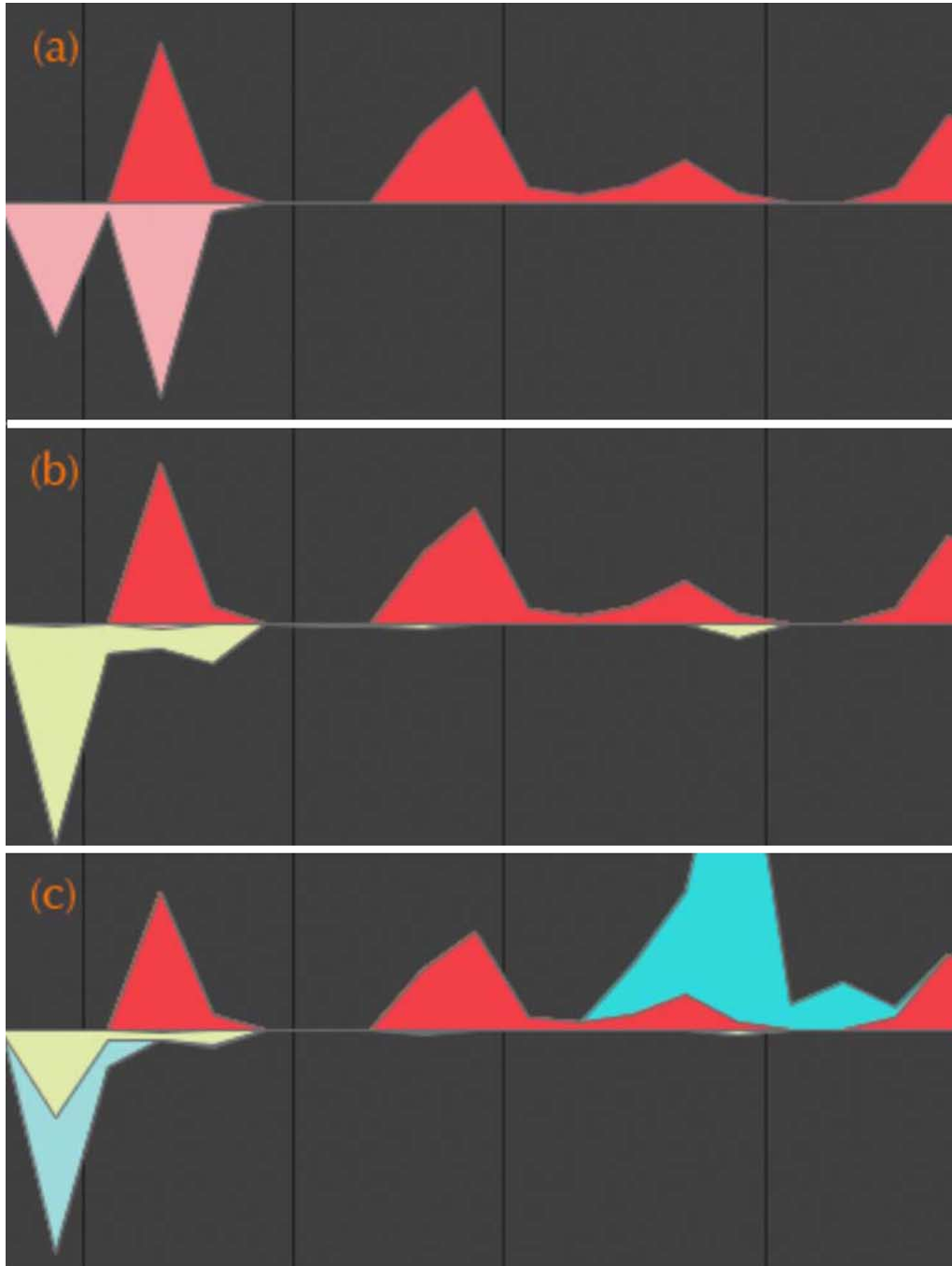
In the demonstration below using the Gaim (now Pidgin) project, CodeSaw identifies a "surprising" reality: despite hundreds of participants, a handful of leaders do the heavy lifting. By overlaying email and code, we can see the "why" behind the "what"—for example, how a surge in email communication (b) often precedes a code release (c).
Insights from the Field: Vindicated and Motivated
Through a study of nine active developers, the researchers moved CodeSaw "out of the lab." The results were psychologically profound:
- Role Confirmation: Users could finally see the distinction between "coders" and "commentators." One PI (Principal Investigator) noted that the tool accurately reflected their role as a manager rather than a coder, validating their specific contribution type.
- The "Vindication" Effect: When users saw their multi-year effort visualized as a persistent mountain of activity, it provided an emotional payoff. One participant described the feeling as being "vindicated."
- Behavioral Change: Interestingly, several developers noted they would increase their commit frequency or write more emails if the tool were public, effectively using the visualization as a gamified "activity pulse" to signal their presence to the group.
Deep Dive: Beyond Metrics to "Spatial Messaging"
A unique feature of CodeSaw is Spatial Messaging. Recognizing that visualization can sometimes highlight "loneliness" in small teams, the authors added a layer where users can leave comments directly inside the graph. These comments are linked to the specific state of the visualization (e.g., a specific timeframe or set of developers), allowing for "social data analysis" where the community discusses its own history in situ.
Conclusion and Takeaways
The genius of CodeSaw lies not in complex algorithms, but in Social Translucence—making the invisible social cues of digital work visible and accountable.
- The Lesson for Platforms: Whether you are building a tool for OSS or an enterprise collaboration suite, visualizing "participation" is not just about management oversight; it's about providing the "immediate reward" that keeps contributors coming back.
- The Future: As social production expands into AI training and decentralized science, tools like CodeSaw will be essential to prevent contributor burnout and maintain the "social soul" of distributed work.