
Social Wi-Fi: Bridging the Trust Gap in Hotspot Sharing via OSN Integration
Social Wi-Fi: Hotspot sharing with online friends
The paper introduces "Social Wi-Fi," a novel architecture that leverages Online Social Networks (OSNs) to enable secure hotspot sharing between friends. By extending the 802.11u ANQP protocol and introducing a new EAP-Social authentication method, it provides a trust-based alternative to public Wi-Fi sharing.
TL;DR
"Social Wi-Fi" is a decentralized network architecture that allows Wi-Fi owners to share their internet capacity specifically with their Online Social Network (OSN) friends. It replaces insecure SSIDs and tedious captive portals with Bloom Filter-based discovery and EAP-Social authentication, ensuring that connections are only established between individuals with a pre-existing social trust.
Problem & Motivation: The "Stranger Danger" of Public Wi-Fi
Most residential Wi-Fi access points remain "locked" because owners fear the liability of sharing. If a guest downloads illegal content or launches a Do-S attack, the owner is often held responsible. Conversely, guests are wary of "Evil Twin" hotspots designed to sniff traffic.
The authors identify a massive untapped resource: unused residential bandwidth. Their core insight is that Online Social Networks (OSNs) already provide a foundational trust layer. If Alice can verify that a nearby hotspot belongs to her Facebook friend Bob, she is more likely to connect, and Bob is more likely to host her.
Methodology: Privacy-Preserving Discovery and Mutual Trust
The paper addresses two technical bottlenecks: Discovery (How do I know Bob is here?) and Authentication (How do we prove we are friends without sharing passwords?).
1. Social Network Discovery (ANQP + Bloom Filters)
Standard SSIDs are limited to 32 bytes—too small to list thousands of friends. The authors extend the Access Network Query Protocol (ANQP), allowing a device to query a hotspot's social affiliations before associating. To protect privacy and save space, they use Bloom Filters:
- Friend names are hashed into a bit vector.
- This allows for high compression (3000 bits can handle 1000 friends with <5% false positives).
- It ensures privacy; a passerby cannot "read" the friend list, they can only "check" if they are on it.

2. EAP-Social Authentication
Traditional EAP methods require pre-shared keys or certificates. EAP-Social replaces these with social knowledge. The Authentication Server (AAA) challenges the guest with a question only a friend would know (or could verify via API), such as the number of mutual friends or a hashed name of a specific mutual contact.
Experiments & Results: Efficiency Gains
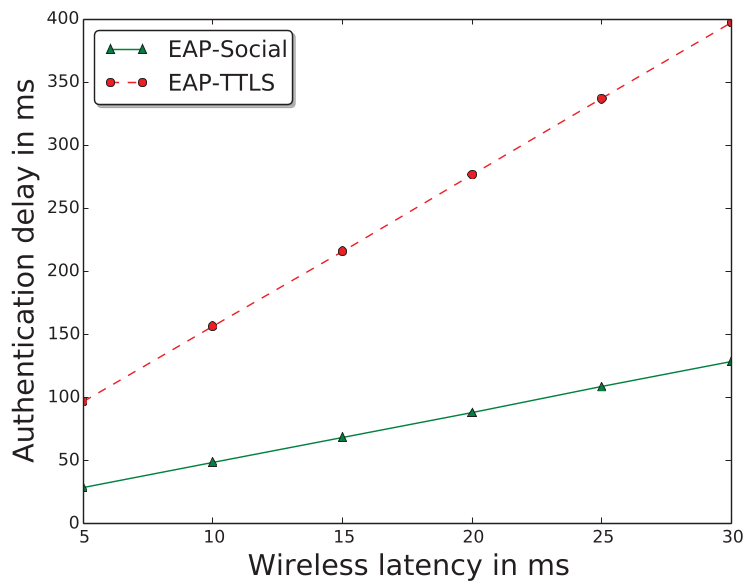
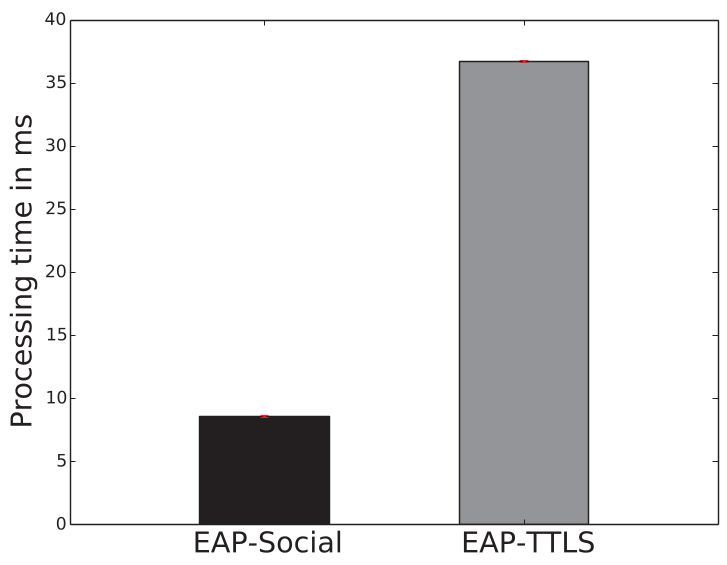
The authors evaluated EAP-Social against the industry-standard EAP-TTLS.
- Latency: EAP-Social requires only 2 RTTs (vs. 6 for TTLS) because it avoids the heavy overhead of Public Key Infrastructure (PKI) handshakes.
- Processing Time: By using simple hash computations instead of RSA/ECC signatures, the server-side processing is significantly faster.
- UX: Unlike "Captive Portals" (the "Log in to Wi-Fi" pages at airports) which take ~10 seconds and multiple clicks, EAP-Social is automatic and completes in under 100ms.
Critical Analysis & Conclusion
Takeaway
Social Wi-Fi effectively modularizes trust. By delegating authentication logic to a "Cloud AAA" that interfaces with social APIs, existing routers can support this feature through simple software updates rather than hardware replacement.
Limitations & Future Work
- False Positives: While Bloom Filters are efficient, a false positive initiates an authentication attempt that will eventually fail, slightly taxing the AP's resources.
- API Dependency: The system's security is entirely dependent on the integrity and availability of OSN APIs (e.g., Facebook, LinkedIn). If an API changes or is restricted, the authentication fails.
- Privacy Balance: While Bloom Filters hide names, the presence of a bit vector still leaks information about the size and composition of the owner's social circle.
Overall, Social Wi-Fi is a pragmatic step toward a "sharing economy" for internet access, moving away from centralized ISPs toward community-driven connectivity.