
SocialCloaking: Decentralizing Location Privacy via Social Trust
11704_SocialCloaking A distributed architecture for K-anonymity location privacy protection.
The paper introduces SocialCloaking, a distributed architecture for K-anonymity in Location-Based Services (LBS). It leverages a combination of Personal Data Vaults (PDV), structured P2P networks (Chord), and Online Social Network (OSN) trust relationships to eliminate the need for a centralized, trusted anonymity server.
TL;DR
Location-Based Services (LBS) are a double-edged sword: they offer convenience but risk exposing your exact whereabouts. While K-anonymity is the gold standard for protection, it has historically relied on a centralized "Anonymizer" server—a massive security liability. SocialCloaking breaks this paradigm by using your Social Network (e.g., Facebook friends) as a distributed P2P network to hide your location, ensuring you only ever share data with people you actually trust.
The "Anonymizer" Dilemma
In a typical K-anonymity setup, a central server collects the locations of all users and creates a K-Anonymizing Spatial Region (K-ASR). This region ensures your query is indistinguishable from other users.
However, the authors point out three fatal flaws in this model:
- Trust Issues: Why should you trust a single entity with your entire history?
- Performance: A central server becomes a bottleneck as the user base grows.
- Security: It is a "honeypot" for hackers.
Previous P2P attempts like P2PCloak or MobiHide tried to decentralize this, but they often required users to trust nearby strangers. SocialCloaking asks: Why not trust your friends instead?
Methodology: Personal Data Vaults & Peer Trust
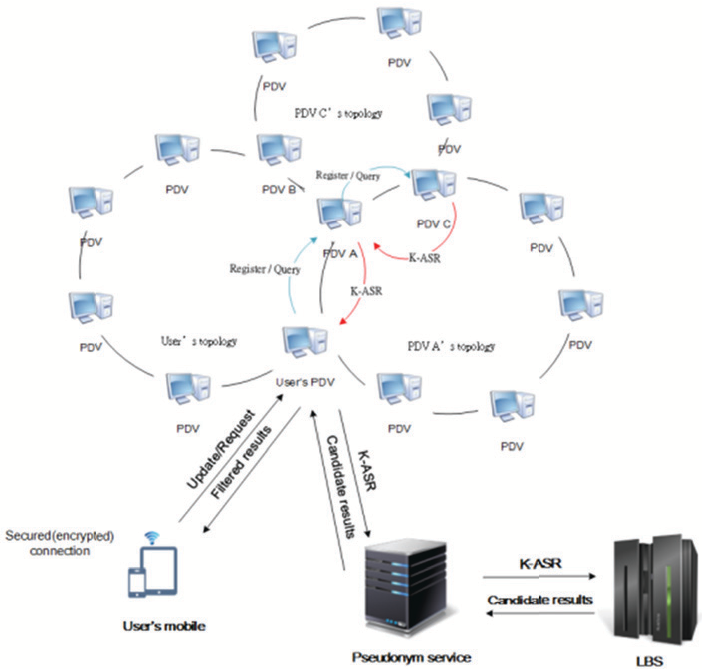
The core of SocialCloaking is the Personal Data Vault (PDV). Instead of your phone talking to a central server, it talks to your PDV (run on your PC, home gateway, or a private VM).
1. The Social Chord Ring
Each PDV constructs its own view of a Chord (Distributed Hash Table). Unlike standard P2P where you join a global network, here your "peers" are only your verified friends from an Online Social Network.
2. Hilbert Curve Mapping
To translate 2D map locations into a 1D searchable format, the system uses the Hilbert Curve. This allows the PDV to map a location to a "key" and find the friend's PDV responsible for that specific geographic segment.
3. The "Registration with Forward" Logic
When you move, your PDV updates your location to a friend's PDV. To enhance anonymity, the "Registration with Forward" variant replaces the user ID with a pseudonym and forwards the data to another friend closer to the location key, effectively "shuffling" the identity.
Performance: Efficiency vs. Privacy
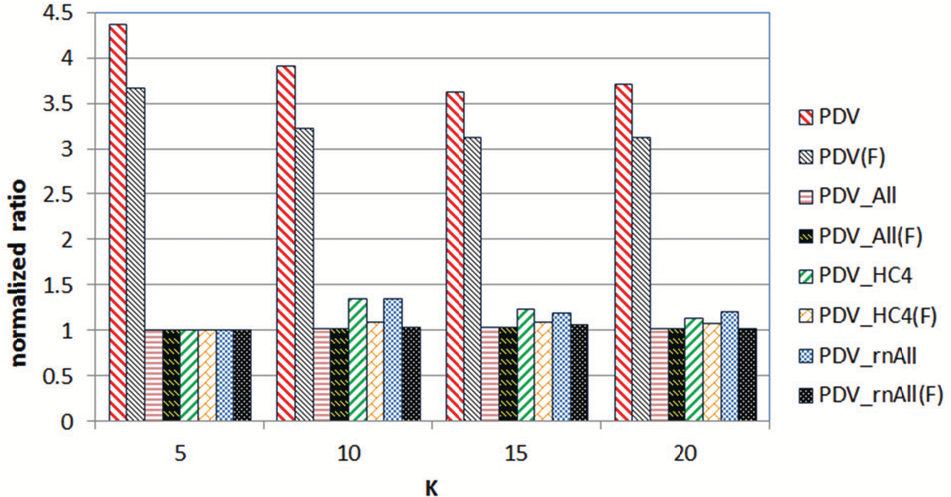
The authors tested several algorithms, with PDV_HC4(F) (using Hilbert Curve features + forwarding) being the standout.
- K-ASR Size: It achieved a cloaking region size nearly identical to a centralized server. This is impressive because it proves decentralization doesn't have to mean "less accurate" or "larger/vaguer" regions.
- Communication Overhead: While a "Flooding" approach (sending to all friends) is optimal for size, it's a network nightmare. PDV_HC4 reduced the message count from 864 to approximately 14 per query.
Defending Against the "Center-of-K-ASR" Attack
A common weakness in K-anonymity is that the querying user is often at the geometric center of the cloaking box, making them easy to guess. SocialCloaking integrates techniques from MobiHide, utilizing 1D Hilbert values to randomly decide the user's rank within the K-set, ensuring the user is just as likely to be at the edge as in the center.
Critical Analysis & Takeaways
SocialCloaking is a clever evolution of P2P privacy. Its greatest strength lies in Sociological Inductive Bias: the assumption that social trust is a more robust foundation for privacy than physical proximity.
Limitations:
- Friend Density: What if a user has very few friends? The simulation uses a 1,000-user sample with dense connections, but "socially isolated" users might suffer from larger K-ASRs.
- Online Availability: The system assumes PDVs are "always on." If many friends' PDVs go offline, the K-ASR formation might fail or become slow.
Future Outlook: This architecture paved the way for modern "Edge-Cloud" privacy designs. As we move toward Web3 and decentralized identities, SocialCloaking’s model of using personal servers to mediate app interactions is more relevant than ever.
Final Summary: SocialCloaking successfully proves that we don't need a "Big Brother" server to keep our locations private; we just need a little help from our friends.