
SocialFan: Infusing Trust and Social Influence into Isolated Recommender Systems
SocialFan: Integrating Social Networks Into Recommender Systems
SocialFan represents a domain-independent framework designed to bridge the gap between traditional Recommender Systems (RS) and Social Networks (SN). It introduces a systematic methodology for creating ad-hoc social infrastructures that capture both explicit "following" behaviors and implicit "interaction" knowledge to enhance recommendation accuracy.
TL;DR
SocialFan is a domain-agnostic toolchain that allows developers to "wrap" a social network around an existing recommender system. It solves the problem of "socially-isolated users" by inferring trust through their interactions with items and each other, ultimately using an Influence-Based Recommendation (IBR) algorithm to refine item predictions based on the opinions of trusted peers.
Problem & Motivation: The Social Vacuum
Most Recommender Systems (RS) treat users as isolated data points. While Collaborative Filtering finds "similar" users, it ignores the human element of trust and social influence.
The authors identify a specific gap: What if you have a great RS (like a niche movie site or a coding platform), but your users aren't "friends" on Facebook? You lose the ability to simulate how people actually make choices—by listening to those they trust. Previous work like ARISE required an existing social graph. SocialFan is designed to build that graph from scratch within the application's own domain.
Methodology: Drafting the Social Blueprint
The core of SocialFan is its two-step methodology: Design and Social Integration.
1. The Interaction Graph
The system tracks how users interact with items (comments, ratings, likes) and represents this as a Bipartite Graph. To find "indirect" social connections, SocialFan performs Network Projection. If User A and User B both hate the same horror movie, a weighted link is created between them in a new unipartite social graph.
2. The IBR Formula (The Math of Influence)
The most critical technical contribution is the modification of the predicted rating . Instead of a static value, the final recommendation is calculated as:
Where is the Influence factor, calculated by:
- Direct Relations (DR): Explicitly following someone (measured by Jaccard coefficient of shared neighbors).
- Indirect Relations (IR): Behavioral similarity propagated through transitivity (friends of friends).
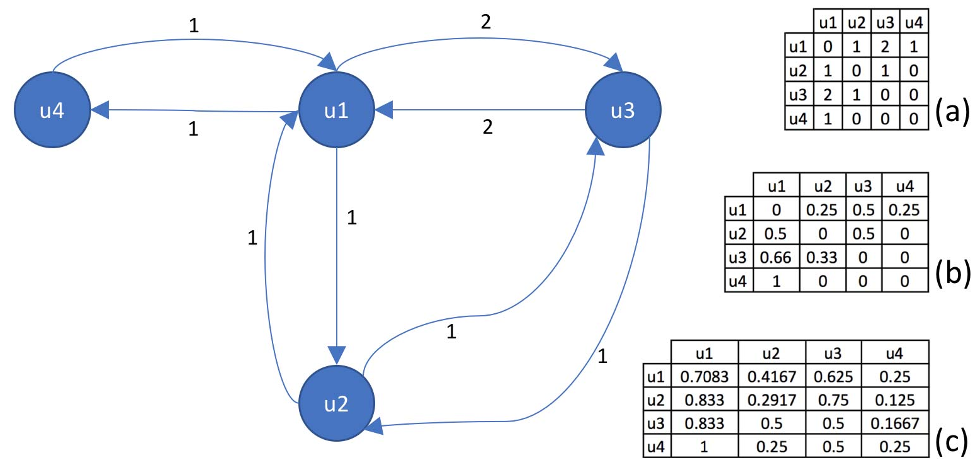 Fig 1: The interaction graph showing how comments on items create implicit bridges between users.
Validation: From Tourism to Code
The authors validated SocialFan on two vastly different domains:
- Madrid!: A tourism recommender. Here, they used Sentiment Analysis to categorize comments as Positive, Negative, or Neutral. If two users consistently leave "Negative" comments on the same tourist spots, their "Indirect Influence" score increases, as they share a specific critical perspective.
- ACR (Acepta el reto): A competitive programming platform. SocialFan was integrated via a Web Services API, allowing the platform to show "Latest Contributions" and social feeds without overhauling its existing database schema.
 Fig 2: Example of the SocialFan widget integrated into the ACR online judge.
Critical Analysis & Conclusion
The brilliance of SocialFan lies in its domain independence. By decoupling the social infrastructure from the recommendation engine, it allows any legacy RS to become "social."
Limitations:
- Cold Start: While it infers relations, new users with no interactions still face a "social cold start."
- Scalability: The network projection and transitivity calculations (propagating trust to distance-1 neighbors) can become computationally expensive as the user base grows into the millions.
Final Takeaway: SocialFan moves us closer to "Context-Aware" AI by recognizing that a recommendation isn't just about what you liked in the past—it's about who you trust in the present.