
SociaLite: Making Datalog Fast for Large-Scale Social Graph Analysis
SociaLite: An Efficient Graph Query Language Based on Datalog
SociaLite is a high-level graph query language based on Datalog, designed to bridge the gap between declarative expressiveness and imperative performance. It introduces optimizations like tail-nested tables and recursive aggregate functions, achieving performance competitive with highly optimized Java while being an order of magnitude more succinct.
TL;DR
SociaLite is an extension of Datalog that tackles the "performance tax" of declarative languages. By introducing tail-nested tables (for adjacency list efficiency) and recursive aggregate functions (for pruning and prioritization), it achieves Java-like speeds with the brevity of a query language. It turns complex graph algorithms into succinct, readable logic.
Background: The Declarative-Performance Chasm
In the world of social network analysis, researchers usually face a trade-off. They can use SQL, which is declarative but fails at recursion; they can use Datalog, which handles recursion but is notoriously slow; or they can write Java/C++, which is fast but requires hundreds of lines of "plumbing" code for every algorithm.
SociaLite's core insight is that Datalog's performance issues aren't inherent to logic—they are caused by a mismatch between relational storage and graph structures.
Methodology: The Three Pillars of SociaLite
1. Tail-Nested Tables: Adjacency Lists in Datalog
Relational databases store edges as multiple rows: (src, sink). This requires repetitive storage of the source node and costly join operations. SociaLite introduces Tail-Nested Tables, which effectively implement adjacency lists within a relational framework.
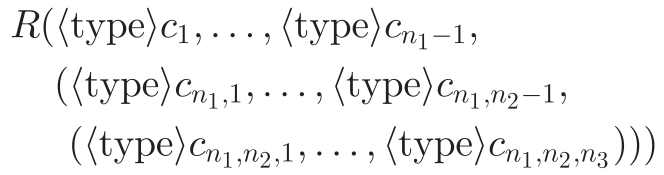
By nesting the "sink" nodes inside a pointer belonging to the "source" node, the engine can iterate through edges without redundant lookups, significantly improving cache locality.
2. Recursive Aggregate Functions
A major breakthrough in SociaLite is the support for meet operations (functions that are idempotent, commutative, and associative, like MAX) in recursive rules.
Traditional Datalog would find all paths before finding the shortest one. SociaLite uses Semi-Naive Evaluation for aggregates, allowing the engine to prune sub-optimal results mid-computation.
3. User-Guided Execution Order
The "How" often matters as much as the "What" in graph theory. SociaLite allows users to provide "hints" (e.g., orderby dist asc). This allows the compiler to implement Prioritized Evaluation, effectively turning a standard recursive lookup into Dijkstra’s Algorithm.
Experiments: Succinctness vs. Speed
The authors evaluated SociaLite against various Datalog engines and hand-optimized Java across several benchmarks (PageRank, Shortest Paths, etc.).
Performance Comparison
SociaLite shows a massive leap over standard Datalog implementations like LogicBlox or IRIS:
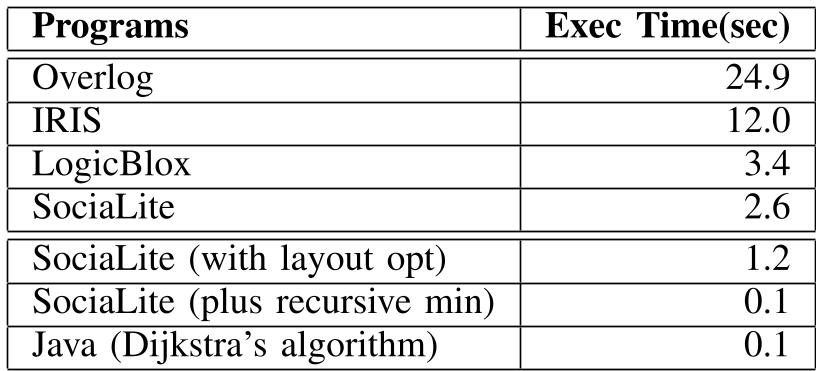
Most impressively, it beats "typical" Java implementations and comes within 16-25% of "highly optimized" Java, which usually takes orders of magnitude longer to develop.
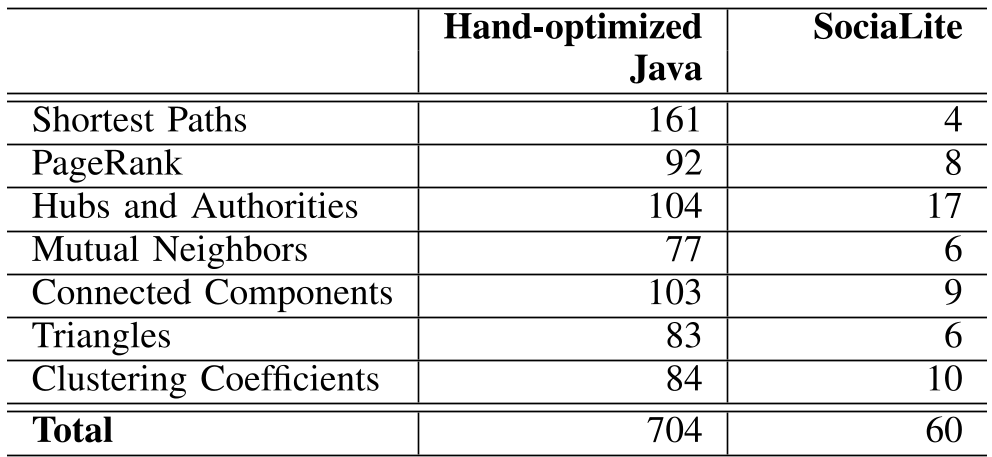
Impact of Code Succinctness
One of the most striking results is the reduction in code complexity. For Betweenness Centrality, a complex metric used to find "influencers" in a network:
- Java Version: 258 lines, 12 hours of dev time.
- SociaLite Version: 21 lines, 30 minutes of dev time.
Critical Analysis & Conclusion
The "Pipelining" Secret Sauce
Beyond the layout, the paper highlights Pipelining. By interleaving rule evaluations, SociaLite avoids materializing massive intermediate tables. This is crucial for "Connected Components" algorithms, where the first IDs found need to propagate quickly before the entire graph is scanned.
Limitations
While SociaLite is a leap forward, it currently relies on the user to provide "hints" for the best performance (like the orderby clause). A truly "intelligent" compiler should eventually be able to infer these optimal evaluation orders automatically through cost-based estimation.
Future Outlook
SociaLite proves that we don't need to sacrifice the beauty of logic programming for the speed of imperative code. As social graphs grow to billions of nodes, the "declarative + optimized layout" approach seen here will likely become the standard for graph database engines.