
Sociality-Aided Multicast: Balancing Reliability and Overhead in DTNs
Sociality-Aided New Adaptive Infection Recovery Schemes for Multicast DTNs
The paper introduces a Sociality-Aided New Adaptive Infection Recovery scheme combined with Polymorphic Epidemic Routing and Network Coding for multicast Delay-Tolerant Networks (DTNs). By leveraging user sociality (homophily) and interest similarity, it achieves state-of-the-art delivery efficiency while minimizing replication overhead through adaptive recovery mechanisms.
Executive Summary
Delay-Tolerant Networks (DTNs) are characterized by intermittent connectivity, where nodes rely on "store-carry-and-forward" mechanisms to deliver data. However, typical multicast approaches face a brutal trade-off: Epidemic Routing ensures delivery but causes a "data storm," while Infection Recovery saves resources but often fails to reach all destinations.
This paper presents a sophisticated framework combining Polymorphic Epidemic Routing, Network Coding, and Socially-Driven Adaptivity. By treating users as members of social groups with shared interests, the authors transform the "unpredictable" nature of node meetings into a structured advantage for data dissemination.
The Core Conflict: Delivery vs. Recovery
In a DTN, how do you know when to stop replicating a packet?
- Static Schemes: Deleting a packet as soon as one destination is reached (Immune/Vaccine) is efficient but disastrous for multicast, where many nodes still need the data.
- Replication Overload: Without recovery, every node becomes an "infected" relay, exhausting battery and bandwidth.
The authors' Research Intuition is that sociality—the tendency of users with similar interests to meet more frequently—can be used to synchronize the dissemination and the recovery phases dynamically.
Methodology: The Polymorphic Social Framework
1. Interest-Casting & Homophily
Instead of broadcasting to everyone, nodes calculate a Cosine Similarity Metric based on interest profiles.
- Threshold (): If the similarity between two nodes or between a node and a packet's relevance exceeds these thresholds, the "infection" (transmission) occurs. This ensures that data flows through the most "interested" (and thus most likely carriers) social circles.
2. Polymorphic Routing & Network Coding
To increase reliability, the message is split into packets and , and a XORed packet is generated. This "Polymorphism" allows a node to reconstruct the original message as long as it encounters any two of the three packets, significantly speeding up the "infection" process.
3. Adaptive Recovery: The "Soft" Approach
The hallmark of this work is the Adaptive Recovery Scheme. Instead of a binary "start recovery now," they use a time-dependent probability: This formula ensures recovery starts slowly when many destinations () are still unreached and accelerates as the network () approaches safety.
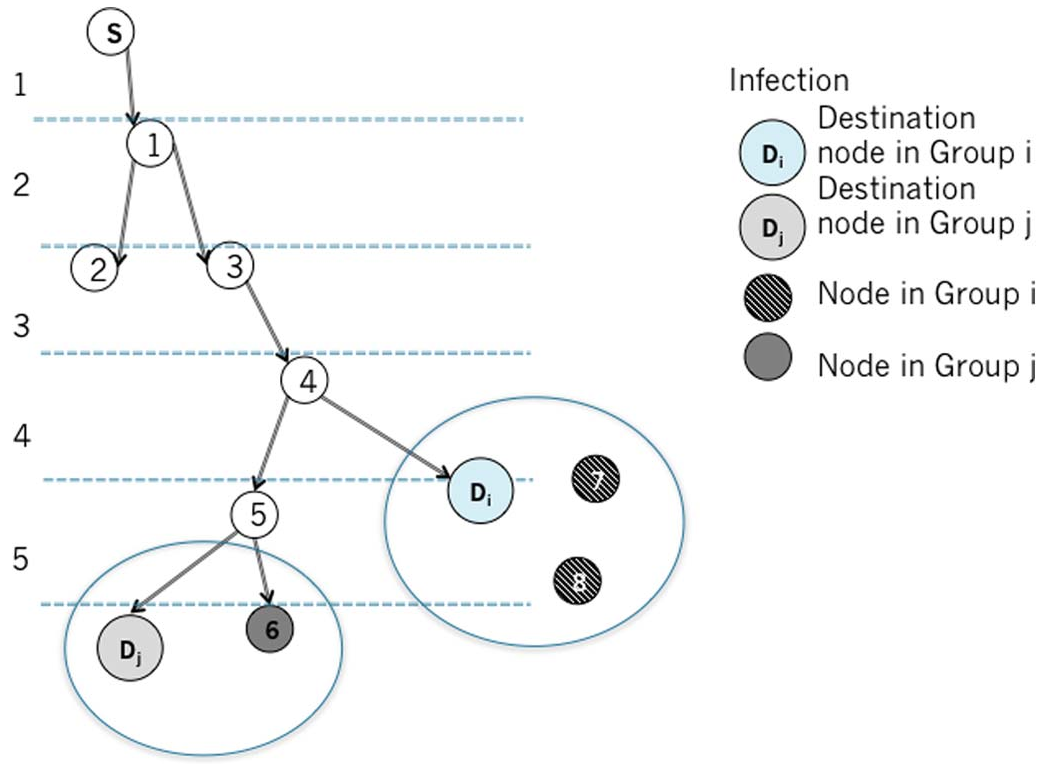 Figure 1: Temporal evolution of packet relaying and the adaptive recovery process.
Performance & Experiments
The authors tested their methodology across two settings: "LABEL" (no cross-community contact) and "Social" (proactive inter-group contact).
Key Findings:
- Survival of the Packets: In aggressive "Vaccine" schemes, delivery often fails because the "antidote" (recovery) spreads faster than the data. Adaptive recovery fixes this by aligning the packet lifetime with the delivery delay.
- Social Advantage: In Setting 2 (inter-group contact), delivery delay was reduced by 20% because social relationships acted as bridges for the information.
- Efficiency: The system achieved a higher System Time Efficiency (), maintaining a healthy ratio between the time needed for multicast and the total packet lifetime.
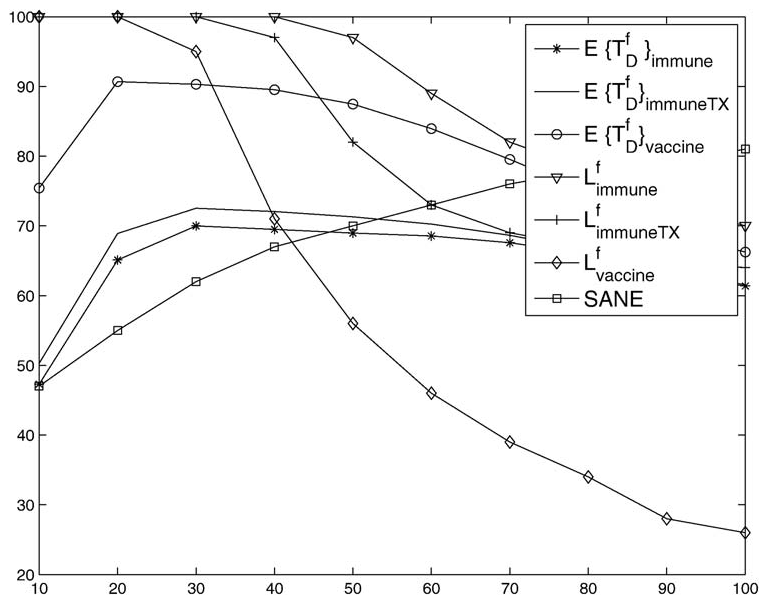 Figure 2: Performance comparison showing the intersection of delivery delay and packet lifetime across different recovery schemes.
Critical Insight: When Sociality Becomes a Double-Edged Sword
The study reveals a nuanced truth: Sociality is not always beneficial. When combined with over-aggressive recovery (like the Vaccine scheme), strong social bonds can cause the "recovery signal" to wipe out the data before it reaches the fringe members of a group.
The work concludes that for a truly robust DTN, one must use slow recovery schemes (Immune) coupled with adaptive probability or highly intelligent global timeouts.
Future Outlook
This theoretical model provides a blueprint for next-generation opportunistic networks. By moving from purely mathematical relaying to social-context-aware dissemination, we can build mobile social networks that are both reliable and energy-efficient.