
Beyond the Screen: How Tuenti Socializing Boosts Teenage Wellbeing
The relationship between socializing on the Spanish online networking site Tuenti and teenagers’ subjective wellbeing: The roles of self-esteem and loneliness
This study investigates the impact of usage intensity on the Spanish social networking site (SNS) Tuenti on the subjective wellbeing of adolescents (aged 12-17). Using structural equation modeling (SEM) on a sample of 344 teenagers, it identifies that Tuenti use promotes socializing, which in turn enhances psychological wellbeing by increasing self-esteem and reducing loneliness.
Executive Summary
TL;DR: Contrary to the "lonely surfer" stereotype, this study reveals that for Spanish teenagers, spending time on the social network Tuenti actually improves their quality of life. By fostering social connections, the platform acts as a catalyst for higher self-esteem and lower feelings of isolation.
Background Positioning: This work serves as a pivotal validation of the "Social Enhancement" hypothesis. Published during a period of transition in digital sociology, it moves the conversation from "Is the Internet bad?" to "How do specific social mechanisms online improve our psychology?"
The "Internet Paradox" Re-evaluated
For years, educators and parents feared that every hour spent online was an hour stolen from "real" life. Early studies (the "Internet Paradox") suggested that digital life led to a decline in social circles.
The authors of this paper challenged that notion. They hypothesized that for adolescents, the digital and physical worlds are not binary. Instead, SNSs like Tuenti provide a controllable environment for "Relationship Management," allowing teens to negotiate the complex social hurdles of puberty with more confidence than they might face-to-face.
Methodology: The Mediational Path
The researchers didn't just look for a direct link between "Time spent on Tuenti" and "Happiness." Instead, they mapped out a sophisticated journey through the teenage psyche using a sample of 344 Spanish students.
The Theoretical Model
The core of the methodology lies in the Structural Equation Analysis. It posits that Tuenti use triggers a chain reaction:
- Intensity of Use stimulates Socializing (strengthening ties with schoolmates).
- Socializing acts as a fork in the road, simultaneously driving up Self-Esteem and driving down Loneliness.
- These two psychological states finally converge to dictate the level of Subjective Wellbeing.
 (The hypothesized relationships between Tuenti usage and psychological outcomes)
Key Results: Data Doesn't Lie
The findings were conclusive. Most Spanish teens (roughly 50%) spent between 30 minutes and 2 hours on Tuenti daily. This was not "compulsive" use, but "integrated" use.
- Self-Esteem Boost: Socializing had a significant positive path to self-esteem (Standardized Regression Coefficient = .22).
- Isolation Reduction: Socializing significantly reduced loneliness (SRC = -.24).
- The Wellbeing Driver: Self-esteem emerged as the strongest predictor of overall life satisfaction (SRC = .47).
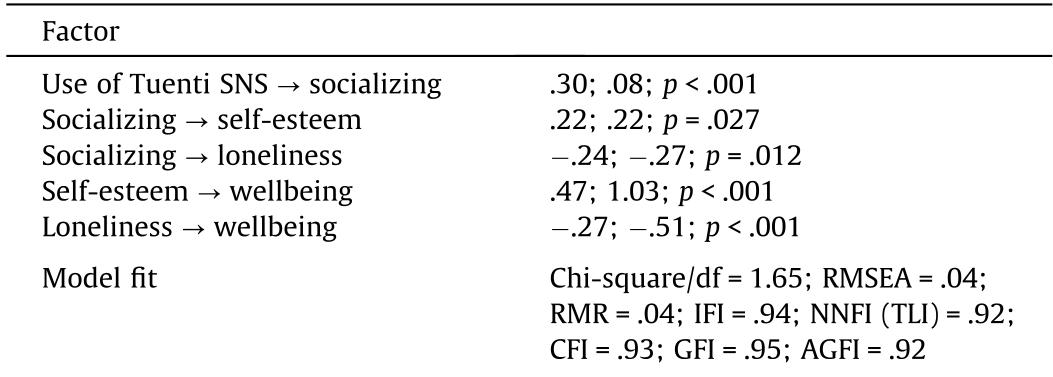 (Table 3: Validating the path coefficients and model fit)
Deep Insight: Why Why Tuenti Worked
The "Secret Sauce" of Tuenti, unlike its contemporary Facebook, was its exclusivity and intimacy. At the time, Tuenti required an invitation and was used primarily to talk to people the teenagers already knew in real life (schoolmates and "weekend friends").
This created a "Positive Feedback Loop." Because the interactions were mostly with real-world friends, the feedback on profiles was generally positive, which reinforced the user's self-image. The asynchronous nature of the platform allowed for Selective Self-Presentation—teens could curate their best selves, which, when validated by peers, directly converted into psychological resilience.
Critical Analysis & Future Outlook
Takeaway: The study proves that digital socializing is "real" socializing. For products and researchers, the lesson is clear: platforms that prioritize high-quality, intimate social circles deliver more psychological value than those focused on "vanity metrics" or stranger-to-stranger interaction.
Limitations:
- Directionality: As a cross-sectional study, it's a snapshot in time. We can't say for certain if Tuenti makes teens happy, or if happy teens are more likely to use Tuenti.
- Platform Evolution: Since 2013, the shift toward public algorithmic feeds (TikTok/Instagram Reels) may have introduced "Upward Social Comparison," which can actually hurt self-esteem—a factor Tuenti largely avoided by remaining a closed "private garden."
Future Prospect: As we move into the era of the Metaverse and AI-driven social apps, maintaining the "Intimacy Advantage" found in Tuenti will be the key to preventing the mental health crises often associated with modern, broader social media.